







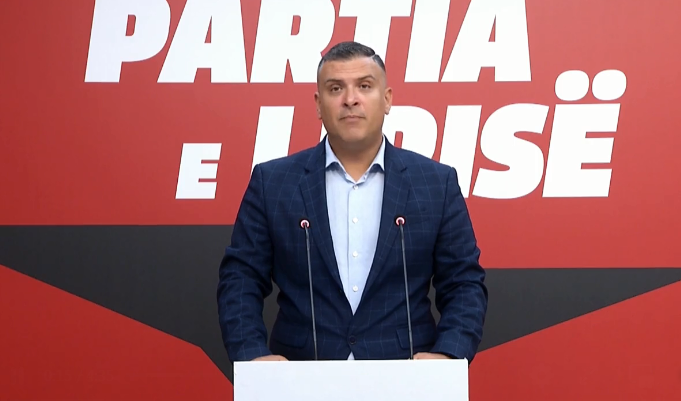
Secretary General of the Freedom Party, Tedi Blushi, harshly criticized the 2027 draft budget, calling it the “most anti-social budget,” which does not translate into well-being for citizens. Blushi accuses the “Rama 4” government of presenting an economic reality that does not match the economy’s real indicators, focusing on the exchange rate, the decline in exports, the weakening of domestic production and the growth of the trade deficit. He focused on the performance of Albanian exports, stating that they have suffered a continuous decline since 2022. According to the figures he presented, exports fell from about 4.8 billion euros to 3.4 billion euros in 2025, a contraction of nearly 28%. Blushi considered this an indicator of the weakening of domestic production and the loss of competitiveness of the Albanian economy.
FULL STATEMENT
Edi Rama’s 2027 budget is the most anti-social budget, the budget of deception and theft, of economic decline, of the euro’s plunge, of production, exports and services! This budget begins with the great deception of the exchange rate. The government has built it on the forecast of a euro exchanged at 96 lek, while today 1 euro is exchanged at 89 lek. So, even at the foundation of the budget accounts, the government projects a reality that does not match what is happening in the economy.
This is only one side of the deception. This is the budget of an economy that is not turning its growth into well-being for citizens, into growth of production and exports. For a small economy that relies on foreign markets to drive growth, exports are the most accurate barometer of a country’s economic vitality, competitiveness and productive capacity. Since 2022, Albanian exports have entered an uninterrupted downward trajectory, falling from about 4.8 billion lek to only 3.4 billion lek in 2025, a total contraction of almost 28%.

This is evidence of the weakening of the productive economy, the loss of markets and the decline in competitiveness. So a country that produces less and less, imports more and more and relies on consumption, construction and tourism. The dimensions of this failure become even clearer when we compare ourselves with the region. In 2025, North Macedonia exported about 8 billion euros in goods, 122% more than Albania, which exported only about 3.6 billion euros. According to official INSTAT data, Albania ended 2025 with only 3.4 billion lek in exports, against 8.8 billion lek in imports. The trade deficit reached about 5.4 billion euros, while exports covered only 39% of imports. In other words, for every 100 lek of goods we import, we manage to export only 39 lek. Meanwhile, the anti-social face of the 2027 Budget appears more clearly in the support for the two ends of life, for newborn babies and for pensioners who have spent a whole life working. According to the calculation of public debt of 16.2 billion euros, every Albanian carries about 8,100 euros of debt on their shoulders.
This means that an Albanian baby starts life with a debt bill it did not create and for which it bears no responsibility. Meanwhile, what is the government offering to support childbirth and child-rearing? The new scheme presented envisages, from July 2027, monthly support until the age of five: 5,000 lekë for the first child, 7,000 lekë for the second and 10,000 lekë for the third, according to the criteria set for beneficiaries. So this support, too, is not a universal right for every baby, but assistance conditional on family income. Meanwhile, countries in the region, such as Serbia, have built much more substantial support schemes for childbirth. Serbia supports the birth rate with 4,260 euros for the first child, 5,112 euros for the second, 19,427 euros for the third and 27,000 euros for the fourth child.
No less dramatic is the situation of pensioners. According to data from the report of the Vienna Institute for International Economic Studies, the purchasing power of the average pension in Albania is only about 19% of the European Union average. A pensioner in Montenegro, that is, an Albanian from Ulcinj, has purchasing power about three times higher than an Albanian pensioner in Shkodër.
According to the same comparison, an Albanian pensioner in Ulcinj, Montenegro, needs about 14 years to reach the current purchasing power of average European pensions, while an Albanian pensioner in Shkodër needs 100 years. An Albanian pensioner in Struga, North Macedonia, needs 23 years to reach the average European pension level, while an Albanian pensioner in Pogradec needs another century of life. A century! This is the horizon that this economic policy offers Albanian pensioners to reach the current European level of pension purchasing power.
The government can talk about doubling the monthly bonus, about indexation and about billions of lekë envisaged in the budget. But pensioners do not live on figures. This budget does not build children’s future, does not guarantee a dignified old age, does not protect domestic production and does not give breathing room to exporters and service businesses. It is not measured by the government’s propaganda, but by the real lives of citizens. A baby starts life with 8,100 euros in debt. A pensioner needs a century to reach the purchasing power of European pensions. And the government calls this a development budget! This is the Anti-Social Budget 2027, a budget that bills corruption to children and makes it harder for pensioners by making a dignified pension impossible for them.