







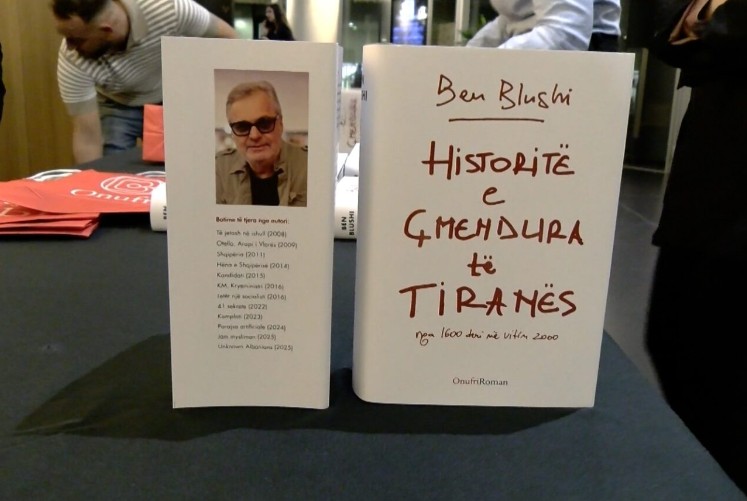
Ben Blushi’s book, “The Crazy Stories of Tirana,” has aroused great interest and sparked a public debate involving writers, historians, researchers, journalists and politicians. Reactions have been divided between praise for the author’s distinctive style and criticism of the way he treats the capital’s historical past. It is precisely the manner of narration that has become the main cause of discussion.
Opposition leader Sali Berisha has also joined this debate. During the promotion of Alfred Lela’s book in Tirana, Berisha criticized the way Ben Blushi has presented Tirana’s stories, describing the author’s accounts as fairy tales that distort history.
Another critical reaction came from historian Marenglen Kasmi, through his text titled “Blushi, We Already Have a Confused Enough History—Don’t Drive Us Crazy Now!” According to him, when literature takes on the task of narrating history, a clear distinction must be made between documented facts and artistic interpretation.
On the other hand, publisher Bujar Hudhri has praised the work, emphasizing that Blushi does not claim to write the history of Tirana, but a novel about its history.
Ahmet Prençi, meanwhile, sees the book as a narrative that goes beyond traditional history. He compares the reading experience to following a historical series, where each chapter brings a special episode. According to him, the book’s strength also lies in its manner of narration, its language and its ability to make history engaging for the reader.

Readers themselves have also shown great interest in the book, recognizing another merit in it. With “The Crazy Stories of Tirana,” Ben Blushi offers readers more than a book about the capital. He brings a new way of reading the city and understanding that its identity has been built not only by architecture and monuments, but also by a series of extraordinary human stories, with the ambitions, passions, mistakes and decisions of their protagonists.
In this sense, the debate around Ben Blushi’s book is not simply a discussion about a new publication. It touches on a much broader issue: how history is written, interpreted and conveyed to the public, as well as the boundary between historical fact and the freedom of literary creation.