







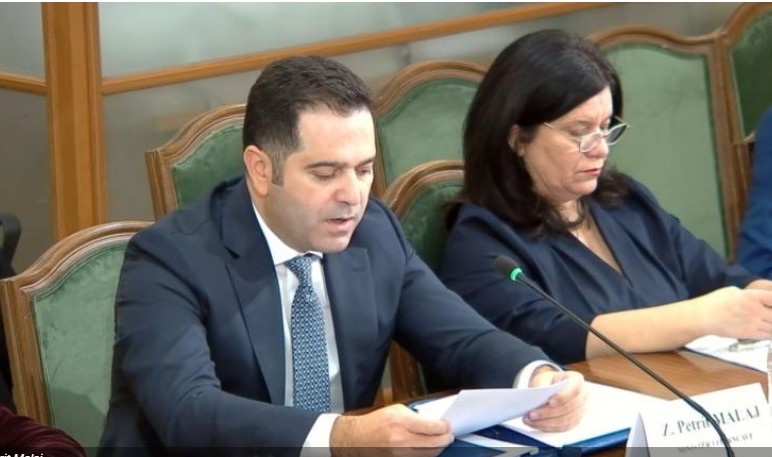
The Minister of Finance, Petrit Malaj, today presented the draft budget for 2027 at the Conference of Chairpersons.
During the presentation, Malaj said the budget will have 3 core priorities: social welfare, social stability and reforms for EU membership.
One of the priorities of the draft budget for the coming year will be pensions, as the minister explained that an indexation of 1.35 billion lek is planned in April, as well as a doubling of the monthly bonus with 20 billion lek.

Speech by the Minister of Finance, Petrit Malaj, at the Conference of Chairpersons:
Today I am pleased to present before you the draft budget for 2027, which we will have the opportunity to discuss together, in full and in more detail, in the Parliamentary Committees.
The draft budget we present today comes at a time when political and economic developments require increased attention, greater responsibility and more careful decision-making.
The aim of the Albanian government is that, not only next year but also in the medium term, we guarantee sustainable economic growth, and continue with the consolidation of all macro-fiscal parameters.
For this very reason, this draft budget reflects the Government’s commitments in concrete policies, financing for economic and social priorities, and ensuring financial sustainability in service of the primary objective, that of Albania’s full integration into the European Union.
The preparation of the 2027 draft budget is based on detailed macroeconomic analyses, our fiscal assessments and careful forecasts of revenues and expenditures.
The Ministry of Finance, taking into account the valued contribution of all institutions, has drafted a budget that responds to the needs of the country and our real financial capacities, but which, on the other hand, maintains the balance between revenues and expenditures.
The 2027 draft budget, just approved by the Council of Ministers and which we are now also presenting here at the Conference of Chairpersons, clearly reflects the priorities for the period 2027–2029, but above all our special commitment to a more social Albania.
Therefore, this draft budget is an expression of our priorities and the most direct measure of our responsibility before citizens.
It is undoubtedly our constant commitment to greater welfare and to the fulfilment of the vision of Albania 2030, in the European Union.
It is the objective of sustainable economic development, of healthier public finances, of more investment and opportunities, but above all of a better standard of living.
With over 10 billion euro in planned public expenditure, as never before, we give this commitment clear and strong financial support.
Our priorities are defined: social protection, education, health, pensions, agriculture, but also defense and security.
These are not merely budget items, but areas where the responsibility of the state is directly measured and from which citizens expect measurable results.
“The 2027 draft budget has 3 core priorities that define the direction of the country’s development:
“]Social welfare and support for citizens;
Fiscal stability and sustainable public finances;
Investment, reform and European integration
One of the government’s main priorities will continue to be support for the elderly.
Pensions hold a special place among the budget’s priorities, through measures aimed at increasing financial support for pensioners and improving their incomes.
Specifically, the following is foreseen:
Indexation of pensions in April 2027, with a projected fund of around 1.35 billion lek.
Doubling the value of the monthly bonus for pensioners according to defined categories, starting from 1 January 2027, with a total projected cost of 20 billion lek for the year.
Alongside pensions, the budget also strengthens social protection policies, with a focus on children, families and the most vulnerable categories.
Our aim is for public support to be more direct and to help cover everyday needs.
Among the main measures, we can mention:
Doubling payments for children with disabilities, as well as recognition of social and health insurance contributions for their caregivers.
Continuation of the baby bonus, but this time through monthly support until the age of 5, where the amount increases progressively for the first, second and third child.
Around 1.3 billion lek per year for social services and affordable housing.
Compensation from personal income tax will continue, up to 48,000 lek, for families with children under 18.
These measures express the social direction of the Budget Project 2027: greater support for pensioners, more care for families and protection for citizens who need it most.
In parallel, the budget will continue to finance priority sectors, while maintaining a balance between improving welfare and the country’s economic development.
All of this could not be turned into concrete policies if we did not have a strong, sustainable economy and if we did not manage to preserve macroeconomic and fiscal stability.
Honourable Chairs,
In the first half of 2026, economic growth was 3.6% year-on-year, reflecting growth across almost all sectors of the economy. Growth during this period was generated mainly by domestic demand, private consumption, investment, as well as the good performance of service exports, particularly tourism, which continues to be one of the main engines of our economy.
Our forecasts for the third quarter also point to a continuation of the sustainable growth pace, while economic indicators will continue to be above the historical average, reflecting the rise in business and consumer confidence in the future of the economy.
For 2026, a real growth of 4.0% is forecast, in line with the sustained performance of economic activity and the positive contribution of the main sectors.
The unemployment rate in the second quarter of the year stood at 8.3%, while labor force participation rose further, reaching 76.3%. These indicators show that the economy is creating more employment opportunities and becoming increasingly attractive to the workforce.
Inflation remains within the 3% limit set by the Bank of Albania. This level reflects fluctuations in international commodity prices, the strengthening of the domestic currency, and the effects of prudent monetary and fiscal policies.
Foreign Direct Investment in the first half of 2026 increased by 50.8%, reaching a value of 1.1 billion euros. It continues its steady growth and is increasingly oriented toward sectors with added value, driving economic growth, employment and productivity gains.
Overall, these results show that Albania is advancing at a sustainable pace toward strengthening economic and fiscal stability, ensuring a more favorable climate for investment, and bringing the economy closer to European Union standards.
Public finances remain the main pillar of this stability, through disciplined management and public debt on a continuous downward trend. In 2025, a primary surplus of 0.3% of GDP was achieved, while public debt fell to 52.9% of GDP, its lowest level since 2008.
This progress has also been reflected in growing international confidence in the Albanian economy.
Leading international rating agencies, such as Standard & Poor’s, have reaffirmed Albania’s long-term sovereign credit rating at “BB”, while also maintaining a “stable” outlook, a clear proof of the sustainability of our financial policies.
In 2027, we will also continue on the path of fiscal consolidation, with a deficit of only 2.3% of GDP, maintaining a neutral primary balance and reducing public debt to 52.4% of GDP. This means that Albania is financing development without jeopardizing stability, and this is a clear distinction between being responsible rather than populist.
Budget revenues for 2027 are projected at 907.9 billion lek (about 9.4 billion euros), or 30.9% of GDP. For 2026, budget revenues are projected at about 843.1 billion lek, or 30.2% of GDP.
Revenues from taxes, customs duties and social and health insurance contributions for 2027 have been projected on the basis of an analysis of the expected 2026 outturn, historical revenue trends and macroeconomic forecasts, taking into account the impact of economic growth, inflation, new fiscal and budgetary policies, the effects of previous policies, as well as additional revenues expected from the implementation of the measures of the Medium-Term Revenue Strategy.
The revenue programming for 2027 supports the Ministry of Finance’s goals of increasing revenues through improved tax and customs administration, implementing important government budgetary reforms/investments, and keeping the budget deficit and public debt under control.
Revenue projections from taxes, customs duties and contributions foresee total revenue reaching around 793.8 billion lekë in 2027, or 56 billion lekë more compared with the expected revenue for 2026, representing an increase of 7.6%.
The main sources of this growth come from economic growth, the impact of inflation, the new measures of the fiscal package and the implementation of the measures of the Medium-Term Revenue Strategy.
Dear Chairmen,
Allow me now to move to a simplified presentation regarding public investments and social priorities, or put more simply, where the money of Albanian taxpayers will go:
For the period 2027-2029, capital expenditures (i.e., public investments) are targeted to be on average around 6.6% of GDP in each budget year, including new public investments that could potentially be enabled under the European Union’s New Growth Plan for the Western Balkans, which aims to foster higher potential growth and faster convergence with EU economies.
For 2027, public investments will represent 6.9% of GDP, or 201.5 billion lekë, for infrastructure, public services and projects that support economic development.
As for the priority sectors:
Social protection holds a key place in the 2027 Draft Budget. Through this budget, we are increasing support for pensioners, strengthening policies for children and families, and continuing to support citizens who need it most.
For 2027, funding for social protection reaches 279.7 billion lekë, or about 30% of total budget expenditures.
Education is a direct investment in the future of the country. For this reason, the 2027 Draft Budget foresees that expenditures in this sector will reach 93.6 billion lekë, with an increase of 4.5 billion lekë compared with the previous level of funding.
The main priorities to be funded are:
1 billion lekë additional for increasing scholarships for students in need.
400 million lekë additional for improving basic education infrastructure.
500 million lekë will be invested in the “After School” program, enabling the extension of hours for children who stay after school until 17:00.
100 million lekë additional for scientific research.
Through these investments, we aim to improve learning conditions, expand opportunities for students and strengthen the link between education, knowledge and the country’s development.
Healthcare remains another important priority of public funding, with the aim of improving access to services and guaranteeing better support for patients.
For 2027, expenditures for the sector are projected at 87.2 billion lekë, with an increase of 5.6 billion lekë.
The main measures include:
1 billion lekë in additional financing for medicines and medical equipment, supporting hospital services and primary and secondary healthcare.
Reimbursable prescription treatment for 400 thousand patients.
Rehabilitation and construction of 20 hospitals across the country.
These funds aim to improve the delivery of health services and support citizens through the supply of medicines, medical equipment and investments in hospital infrastructure.
Security and public order remain an important part of our priorities.
To this end, the budget provides the necessary funding for these sectors, as well as additional support for State Police employees.
Funding is planned as follows:
36.7 billion lekë for public order.
3.3 billion lekë additional for the salaries of State Police employees. 8,500 employees will benefit. In the inspector category, the base salary for rank increases by 20,000 lekë (to 93,000 from 73,000 today). The increase is on top of the base salary. Other categories will receive salary supplements of 10,000 to 15,000 lekë per rank.
Alongside strengthening institutional capacities, the salary increase is part of our commitment to support employees who contribute every day to guaranteeing public order and security.
Agriculture remains an important sector for the economy and the development of rural areas.
The budget for agriculture is planned at 17.9 billion lekë, with 1.1 billion lekë in additional financing from the state budget.
Through the policies we will implement, we aim to increase the number of beneficiaries. For 2027 we have planned around 43,660 beneficiaries, a number that will increase further in the medium term.
Among the main measures I can mention:
Continuation of VAT compensation of 10% for farmers, with an annual fund of 3 billion lekë.
An additional 100 million lekë for the National Scheme.
An additional 400 million lekë for improving irrigation and drainage systems.
Thus, in total, the direct support scheme for farmers is planned to increase by 5.3 billion lekë.
Expenditure on Infrastructure and Energy will account for 2.5% of GDP with a total fund of 75.4 billion lekë, where key policies include:
Construction of the water supply and sewerage network in: Mat Municipality, Memaliaj, Sarandë, Fier, Lezhë, Shkodër and Velipojë; Reconstruction of existing water supply lines in Kukës, etc. Construction of a water reservoir in Tirana Municipality.
The new Port of Durrës (Porto Romano) and the Triport Port, Tirana-Durrës/Rinas railway, Vorë-Hani i Hotit railway, Durrës-Rrogozhinë railway;
Elbasan-Lekaj axis, Elbasan bypass, Elbasan-Qafë Thanë, widening of Tirana-Durrës, Tirana-Ndroq-Plepa and the Tirana bypass.
For Defence, we will continue to finance the modernization of the Armed Forces and the fulfilment of Albania’s commitments to NATO.
For 2027, the following is planned:
76.7 billion lekë for the Ministry of Defence.
7 billion lekë in additional financing.
Defence expenditure at the level of 2.35% of GDP.
These investments aim to strengthen the country’s defensive capacities and support our commitments within the Alliance.
Expenditure for the 2027 local budget will reach 114.6 billion, an increase of 17% compared with 2026.
58.6 billion lek will come as revenue from local finances themselves,
56 billion lek comes as support from the state budget through unconditional transfers and sectoral transfers.
Dear Mayors,
The Ministry of Finance, in parallel with the 2027 Budget, has also drafted the 2027 Fiscal Package.
The proposed changes will be revenue-neutral, as the principle on which they are based is the redistribution of income, ensuring the protection of the most vulnerable categories and the middle class.
The Fiscal Package is therefore conceived around three key principles:
Redistribution of income
Strengthening fiscal justice;
Improving the efficiency of the tax system;
In this framework, changes have been proposed to: the tax on dividends, personal income tax, VAT, the continuation of the excise harmonization calendar as required by the EU, and the shift of the turnover tax from fuel to annual vehicle taxes.
These measures aim to ensure a fairer tax system, increase the contribution of those with a higher ability to pay, limit room for tax avoidance, and guarantee stable revenues for financing public policies and priority investments.
The main changes include:
increasing the dividend tax rate from 8% to 15%;
revising the progressive structure of the income tax on employment, easing the burden on the middle class and strengthening progressivity for higher incomes;
lowering the VAT registration threshold from 10 million lek to 5 million lek;
raising the standard VAT rate from 20% to 21%;
applying the reduced 6% rate to 54 basic-basket products;
shifting the turnover tax from consumption to the annual vehicle tax;
continuing the calendar of excise increases for tobacco products and aligning with European Union directives.
Overall, the 2027 Draft Budget and the accompanying fiscal package are a concrete instrument for implementing our priorities for the 2027–2029 period, placing the citizen, well-being and the sustainable development of the country at the center.
Through this budget, we are strengthening support for pensioners and families, investing in education and healthcare, supporting farmers, increasing funding for public order and security, and providing greater financial support to municipalities to improve services and investments for communities.
Equally important is the responsibility we have to manage public finances carefully, to maintain fiscal sustainability, and to direct every resource toward the needs and objectives of the country.
Our goal is not simply to finance more, but to ensure that every policy translates into greater support for citizens, higher-quality services, more development, and a higher standard of living.
Finally, but no less importantly, the 2027 Draft Budget is part of our medium-term commitment to a more competitive economy, a more protected society, and an Albania that advances more quickly toward European Union standards.