







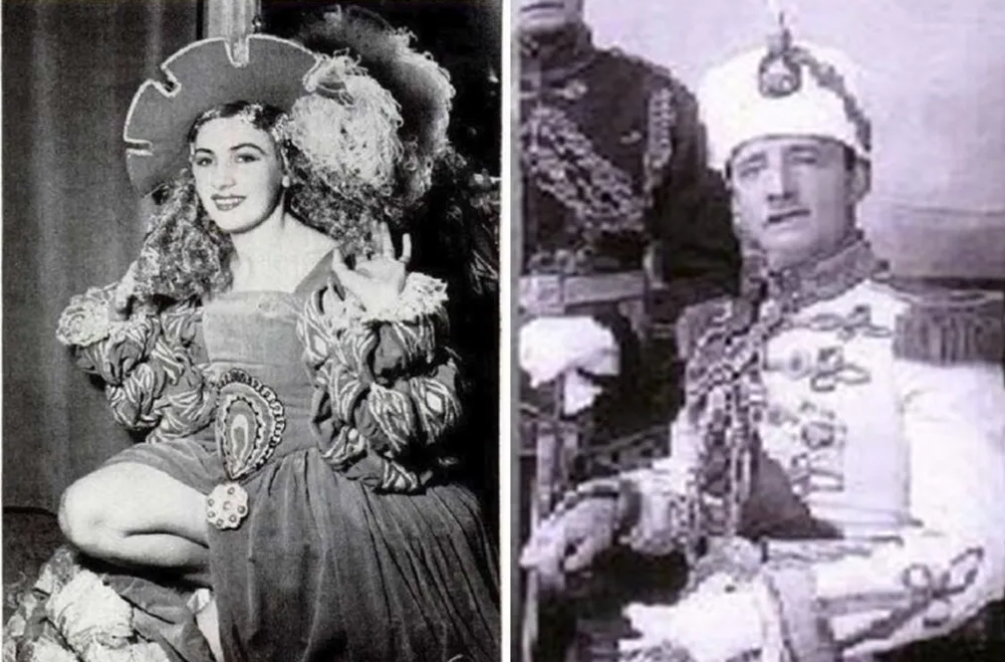
Tania Visirova, the Parisian ballerina who lived in King Zog’s shadow: Secret love, royal gifts, land in Xhafzotaj and the attempt to obtain a pension from the Albanian state.
Tania Visirova’s story is one of the least known but most intriguing episodes in the private life of King Ahmet Zogu I.
A woman who began life as a poor emigrant in Paris, became part of the famous French cabaret scene, ended up in Albania in the late 1920s and, according to her recollections, for several years had a special romantic relationship with the Albanian king.
But her story does not end with her departure from Albania. Decades later, in 1977, she would appear at the Albanian diplomatic mission in France, seeking a pension from the Albanian state and inquiring about a property she claimed Ahmet Zogu had given her.
This is a story involving love, power, luxury, the life of the Albanian royal court, emigration, personal memories and a property issue that seems never to have been resolved.
Who was Tania Visirova?
Tania Visirova, the stage name of Tatiana Fomova-Stonovskaya, was born in 1908 in Bessarabia, a territory now part of Moldova.
Some sources mention the city of Kishinev, today Chișinău, while others give different versions of her birthplace.
She came from a family of mixed origin. According to her French biography, her father was of Russian-Polish origin, while her mother was of Romanian-Moldavian origin. Her family also mentions a paternal grandmother of Chinese origin.
Her early life was disrupted by the turmoil and aftermath of the Bolshevik Revolution. The family faced hardship, displacement and uncertainty, while Tania and her mother eventually headed to France.

In 1927, Tania arrived in Paris. She was young, without wealth and in need of securing a livelihood. She initially posed for artists and photographers before entering the world of entertainment and cabarets.
French sources describe her as a woman of extraordinary beauty who very quickly became a well-known figure on the Parisian stage.
From a poor emigrant to one of the figures of Paris cabarets
In Paris, Tania Visirova became involved in the entertainment world, where she worked as a model and later as a dancer.
She became part of the Folies-Bergère, one of the most famous entertainment institutions in Paris, known for its musical revues, dance, extravagant costumes and performances that attracted the elite audience of the time.
At that time, Tania became known by the pseudonym “La Visirova” and, according to the French press, was considered one of the most beautiful women on the Parisian stage.
An article in the newspaper Le Monde, published on December 19, 1980, brought her back to the attention of the French public. The article, titled “La Vierge des Folies-Bergère,” described Visirova as a woman who had once been beautiful, famous and wealthy, but who in old age lived alone and in modest conditions.
The French newspaper noted that she had an extraordinary memory and that she had recounted her life to journalist Maria Craipeau.
This article is an important source, because it shows that Visirova’s story is not merely an account repeated by the Albanian media. She was also a figure who was interviewed and documented in France at the end of her life.
How did Tania Visirova end up in Albania?
According to her account, in 1929 Tania received an offer to come to Albania.
She thought she had been contracted to dance in a theater in Tirana, as part of activities organized for the Albanian kingdom.
In some versions of the story, it is mentioned that the contract was for a limited period, while the payment was very high for the time.
Tania accepted the offer.
She arrived in Albania in August 1929. According to an account published by a diplomat, her arrival was linked to a contract signed for an artistic engagement, but the situation changed quickly.
Instead of completing her engagement as a dancer and returning to Paris, Tania settled in Albania and became part of the private life of King Ahmet Zogu.
Some sources say she was kept in a residence in Durrës, where the king visited her and where, according to her account, the love affair between them developed gradually.
A relationship that lasted several years
Tania Visirova and Ahmet Zogu, according to her own accounts, -“we lived in a love relationship that lasted from 1929 to 1932 or 1933.”
The sources are not entirely consistent in determining the duration. Some speak of three years, while others of four years.
This discrepancy may be related to how the period is calculated: from her arrival in Albania, from the beginning of their cohabitation, or until her final departure.
Nevertheless, it seems the relationship was not a short episode. It lasted for a considerable period and, according to sources, Tania became one of the women closest to the king during this period.
However, she did not become queen.
The relationship was not formalized with an official marriage.
“We made love on schedule” – Visirova’s personal account
One of the most distinctive parts of Tania Visirova’s story is her account of her intimate relationship with King Zog. In an interview and account published many years later, she described the relationship as a bond in which, according to her, even intimacy was influenced by protocol and the routine of royal life. In one account, she says that “Protocol also dictated our hours of love.”
She described the meetings, walks, lunches and the time she spent with the king, but also expressed dissatisfaction with how well organized the relationship and the meetings were.
In another part of the account, she says that Zog had a great weakness for her, but that protocol and the obligations of the royal role often dominated their private life.
It is important to note that these are Visirova’s personal testimonies, recorded and published many years after the events. They are not official documents of the royal court.
However, they constitute an important source for understanding how she remembered and interpreted her relationship with the king.
Why did she not become the official wife of King Zog?
One of the most interesting questions in this story is why Tania Visirova, despite her long relationship with the king, did not become his official wife.
In the published accounts, it is mentioned that King Zog’s family, especially his mother, did not accept the possibility that he would marry a woman who was not Muslim.
In some versions, Tania says that the king had promised he would not marry her as long as his mother was alive.
This factor, according to her accounts, was one of the reasons the relationship was not formalized.
Here we should be careful: we do not have this from the sources we have reviewed, or from any official royal document that could confirm such a promise. This element comes from Visirova’s later accounts in her book.
The King’s gifts: jewelry, money and a property in Xhafzotaj
One of the most important aspects of the story is the question of the gifts that Tania Visirova claimed to have received from Ahmet Zogu.
According to some sources, she received: precious jewelry; money; personal gifts; a diamond ring; a property in Albania. In Visirova’s French biography, a diamond ring of about 7.5 carats is mentioned, said to have been given to her by Zogu for her 21st birthday.
Another element repeated in the sources of the time is the gift of 10,000 square meters of land in Xhafzotaj, in the Durrës area.
In some articles, the area is described as 10 hectares, but here there is an important discrepancy: 10,000 square meters = 1 hectare; 10 hectares = 100,000 square meters.
So, the sources that mention 10,000 m² and those that mention 10 ha are not referring to the same area.
This is a discrepancy that should be clarified through ownership documents, if they exist.
It should not automatically be presented as proven fact that Tania owned 10 hectares of land. What can be said is that in her accounts and in later articles a gift of land in Xhafzotaj is mentioned, but the area varies according to the source.
A particularly interesting detail: Tania sought help from the Albanian state in 1977
This is one of the most interesting and least known parts of the story.
In 1977, many decades after leaving Albania, Tania Visirova appeared at the Albanian embassy in France.
At that time, diplomat Idajet Hoxha was First Secretary and Consul General at the Albanian representation.
According to his account, Tania requested:
A pension from the Albanian state;
Recognition of her status as former partner of King Zog;
Assistance regarding a property in Albania;
The possibility to sell the land she claimed to have received as a gift from Ahmet Zogu.
This is a part that significantly changes the perspective of the story.
Tania was not simply a woman who had had a relationship with a king and then disappeared from history. Decades later, she still had a claimed legal and economic connection to Albania.
According to Idajet Hoxha, she had an interest in the land in Durrës that, according to her, Zog had granted her by document.
The diplomat followed the matter, but according to the published account, the problem was not resolved.
This raises a very interesting historical and legal question:
Did a genuine land-donation document from Ahmet Zogu to Tania Visirova exist, and what happened to that property after her departure from Albania?
From the public sources we have reviewed, we have not been able to find the donation document itself, a complete property record, or a decision confirming that she legally owned the land.
Therefore, this remains a matter requiring further research in archives.
Tania Visirova and the assassination attempt against King Zog in Vienna
Another interesting element of this story is its connection to episodes in King Zog’s life outside Albania. In a 2012 article, diplomat Idajet Hoxha mentions that, while watching film footage of an assassination attempt against King Zog in Vienna in 1931, he noticed a woman near the king, whom he identified as Tania Visirova. This episode has been used as one of the elements that prompted him to seek more information about Visirova’s relationship with Zog.
However, to consider this as conclusive evidence of the woman’s identity in the film, the footage itself, the photograph, and the identification of the person must be verified.
This is an important direction for further research, because film documents of the time may offer visual evidence of Visirova’s presence in King Zog’s circle.
Her account became a book: “Du Caucase aux Folies-Bergère”
One of the main sources for Tania Visirova’s life is the book: Tania Visirova: Du Caucase aux Folies-Bergère. The author is Maria Craipeau, and the book was published in 1980 by the publisher Mazarine.
The book contains about 241–260 pages, depending on the edition, and is based on Visirova’s account of her life. The title can be translated as: “Tania Visirova: From the Caucasus to the Folies-Bergère.”
The book describes her journey from childhood, emigration, life in Paris, career in cabaret, relationship with King Zog, and life after leaving Albania.
According to the book’s bibliographic description, she was a girl from a good family, but her life was overturned by the Russian Revolution, poverty, and emigration. In Paris, she first became a model and later a well-known figure on the stage.
This book is particularly important because her story was not documented only by journalists many years later; Visirova had recounted her life in France before the story spread widely in the media.
French newspapers
Le Monde documented her life in 1980
On December 19, 1980, the French newspaper Le Monde published the article: “La Vierge des Folies-Bergère.” Colette Godard’s article describes Tania Visirova in the last years of her life. According to the newspaper, she had once been a beautiful and famous woman in Paris, while in old age she was a lonely, poor woman living with extraordinary memories.
The article also mentions her connection with King Zog of Albania. This source is important for several reasons:
It was published in a well-known French newspaper;
It was written during Visirova’s lifetime;
It confirms that she was a real person and a well-known figure in Paris;
It mentions her relationship with King Zog;
It documents her condition in the last years of her life.
A life that ended far from luxury and fame
Despite the gifts and former fame, Tania Visirova’s life in her final years was very difficult.
According to French sources, she left Paris and lived in the south of France, where she worked as a dance teacher.
She and her mother remained very close and, according to the article in Le Monde, were never separated.
In the last years of her life, Tania lived in quite difficult conditions.
She died on April 13, 1984, in Roquestéron, France.
According to French biographical sources, she was buried next to her mother.
What is documented and what remains unclear?
To avoid turning the story into a legend, it is important to divide the information into categories.
Elements supported by multiple sources
Tania Visirova was a well-known dancer and model in Paris.
She worked at the Folies-Bergère.
She was linked to King Ahmet Zogu.
Their relationship lasted several years.
She recounted her story in a book published in 1980.
Le Monde interviewed her and wrote about her in 1980.
She lived in France after leaving Albania.
She died in 1984.
Elements based mainly on her account
The intimate details of the relationship with King Zog;
The description of the protocol for meetings;
Many of the personal gifts;
The promises the king may have made to her;
The circumstances of her departure from Albania.
Elements requiring other documents
The original document for the land donation;
The exact area of the land in Xhafzotaj;
The legal status of the property;
The documents of the pension request in 1977;
Albanian-French diplomatic correspondence;
The final identification of Visirova in the footage of the Vienna assassination attempt.
The remaining question: Was Tania Visirova a “secret woman” of King Zog?
In the history of King Ahmet Zogu, Geraldine’s name is linked to the official marriage and to her role as Queen of Albania.
But Tania Visirova’s story presents another side of his private life.
She was not an ordinary court figure. She was a woman who came from Paris, a well-known dancer, an emigrant who had gone through great hardships and who, for a period of her life, became part of the life of a king, or, so to speak, his lover.
Her story is an example of how the private relationships of historical figures can remain hidden, fragmented, and documented only through memories, newspapers, and later testimonies.
But what makes the story even more interesting is that Tania did not forget Albania.
In 1977, many years after leaving, she got back in touch with the Albanian diplomatic representation, seeking a pension and trying to resolve the issue of the land she claimed to have received from King Zog.
This is not simply the story of a secret love.
It is the story of a woman who went from emigration and poverty to a relationship with a king, of a woman who went from luxury to a rather poor life, and of a woman who at the end of her life still had an unresolved matter with Albania.
A figure who deserves more attention
Tania Visirova remains a figure who deserves more attention from Albanian historiography. Her story contains elements documented by French sources, autobiographical accounts, diplomatic testimonies, and articles published in Albania and France.
However, the land issue in Xhafzotaj and her pension request in 1977 are perhaps the most interesting parts for further historical research, because they could lead to archival documents that would help confirm the story more clearly.
If the land donation documents, diplomatic correspondence, or the pension request file are found in archives, they could reveal a much more complete story than what has been published to date.
Sources
Le Monde, Colette Godard, “La Vierge des Folies-Bergère”, December 19, 1980 — an article on the life of Tania Visirova and her account to Maria Craipeau.
Maria Craipeau, Tania Visirova: Du Caucase aux Folies-Bergère, Mazarine, 1980 — the biographical book based on Visirova’s account.
Gazeta Telegraf, “Hoxha: Let me tell you about Tania Visirova, the first woman of former King Ahmet Zogu”, October 23, 2012 — diplomat Idajet Hoxha’s account of his contacts with Visirova in 1977 and her requests concerning her pension and property.
Gazeta Telegraf, “Tania Visirova: How I lived with Ahmet Zogu, King of the Albanians, for four years”, October 25, 2012 — an account of her relationship with Zogu.
Lapsi.al, “We made love on a schedule, he never satisfied me…”, January 3, 2018 — a summary of Visirova’s personal account.
Balkanweb, “Zog’s Moldova, the journey of the cabaret dancer who never became a queen” — an article on Visirova’s life and her account.
Bibliothèque nationale de France (BnF), the bibliographic catalogue for Roger Vailland’s work, La Visirova, ou Des Folies Bergères jusqu’au Trône, published in Paris-Soir during 1933.
Wikidata / French biographical sources, data on the name, life, career, and death of Tania Visirova.
Prepared by: NDREK GJINI