







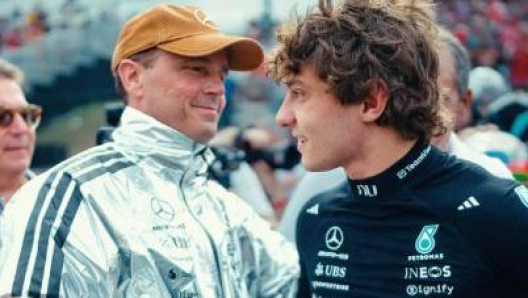
NASA astronaut Reid Wiseman, a figure who has pushed the boundaries of human exploration, has taken on a new role as ambassador for the Mercedes Formula 1 team. Wiseman, who this year commanded the Artemis II mission – the first crewed trip around the Moon since 1972 – broke numerous records. At the age of 51, he became the oldest person to travel around our satellite, surpassing the distance of over 250,000 miles set by Apollo 13 in 1970, marking the greatest distance ever reached in space by human beings. His deep experience with extreme challenges makes his perspective on Formula 1 particularly interesting.
Wiseman says he accepted the ambassador role with pleasure, emphasizing that it ‘highlights the innovation, leadership and high-performance culture that are the foundation of success in Formula 1.’ He is amazed by achievements in this sport, considering Formula 1 engineering ‘more complex than what is done in space.’ This statement comes from a man who has seen up close the complexity of spacecraft. He notes that in Formula 1, everything is pushed to a higher level, always seeking that ‘something more’ that rivals do not have, unlike space missions where the emphasis is on proven and reliable systems, allowing certain compromises on weight.
One of the main analogies Wiseman makes between Formula 1 and space exploration is the mindset and the pursuit of perfection. He emphasizes that both fields require a strong culture of challenge and achieving results. ‘Everyone here is at the maximum of their abilities, or if they are not, they are working to be,’ he says of the F1 environment. He admires how Toto Wolff has built an extraordinary team that cares for people, resulting in a squad that works to achieve the best not only for themselves but for all members. This collective approach, combined with individual talent, is essential for success in both fields.

The astronaut cannot fail to highlight the uniqueness of Formula 1 drivers, whom he calls ‘true superstars.’ He appreciates not only their physical and driving skills but also the technical and engineering capabilities they acquire, as well as their pronounced sense of leadership, even though F1 is considered an individual sport. Among them, Wiseman singles out Kimi Antonelli, the world champion, whom he considers ‘even more special.’ He recalls meeting Antonelli at the Johnson Space Center in 2024, when Kimi was only 17 and not yet racing in Formula 1.
Wiseman was impressed by Antonelli’s humility, simplicity and extraordinary curiosity, as he asked questions nonstop about everything. ‘It is people like him that I seek to meet, because that curiosity is very powerful and is the key to being special people, as he has demonstrated with his arrival in Formula 1,’ Wiseman says. He sees Antonelli’s rise as a clear example of teamwork, where individual talent combines with the group’s ability to work together toward the best possible result.
Another characteristic that unites F1 and NASA, according to Wiseman, is the relationship between the driver and his race engineer. He laughs when he hears Bono and Kimi talking on the radio, because it is ‘exactly the same thing we do when we are in space.’ He describes a similar communication process, where information is exchanged and interpreted, creating a special connection. Wiseman will continue to explore this Formula 1 universe in his role as Mercedes ambassador during the upcoming season, believing there is great narrative potential and a sense of adventure that comes from sharing the stories of people who have pushed the boundaries of the known.
From La Gazzetta dello Sport