







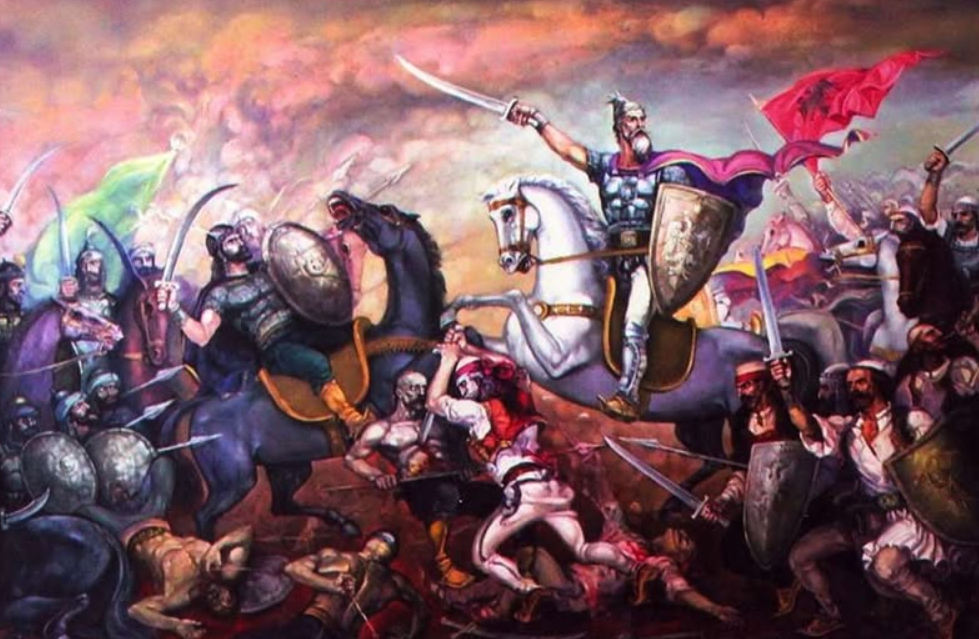
Archival sources provide numerous historical details about the alliance between Skanderbeg and the English knight, Sir John of Newport.
Papal Special Envoy and Diplomatic Mediator
Before he fought on the front lines of battles, John of Newport was deeply involved in European diplomacy. Archival records concerning Pope Callixtus III identify John of Newport as (special envoy) of the Pope in Bosnia, Slavonia and Arbëria.
He was an adviser and chamberlain (camerlengus) to King Alfonso V of Aragon and Naples, who was Skanderbeg’s main financial supporter through the Treaty of Gaeta.
This dual connection allowed John of Newport to act as a high-level mediator, moving from a diplomatic envoy to an active commander of a unit of foreign soldiers (highly skilled and talented archers) who had come to fight alongside Skanderbeg and under his orders.
The Great Turning Point at the Battle of Albulena (1457)
John of Newport’s decisive military moment came on 2 September 1457, during the Battle of Albulena (White Water).
An Ottoman army of around 80,000 men under the command of Isak Bey Evrenos and Skanderbeg’s rebellious nephew, Hamza Kastrioti, had poured into Arbëria. Skanderbeg had spent months preparing to face this battle successfully and avert defeat.
John of Newport commanded a specialized unit of professional English and Welsh archers (with longbows and claws). The English longbow was still a legendary weapon in Europe.

When Skanderbeg launched his surprise attack on the Ottoman camp, John of Newport’s archers unleashed devastating volleys of arrows. The battle was a brilliant Arbërian victory that crushed the Ottoman forces and saved the uprising.
A Dramatic Warning for the Pope
After the victory of 1457, Skanderbeg remained in inevitable danger. He sent John of Newport to Rome together with an ambassador returning from Naples.
According to a preserved letter by Cardinal Enea Silvio Piccolomini (who would later become Pope Pius II), John of Newport arrived at the papal court to request reinforcements.
John of Newport, speaking as an eyewitness to the Ottoman war machine, openly and firmly warned Western Europe, saying: “The conquest of Europe will be a fact, because there is no other power capable of resisting the Ottomans if the Arbërian fortress falls.”
Part of an International “Foreign Legion”
John of Newport was not an isolated case. Skanderbeg’s administration in his capital, Krujë, attracted a large number of fighters from other countries, as well as many merchants and knights from Western Europe, who saw the Arbërian resistance as the first line of defense of Christendom.
Stefan Maramonte, for example, was a well-known Italo-Slavic warrior who served as Skanderbeg’s ambassador in Milan, or the German volunteers, recorded as distinguished soldiers who helped defend Krujë during the brutal Ottoman sieges, or Pal and Andrea Gazulli, highly educated Arbërian scholars and diplomats who managed Skanderbeg’s networks in Venice, Rome and Ragusa (Dubrovnik).
Note:
William “Bill” Bland, a British writer, historian and Marxist-Leninist (Enverist) activist, was the founder of the “Albania Society of Britain.” For years he tried to uncover the historical traces of John of Newport and his connections with Skanderbeg.
During a visit to Albania in 1984, Bland searched Albanian archives for documents to prepare a historical and biographical study of this knight. However, he acknowledged that he had not found original documents in Albania and that he would have to continue his research elsewhere.
According to him, the most important evidence for the existence and role of Newport was located in Italian and Vatican archives, including the letters of Cardinal Piccolomini, and not in the documents kept in Albania.
Bland’s interest in John of Newport was linked to his effort to document the history of Anglo-Albanian relations. He saw Newport as an early symbol of cooperation between two peoples, a Westerner who transcended cultural differences to fight alongside Skanderbeg.
However, the possibility that this commitment also had other motives cannot be ruled out. As a staunch supporter of Enverism, Bland may have benefited from funds that the Albanian communist regime distributed to Marxist-Leninist groups in various parts of the world. During that period, considerable sums of money ended up in the hands of individuals and organizations that claimed to support the regime of Enver Hoxha, but which in some cases may have had more personal and political interests than genuine ideological conviction.
Prepared by: NDREK GJINI