







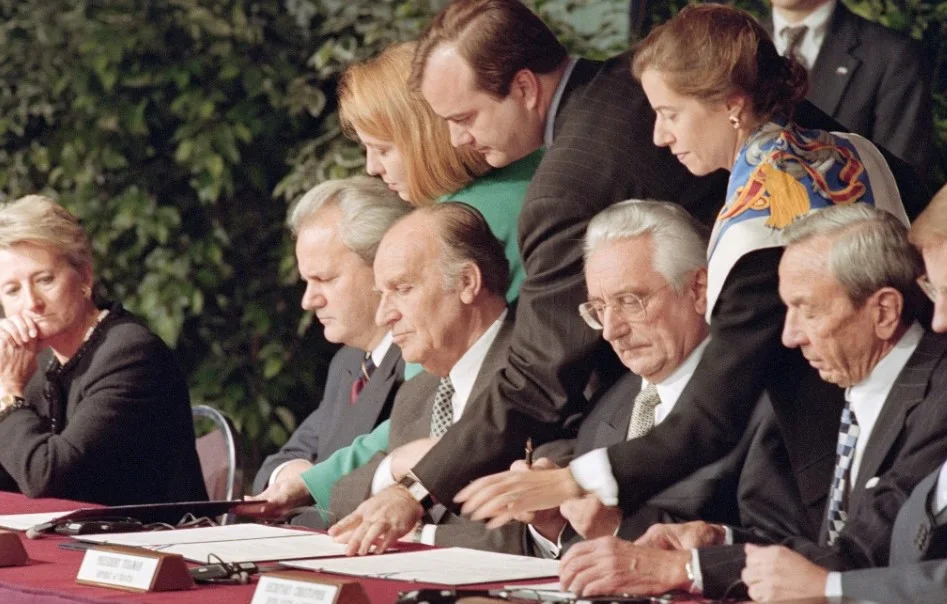
Dayton Agreement, the document that ended the war in Bosnia and Herzegovina, was reached on November 21, 1995, at Wright-Patterson Air Force Base in Dayton, Ohio, in the United States. Today marks 31 years since the initial signing of the General Framework Agreement for Peace, after three weeks of negotiations.
The document was initialed by the then President of Bosnia and Herzegovina, Alija Izetbegović, the President of Serbia, Slobodan Milošević, and the President of Croatia, Franjo Tuđman. In the presence of the then U.S. Secretary of State, Warren Christopher, the text was signed.
Diplomat Richard Holbrooke and General Wesley Clark also played a key role in the mediation, according to Euronews Albania, which commemorates the anniversary of the agreement. Zelensky: Trump and Xi can stop the war with a meeting remains another topic of the day, but here the focus is on Dayton.

The agreement, together with its 12 annexes, defined the organization of Bosnia and Herzegovina as a state with three constituent peoples and others. According to this document, the country was divided into two entities: the Federation of Bosnia and Herzegovina and Republika Srpska. After the agreement was reached in Dayton on November 21, the document was officially signed on December 14, 1995, at the Élysée Palace in Paris.
In Republika Srpska, November 21 is marked as an official holiday and a day off, in commemoration of reaching the General Framework Agreement for Peace. However, 31 years after the end of the war, the focus is not only on the agreement’s historical importance in stopping the conflict.
It also extends to the political and social consequences that the document has left in the country. For the generations that experienced the war, peace meant the end of killings, bombardments and destruction. While for the generations born after the conflict, it also means opportunities for education, employment, free movement and a life without the constant fear of war returning.
The experiences of people born in 1995 also have particular importance on this anniversary. They did not take part in the negotiations and did not decide on the constitutional structure or the political system in which they grew up. But they have completed their education, sought work and tried to build their future within this system.
The wartime past remains an important part of Bosnia and Herzegovina’s history and of the memory of the victims. However, confronting the past is not the same as constantly reviving political threats of a new war. Between the obligation not to forget the crimes and the right of new generations to live without fear, Bosnia and Herzegovina continues to face the challenge of building a normal life, 31 years after the end of the war.