







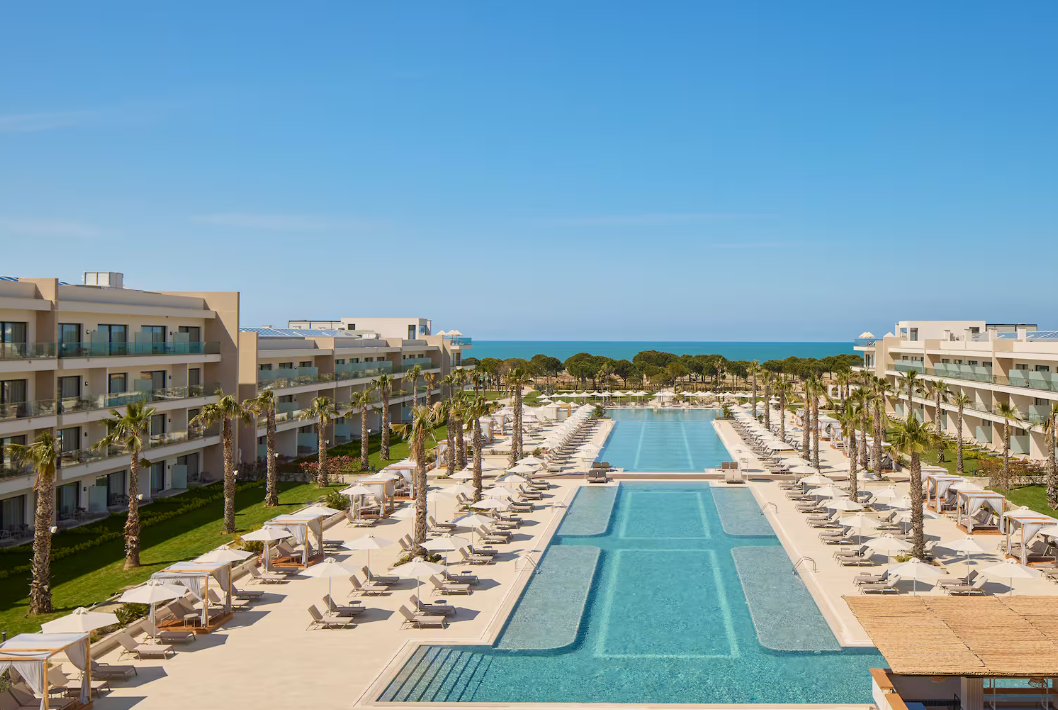
The Council of Ministers approved at its meeting on 5 November a decision defining the categories of accommodation structures and the conditions that new tourism projects must meet. One of the main changes is the definition of the “mixed resort” category, where, alongside hotels and tourist facilities, apartments or villas for residential use may also be built. According to the decision, at least 60% of the total construction area must be used for tourism, while the residential part may not exceed 40%. This ratio is calculated on the construction area and not on the land area.
To avoid ambiguity in the division of spaces, developers must specify in the project which premises will serve tourism and which will serve residence. Shared spaces are included in this calculation according to their use. Another rule is the requirement of a preliminary categorization certificate before the construction permit is approved. The document will be issued by the ministry responsible for tourism and will verify whether the project meets the criteria of the proposed category. However, the certificate does not replace the construction permit. The decision also establishes that apartments, villas and rooms that in new projects are intended for tourist accommodation will no longer be categorized as separate structures. They will be part of the resort and will operate under its joint administration.
Apartments designed for residential use, however, cannot automatically be used for tourist accommodation. For this, legal requirements must first be met and a change of their designated use must be approved. The new rules do not revoke the validity of certificates previously issued for apartments, villas, rooms or hotels operating separately. Structures that have received these certificates may continue their activity under the approved category. Likewise, projects that obtained the construction permit before law no. 83/2026 entered into force are not obliged to obtain a preliminary categorization certificate. The decision enters into force upon publication in the Official Gazette.

D E C I S I O N O N T H E D E F I N I T I O N O F T H E C A T E G O R I E S O F A C C O M M O D A T I O N S T R U C T U R E S
Pursuant to Article 100 of the Constitution and point 2 of Article 43/1 of law no. 93/2015 “On Tourism”, as amended, on the proposal of the Minister of Tourism, Culture and Sports, the Council of Ministers
DECIDES:
1. This decision defines the categories of accommodation structures according to typology, function, organizational method and service characteristics of accommodation, as well as the design and construction criteria for integrated category projects. These criteria are also verified during the preliminary categorization procedure, in accordance with the legislation in force on tourism.
2. For the purposes of this decision, the following terms have the meanings below:
a) “Preliminary categorization certificate” means the document issued by the ministry responsible for tourism, before the construction permit for the accommodation structure is approved, which determines the proposed category and certifies the project’s compliance with the criteria of the relevant category, without replacing the construction permit or other acts required by the legislation in force;
b) “Apart-hotel”, an accommodation structure consisting of apartments intended for tourist accommodation, which may be individually owned and provide shared services serving tourism, under the same administration and management, with a common reception or lobby;
c) “Resort mix”, an integrated development, presented for preliminary certification, which includes an accommodation structure of the “resort” category, units with residential function, as well as premises, services and infrastructure shared for the purposes of the development;
ç) “Tourist component”, the totality of the construction surfaces of the accommodation structure of the “resort” category and of other surfaces intended exclusively for tourist functions and services;
d) “Residential component”, the totality of the construction surfaces of buildings, units or parts of buildings intended for residential function;
dh) “Total construction surface”, the sum of the construction surfaces resulting from the technical project documentation for the relevant component, calculated in accordance with the legislation in force on territorial planning and development;
e) “Part of the building”, the functionally distinguishable part of a mixed-use building, whose surface, based on the technical project documentation and the documented use, is assigned to the tourist component or the residential component, as applicable, in accordance with the documentation approved under the legislation in force on territorial planning and development.
3. Accommodation structures are categorised as follows:
a) “Bujtinë” (guesthouse);
b) “Fjetinë” (hostel);
c) “Kamping” (campsite);
ç) “Hotel”;
d) “Motel”;
dh) “Resort”;
e) “Qendër kurative” (therapy centre);
ë) “Fjetje dhe mëngjes” (B&B);
f) “Apart-hotel”;
g) “Strukturë akomoduese e trashëgimisë kulturore” (cultural heritage accommodation structure);
gj) “Resort mix”, as a sub-category of the “resort” category, solely for the purposes of preliminary certification of integrated development.
4. For the categories provided for in point 3 of this decision, the terms defined in law no. 93/2015, “On tourism”, as amended, have the meaning given in that law. For the categories and terms defined in point 2 of this decision, the definitions of this point apply.
5. Apartments, villas and rooms within a “resort mix” development are treated according to the destination set out in the approved project documentation. Where they are intended for tourist accommodation, they are included in the tourist component and in the structure of the “resort” category, under its common administration, without being categorised separately. Where they are intended for residential function, points 17 and 18 of this decision apply to any change of their destination or use.
6. In new projects, apartments, villas and rooms intended for tourist accommodation are not categorised as separate establishments. They are included in the tourist component of a “resort” category structure, including the “mixed resort” development, and are covered by its certificate. Units designed as residences, outside such a structure, cannot be offered as tourist accommodation unless they are included in a project that meets the requirements of the “resort” category, in accordance with the legislation in force.
7. A dispersed hotel may be organised within the “resort” category, including the tourist component of a “mixed resort” development, when it simultaneously meets the definition of a dispersed hotel and the definition of a resort, in accordance with points 61 and 28 of Article 4 of law no. 93/2015, “On Tourism”, as amended. Its units are located in existing buildings, close to one another, under the management of the same tourism operator, and are included in the joint organisation and administration of the resort. Categorisation is carried out for the resort as a whole. The designation “dispersed hotel” does not replace compliance with the requirements of the “resort” category. For structures certified earlier, the provisions of point 21 of this decision apply.
8. Before the building permit for an accommodation structure is approved by the responsible authority, each developing entity shall be provided with a preliminary categorisation certificate, in accordance with point 1/1 of Article 43/1 of law no. 93/2015, “On Tourism”, as amended. The conditions, criteria, deadlines and procedures for categorisation, including preliminary categorisation, are determined in the regulation approved by the minister responsible for tourism, in accordance with point 6 of Article 43/1 of law no. 93/2015, “On Tourism”, as amended.
9. For a “mixed resort” category project, the tourist component and the residential component shall be determined, identified and presented distinctly in the project documentation, in accordance with the legislation in force on territorial planning and development.
10. In the development of the “mixed resort” category, the total construction area of the tourist component must be no less than 60 (sixty) percent of the sum of the total construction areas of the tourist component and the residential component. The total construction area of the residential component must not be greater than 40 (forty) percent of this sum.
11. For calculating the ratio set out in point 10 of this decision:
a) the tourist component includes the total construction areas of the accommodation structure of the “resort” category and other areas intended exclusively for tourist functions and services;
b) the residential component includes the total construction areas of buildings, units or parts of buildings intended for residential use;
c) the areas of premises, services and common infrastructure that simultaneously serve the tourist component and the residential component and cannot be objectively separated by use are allocated to both components in proportion to the areas directly identified for each component;
ç) areas that, despite their designation in the project, mainly serve one component, or whose use can be objectively divided, shall be charged to the respective component or divided between the components in proportion to documented use. No construction area of the development shall be excluded from the calculation of the ratio.
12. The documentation of the “mixed resort” project shall contain a table of areas for each building, floor and function, the identification of the areas of the tourist component, the residential component and the common areas, the manner of distributing the latter, as well as the calculation of the ratio, in accordance with points 10 and 11 of this decision. The table and calculation shall be signed by the responsible designer and by the developer.
13. The ratio set out in point 10 of this decision shall be calculated only on the total construction area.
14. The provisions of points 9 – 13 of this decision shall apply without prejudice to the permitted land use, building intensity, land-use coefficient for construction, height, distances and other development indicators set out in planning documents or in special regulations approved by KKTU.
15. The preliminary categorisation certificate assesses the conformity of the project with the proposed tourist category. It does not create a right to build, does not replace the building permit and does not limit the competences of the authority responsible for territorial development.
16. Any change to the project, applied after the entry into force of this decision, before or during construction of the structure, that affects the proposed category, the functional division of components or the ratio set out in point 10 of this decision, shall be subject in advance to amendment of the preliminary categorisation certificate and, as applicable, to procedures for amending the building permit, in accordance with legislation in force.
17. Upon completion of construction of the “mixed resort” development, only the tourist component of the “resort” category shall be subject to the categorisation and classification procedure as an accommodation structure, including apartments, villas and rooms designated for tourist accommodation, as well as the dispersed hotel, organised in accordance with point 7 of this decision. Units of the residential component shall not be categorised or classified as part of the accommodation structure, except when used for tourist accommodation and meeting the requirements of legislation in force on tourism.
18. Changing the destination or use of residential component units for tourist accommodation purposes shall be carried out only after meeting the requirements of tourism legislation and territorial planning and development legislation. After approval of the change, the units shall be included in the tourist component and in the administration of the “resort” category structure, without being categorised separately as “tourist accommodation in dwellings”, and the change shall be reflected in the project documentation and in the calculation of the ratio in accordance with points 10 and 11 of this decision.
19. For accommodation structures for which a building permit was issued by the competent authority before the entry into force of law no. 83/2026, no preliminary categorisation certificate is required. These structures shall undergo categorisation and, where applicable, classification, in accordance with legislation in force on tourism, before commencing operation.
20. Accommodation structures for which a building permit has not yet been issued by the responsible authority before the entry into force of law no. 83/2026 shall undergo categorisation to obtain a preliminary categorisation certificate.
21. Categorisation certificates issued before the entry into force of this decision, including certificates for the categories “apartment”, “villa”, “room”, “block of apartments” and “dispersed hotel”, shall retain their validity in accordance with legislation in force on tourism. Tourist accommodation units holding these certificates shall continue operating in accordance with the certified category, fulfilling the obligations set out in legislation in force for carrying out tourist accommodation activity.
22. New categorisation applications shall be examined in accordance with the categories set out in this decision. Where the project provides for apartments, villas, rooms or blocks of apartments for tourist accommodation, they shall be identified in the tourist component of the “resort” category structure, including “mixed resort”, and shall not be categorised separately. The conditions, criteria, deadlines and procedures for categorisation shall be set out in the regulation approved by the minister responsible for tourism, pursuant to point 6 of article 43/1 of law no. 93/2015 “On tourism”, as amended.
23. The Ministry of Tourism, Culture and Sport is entrusted with the implementation of this decision.
This decision enters into force upon publication in the “Official Gazette”.