







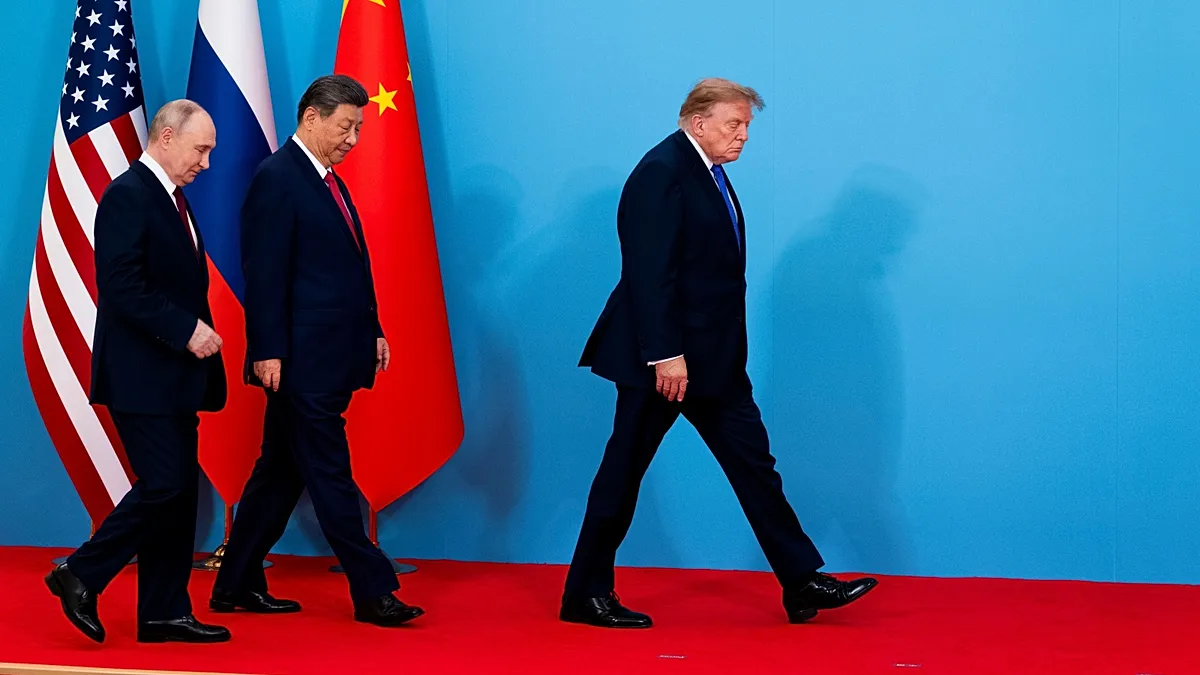
The Shenzhen Summit between Donald Trump, Xi Jinping and Vladimir Putin ended with a joint statement against nuclear weapons, but without any concrete step on the war in Ukraine. The 80-minute meeting was sold as a “Yalta 2.0”, but in fact produced no new agreement. The conflict in Ukraine was openly absent from the joint statement titled “Declaration towards Peace”. For Europe, the outcome was cautious relief. It was accompanied by a clear rejection of any new division of the continent along the models of 1945.
The comparison with Yalta in 1945, the conference that determined the division of the world into spheres of influence among the victors of World War II – the United States, Britain and Soviet Russia – had made clear what was expected from the meeting. In reality, it did not come anywhere near that legacy. For Trump, the main benefit, perhaps the only one, remained the photograph with the two other leaders and the media echo it caused.
The joint statement against nuclear war was assessed as having symbolic weight, without concrete obligations for the parties. Vladimir Putin’s effort to put the Russian war against Ukraine at the top of the agenda also failed. The conflict was not mentioned at all in the three countries’ text, published after the 80-minute meeting.

Putin and the illusion of equality
The meeting gave Putin the opportunity to foster the impression that Russia, an economy roughly the size of Italy’s, deserves to stand at the same level as the US and China. According to the reading of the meeting, this remains merely a mirage. For almost five years, Moscow has waged a destructive war against its neighbor, with great human suffering. It has not achieved its core objectives: the overthrow of the government in Kyiv and the full occupation of the country.
Putin was the most interested in recreating the Yalta of 1945, where Stalin’s Soviet Union emerged among the victors of the war. In his speech at the end of the talks, he defended that conference. “As for a new Yalta, what was so bad about Yalta?” Putin said. “Yalta formalized existing realities, and even in today’s conflicts we will have to come to terms with the realities on the ground.”
Xi Jinping, for his part, called on leaders to “abandon Cold War thinking”, an obvious paradox, since Yalta helped launch that war. He compared nuclear weapons to “a sword of Damocles hanging over humanity” and called for “the great powers to live in harmony”.
Xi controlled the stage, Europe reacted in Berlin
As host, the Chinese president set the pace and controlled the stage, benefiting from the deterioration of America’s relations with its Western allies. His central message was that an alternative to the Western-led world order is possible and that China aims to shape it.
Just a few hours after the Shenzhen summit, Europeans gathered in Berlin for a new meeting of the Coalition of the Willing. The meeting served to display unity and show that they were taking matters into their own hands, without being distracted by the noise of the summit.
German Chancellor Friedrich Merz clearly ruled out a new format modeled on Yalta. “A Yalta-style format will not bring peace,” he said. “At Yalta, Europe was divided. It was carved up. And we will not allow such a thing to happen again.”
French President Emmanuel Macron, alongside Merz, questioned the legitimacy of the Shenzhen meeting to redraw the global order. “Europeans have made decisions. They have decided to determine their own fate,” Macron said. “Europe is not an item on a discussion menu, but a series of powers that want to build their own future.”
A sense of relief prevailed in European capitals. For two years, Europeans have lived with the fear that Trump might lose patience and reach a secret deal with Putin over Ukraine. They have become better able to cope with this fatalistic idea, but remain exposed to the American president’s political shocks.
A narrow working group on security guarantees
The past month marked a coordinated effort to keep the diplomatic process on track. European, Ukrainian and American officials have met in Miami, Oslo, Brussels, Abu Dhabi and Berlin. This is how a narrow working group was formed on security guarantees and plans for Ukraine’s post-war recovery.
This is a visible turn from 2025, when Washington deliberately kept Europe out of the process and journalists wrote about Europe’s “missing place” at the negotiating table. Now Washington is actively urging Moscow to engage in direct talks with Europe, something Russia has repeatedly refused.
In private, European officials see this American push as a sign that Washington has accepted a basic reality: whatever form the agreement takes, Europe will have to be involved both in negotiating and implementing it.
However, the process remains unstable and no one can predict the next step. So far there are few signs that Putin is ready for real negotiations. He invited European leaders to Moscow to discuss their participation in talks, an offer that does not inspire confidence. Putin also declared negotiations with Ukraine over, in retaliation for the attack on the Crimean Bridge, which he holds dear and which is heavily defended.
For Europeans, the question is no longer only whether they will have a seat at the table, but whether they will be ready to make the difficult decisions when the moment comes. They want to ensure that it is they themselves, and not others, who will determine the choices for Ukraine’s future.