







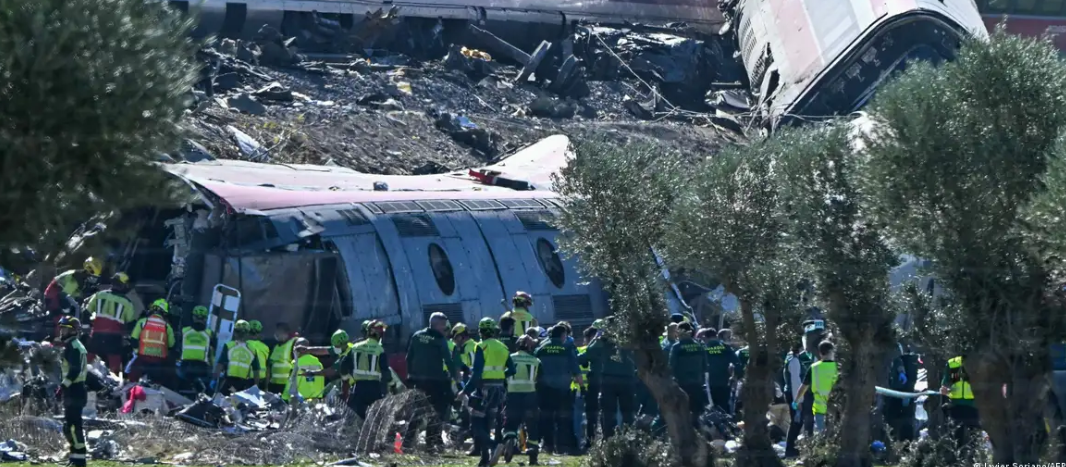
While more than 100 injured people are receiving medical treatment, investigations into the causes of the accident have begun. What is clear is that there was a technical fault at the start of the tragedy.
According to initial information, the automated safety system in the Castile-La Mancha region had gone out of operation. The computer-controlled system determines which trains on the Madrid-Seville high-speed line must stop or reduce speed when the distance between two trains decreases. According to initial investigations, the accident was most likely caused by human error.

Madrid control centre took control of the trains
According to Transport Minister Óscar Puente, the automated system went out of operation at 8:30. As a result, all trains on the 63-kilometre segment of the line were stopped. Afterwards, staff at the control centre in Madrid took over management of traffic.
According to the Spanish newspaper El País, only six minutes later the Madrid control centre gave drivers, in writing and by telephone, instructions to continue their journey at “normal” speed. In fact, regulations in such cases require travel at reduced speed, at 40 kilometres per hour. At this speed there is a chance the train could brake in time.
Only 25 kilometres apart, two trains were on the same railway line: a high-speed train operated by the state company Renfe, with 397 passengers on board, and an Iryo train with 147 passengers. The latter, apparently, had been unable to depart due to technical problems, according to the newspapers El Mundo and El País.
Iryo train staff had informed the control centre by telephone about the technical problems. In addition, according to El País, the screens in the Madrid control centre clearly showed that the Renfe and Iryo trains were on the same line. However, 17 minutes later the Renfe train crashed at high speed into the Iryo train.
Transport Minister Puente speaks of human error. The signal had been set to red, the minister explained. However, an employee of the railway network operator Adif in the control centre had given permission to continue the journey, while the Iryo train was still stopped, Puente said. This is “inexplicable” and a “wrong decision”.
Train drivers’ union: Circumstances “very strange”
Many things remain unclear. The train drivers’ union described the circumstances of the accident as “very strange” in a statement to the newspaper El Mundo.
Apparently, no one in the control centre instructed the driver of the Renfe train to remain stopped. The responsible employee is now represented by a lawyer. It is now being investigated why neither his superior nor his colleague warned of the impending accident.
Another serious accident this year, in January
The accident brings back memories of the serious railway accident that occurred in January this year near Adamuz, in Andalusia. At that time, an Iryo high-speed train derailed and crashed into a Renfe train coming from the opposite direction. 46 people lost their lives in that accident and more than 150 others were injured. A broken rail is suspected as the cause of the accident, which at that time occurred on an open stretch of the railway line./DW/