







Kazakhstan is building Alatau City, a new city near Almaty that aims to bring together digital finance, logistics and new technologies in a single space. The project is a presidential initiative and enjoys national strategic importance status, with state support envisaged in legislation. The city was officially created by presidential decree in January 2024 and will include existing settlements about 47 kilometers north of Almaty.
In May 2026, Kazakhstan adopted a constitutional law establishing the city’s Special Legal Regime. It provides stable tax conditions for ten years, investment incentives and legal mechanisms to protect investors’ capital. President Kassym-Jomart Tokayev has also called for the creation of an Investment Court based on English common law principles, to resolve commercial disputes. The government is expected to submit amendments to the constitutional law by the end of January 2027.
Tokenization and partnership with the exchange
One of the project’s pillars is the tokenized economy, which the authorities want to develop in partnership with KASE, Kazakhstan’s stock exchange, and with the Astana International Financial Centre. The Ministry of Artificial Intelligence and Digital Development sees tokenization as a means to attract investment quickly and easily.

“When we create a platform for tokenization, anyone from any country will be able to register, go through the admission process, undergo KYC checks and so on,” said Nodirbek Nozirkulov, deputy chairman of the Committee for Digital Assets and Innovative Technologies. According to the project description, investors can buy tokens representing a share of a property’s value or an interest in an asset. Tokenization can divide high-value assets, such as real estate and large projects, into smaller digital units.
This could open the way for small investors, although the scope of access, costs and liquidity will depend on how the system is regulated and operates in practice. Blockchain-based tokens can be traded digitally, potentially across borders, without some traditional intermediaries.
Alatau City is positioned as a digital finance hub along the Middle Corridor, where transit volumes rose by 22 percent in the first eight months of the year. The city aims to benefit from existing transport and logistics links in the region. By 2040, plans envisage three million square meters of high-standard warehouses, as well as duty-free storage space.
Testing the low-altitude economy and drones
The city has been conceived to accommodate drones and robots and will serve as a testing ground for the low-altitude economy, enabling companies to develop and test new technologies. “The city’s master plan includes red lines for air corridors, vertiports and drone ports, so this infrastructure is integrated into the city from day one,” said Alisher Abdykadyrov, executive director of the Alatau City Authority.
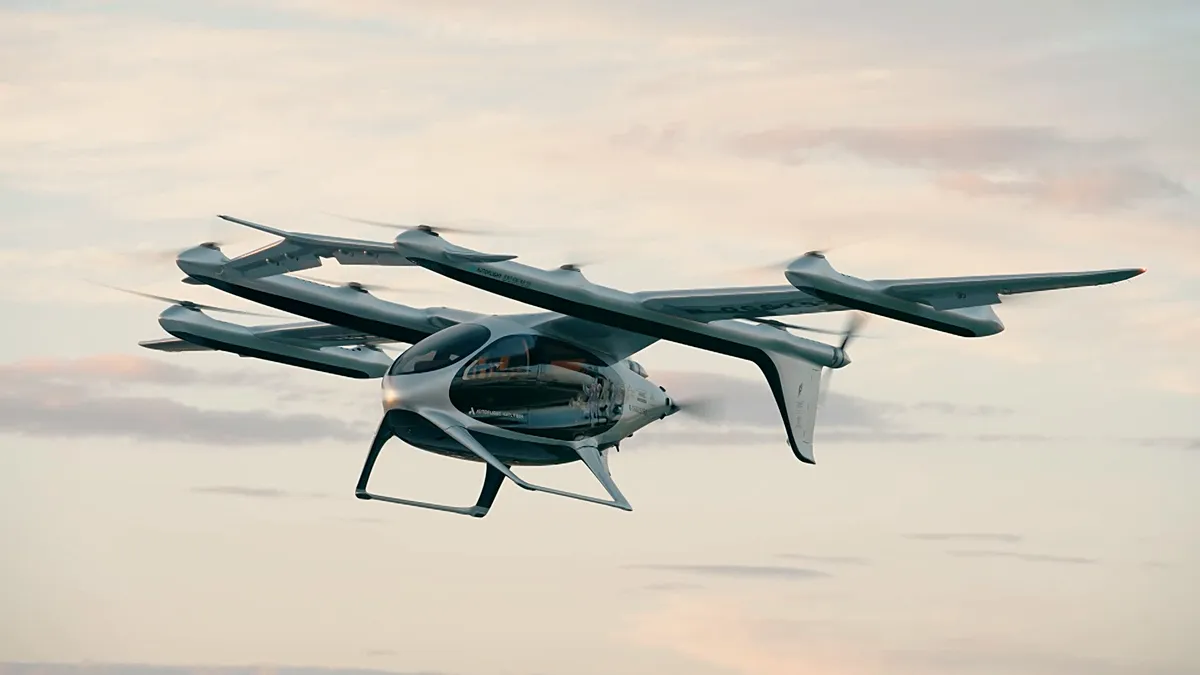
According to him, companies developing these technologies find it difficult to integrate them into existing cities, which were not designed for them. In May 2026, Alatau hosted demonstration flights of a passenger air taxi, a step that could mark the beginning of the urban air mobility industry in the region. The electric aircraft, designed for one pilot and five passengers, is being developed by a group of private companies with local and international participation.
“Our goal is not simply to import technology, but to build an entire industry: infrastructure, engineering expertise and new jobs for Kazakhstan’s professionals,” said Sergey Khegay, founder and executive director of the company. Delivery drones have also been demonstrated in the city. According to an international investment bank, the global urban air mobility market could reach up to 1.3 trillion euros by 2040.
Investment and ambitious targets
Alatau is not being built on empty land. Several industrial zones already operate within its territory, while international companies are active in the area and industrial and logistics projects are under development. This year, 26 infrastructure projects worth around 70 million euros are being implemented. In October, construction began on a multifunctional complex in the business district, with two towers that will house offices, a hotel, shops and public spaces.
The city’s portfolio includes 67 projects in sectors ranging from energy and pharmaceuticals to logistics and digital infrastructure, with an investment target of around 6.2 billion euros. Plans also envisage a campus of a Korean university. The city aims to reach two million residents by 2050. Taking China’s Shenzhen as a benchmark, its development is expected to require up to 90 billion euros in infrastructure investment, including just over 4 billion euros in the next three years.
To attract investors, Alatau is also organizing international tours. During the European tour in Berlin, Frankfurt and London, 27 documents were signed, with an investment potential of nearly 2 billion euros. The parties discussed projects in infrastructure, industrial manufacturing, education, healthcare and the introduction of tokenization mechanisms.
“The most important thing about this tour is not the immediate results. The fact that we have basic agreements and preliminary understandings could increase future investment figures three to five times,” said Kanat Bozumbayev, deputy prime minister of Kazakhstan.
The master plan places artificial intelligence and digital technologies at the center of development. High-speed 5G connectivity is expected to link smart infrastructure elements, from energy meters and automated homes to intelligent transport, parking and surveillance and waste management systems. Between 30 and 40 percent of treated water is expected to be reused for landscaping and industrial purposes.
The energy supply envisages a 250-megawatt gas plant, with the possibility of hydrogen technology in the future, as well as a 100-megawatt solar plant. The master plan also provides for data centers, but “only for the city’s own needs,” according to Abdykadyrov, which are expected to require 50 megawatts of electrical capacity by 2040. For Kazakhstan, Alatau represents an effort to bring together digital finance, logistics and new technologies in one city, with the ambition of turning it into a new hub for international trade and investment.