







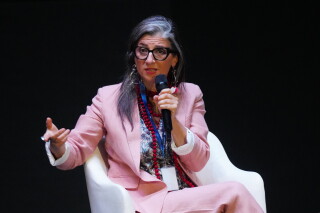
Francesca Albanese, the United Nations special rapporteur for human rights in the Palestinian territories, was stranded at an airport terminal in Costa Rica on Friday after being denied entry to the country. She is awaiting a court decision that will determine whether she can enter the country or must leave. Albanese posted a photo on the X platform showing a suitcase next to a row of empty seats, with the caption: “This is where I will spend my first night in Costa Rica.”
Costa Rican immigration authorities blocked her entry on Thursday, stating that she was the subject of an international “alert” over suspected links to terrorism and that her presence posed a risk to national security. Albanese is a high-profile independent investigator who examines human rights abuses in the Palestinian territories. She is part of a group of experts appointed by the 47-member UN Human Rights Council in Geneva to monitor and report on human rights conditions in specific countries and compliance with specific rights worldwide. She was sanctioned by the United States in July 2025 for her work and harsh criticism of U.S. and Israeli policies during the war in Gaza. Secretary of State Marco Rubio described her work as a “political and economic war campaign against the United States and Israel.”
Albanese had traveled to Costa Rica at the invitation of the University of Costa Rica, which had planned to award her an honorary doctorate. After the entry denial, a habeas corpus petition was filed on her behalf in the Constitutional Chamber of the Supreme Court. The court issued a temporary order allowing her to remain in the country and gave immigration authorities 24 hours to explain the reasons for denying entry. While the petition is pending, Albanese remains in a room at the airport. From there, she joined the university’s honorary doctorate ceremony via video call. One of her assistants, who was allowed to enter the country, accepted the diploma on her behalf.
In her speech, Albanese said the decision to deny her entry could be linked to the sanctions. “I am deeply outraged that the Costa Rican government has spread false information linking me to terrorism. Defending human rights is not terrorism, and the government will answer for these insinuations, as it should in a country governed by the rule of law,” Albanese said. She also criticized what she described as the Costa Rican government’s cooperation in Israeli policies of repression against Palestinians, citing the signing of a free trade agreement with Israel that awaits legislative ratification.
Costa Rica’s right-wing government is among several governments in the region that have sought to align with the Trump administration, accepting deportations from the United States to third countries, a move that provoked sharp criticism, and has built a Bukele-style mega-prison as part of its pledge to fight crime. Costa Rica’s President Laura Fernández has not commented on the matter, but her presidency minister, former President Rodrigo Chaves, addressed the court’s intervention on social media. “Another usurpation by an increasingly arbitrary judiciary, one that usurps the powers of the other two branches of government and now protects foreigners flagged by international alerts for links to TERRORIST ACTS!” Chaves wrote about the habeas corpus petition that halted Albanese’s deportation.
Costa Rica’s Ombudsman’s Office criticized immigration authorities for the “automatic” denial of Albanese’s entry without assessing her case, her official status or her immunity as a UN rapporteur. UN High Commissioner for Human Rights Volker Türk also said he was “deeply concerned” by Costa Rica’s decision to deny her entry.
From AP News