







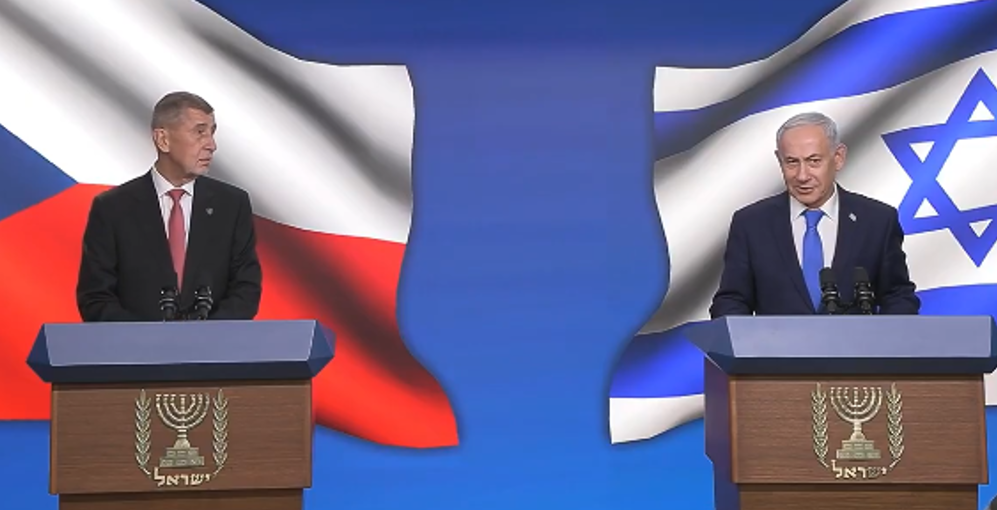
During a meeting with his Czech counterpart, Andrej Babiš, held Tuesday in his office in Jerusalem, Israeli Prime Minister Benjamin Netanyahu presented an assessment of Iran that extends the risk beyond Israel. According to him, Tehran’s military capabilities, terrorist activity and nuclear ambitions pose a threat not only to Israel but also to European countries.
The Iranian threat, he stressed, recognizes no regional borders and directly affects the continent. This is the Iranian threat that Europe must take seriously, added the Israeli prime minister, according to whom the risk extends beyond the borders of the Middle East. “Iran’s missiles do not stop at Israel’s borders, nor does its terrorism, nor its nuclear ambitions.
Europe is not a spectator. Europe is a target,” Netanyahu declared during his speech. He also criticized European leaders who, according to him, have distanced themselves from Israel, and praised the position of the Czech prime minister.

“There are weak leaders who turn their backs on Israel, while you stand tall. You do not follow the crowd, you do not back down in the face of terrorism, you follow your conscience,” Netanyahu said, addressing Babiš. Netanyahu’s statements brought renewed attention to the stance of European countries toward Iran.
The Israeli prime minister presented the Czech Republic as an example of a state that continues to support Israel, in contrast to other European leaders whom he accused of turning their backs on his country. Shortly before the end of the official statements, the Czech prime minister responded to his Israeli counterpart, highlighting security and investment opportunities in his country.
“The Czech Republic is a very safe country,” Babiš declared, while Netanyahu agreed with him. “Very safe. And it is the future of Europe.
You know, many people are moving from Germany to the Czech Republic, to this region. This is the future. The Czech Republic is the best country for investment,” the Czech prime minister said.
Babiš’s visit began with a private meeting with Benjamin Netanyahu, during which the two leaders held bilateral talks. Afterwards, an expanded meeting was held with the participation of government officials from both countries. The talks were attended by the foreign, defense, public health and sports ministers of both states, as well as the head of the National Security Council, the Israeli prime minister’s military secretary and the ambassadors.
The meeting in Jerusalem took place on Tuesday, while Netanyahu’s statements on Europe and Iran were made public during the joint conference with the Czech prime minister.