







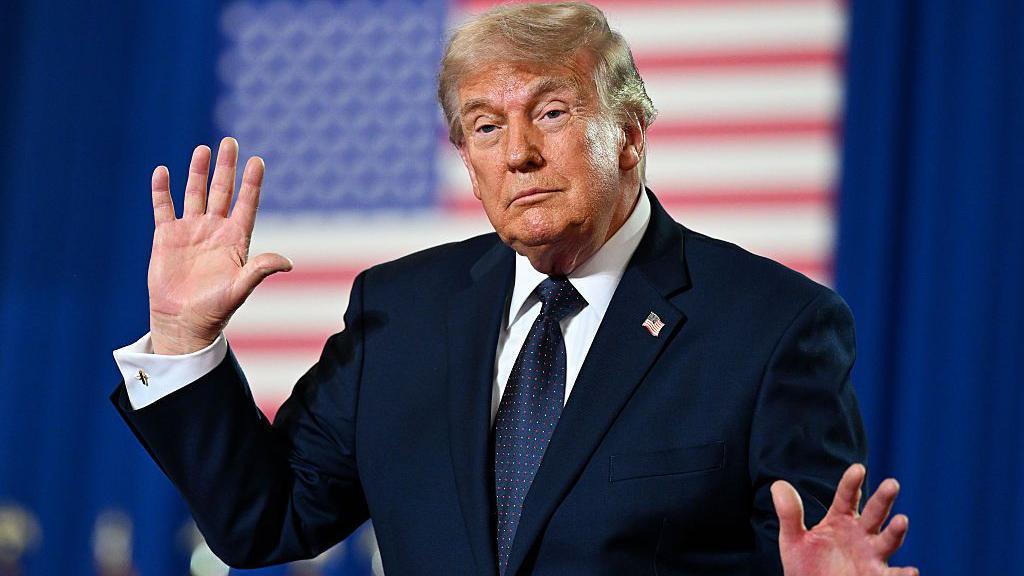
The November 3 elections in the United States could change the balance of power in Washington and affect the remaining two years of Donald Trump’s presidency.
Americans vote tomorrow for the new composition of Congress.
Even though Trump is not on the ballot, the result will be an important test for his presidency and for the possibility of implementing his political agenda.
Republicans aim to retain their majority in both chambers of Congress, while Democrats are trying to take control of at least one of them. This would give Democrats more opportunities to obstruct the president’s legislative initiatives and to exercise oversight of his administration.
The elections are taking place at a time when the cost of living, the state of the economy and immigration are among the main concerns of American voters.
According to a Reuters/Ipsos poll conducted from October 22 to October 26, 53 percent of voters expected to take part in the elections support Democratic candidates, compared with 44 percent who support Republicans.
However, a lead at the national level does not guarantee victory, since the majority in Congress will be determined by the results of individual races.
Interest in the elections has also been reflected in early voting.
According to data from the University of Florida, reported on November 1, more than 54 million Americans have voted before Election Day.
What are Americans voting for?
Midterm elections are held every four years, at the midpoint of the American president’s term.
In these elections, voters do not choose the president, but members of Congress – the institution that passes laws, decides on federal spending and oversees the work of the administration.
Congress consists of two chambers: the House of Representatives and the Senate
In the House of Representatives, where members are elected every two years, all 435 seats are contested.
In the Senate, where members serve six-year terms, 35 of the 100 seats are being voted on this year. Of these, 33 are part of regular elections, while the other two, in Florida and Ohio, are special elections to fill the terms of senators who left office early.
Americans also vote for governors in 36 states and three U.S. territories, as well as for members of state legislatures and other local officials.

What is at stake for Republicans and Democrats?
Republicans currently control both chambers of Congress, giving Trump support to advance his legislative agenda.
In the Senate, Republicans hold 53 seats, Democrats 45, while two independent senators work with the Democrats. To win the majority, Democrats need to gain at least a net of four additional seats.
In the House of Representatives, where 218 seats are needed for a majority when all seats are filled, the Republican lead is narrower.
Among the races that could decide the majority in the Senate are those in Maine, Michigan, North Carolina, Ohio, Texas and Alaska.
Democrats aim to benefit from dissatisfaction with the Trump administration, while Republicans are seeking support for the continuation of the president’s policies.
Why are the midterms considered a test for Trump?
Midterm elections are traditionally seen as a test for the American president, as they give voters the opportunity to express their stance on his policies.
Historically, the president’s party often loses seats in Congress during these elections.
This year, Trump is an important factor in voters’ decisions.
According to a survey by the Pew Research Center, 63 percent of registered voters say the president is a factor in their vote for Congress.
Of all registered voters surveyed, 44 percent say their vote is against Trump, while 19 percent say it is in support of him.
The economy, meanwhile, remains the top concern.
The same survey, conducted from September 28 to October 4, shows that 84 percent of registered voters consider it very important to their vote.
The cost of living, including the prices of food, housing, energy and healthcare, has been at the center of the electoral debate.
Another issue dividing the two parties is immigration.
Republicans support the Trump administration’s tough policies on border control, while Democrats criticize the way they are implemented and their consequences for immigrants.
The war with Iran has also entered the electoral debate, especially due to rising fuel prices and dissatisfaction with how the Trump administration has managed the conflict.
For Trump, the result will be an indicator of support for his presidency, but also a factor that could make it easier or harder to implement policies during the rest of his term.
What happens if Democrats win control of Congress?
If Democrats take the majority in the House of Representatives, they will have more opportunities to block Trump’s legislative initiatives and to exercise oversight of his administration.
They will be able to lead parliamentary committees, launch investigations, request documents and summon officials to testify.
The House of Representatives also has the authority to bring charges against the president under the procedure known as ‘impeachment’. The Senate then decides whether the president should be removed from office, which requires the votes of two-thirds of the senators present.
If Democrats win the majority in the Senate, they will be able to block or delay the confirmation of presidential appointments, including federal judges and senior administration officials.
If the two chambers of Congress are controlled by different parties, passing laws may become more difficult, pushing the White House to seek agreements with the opposition.
Even if Republicans lose control of Congress, Trump will remain president and will continue to exercise his executive powers. However, there will be less room for initiatives that require the approval of lawmakers.
What could change for Europe and Kosovo?
The election result may have an impact beyond the United States, particularly on relations with allies and on security issues.
Congress plays an important role in approving funds for defense and foreign aid.
A change of majority in one or both chambers could affect decisions on support for Ukraine, American commitment to NATO and relations with Europe.
However, the American president retains broad authority in directing foreign policy and commanding the armed forces.
For Kosovo, the importance of these elections is mainly linked to American commitment to security in the region, including the presence of American troops within KFOR, as well as diplomatic support for the Western Balkans.
Congress can influence these issues through funding, legislation and oversight of the administration. However, a change of majority would not automatically mean a change in American policy toward Kosovo.
The concrete impact will depend on the priorities of the Trump administration and the decisions of the new Congress, whose term begins on January 3, 2027./REL