







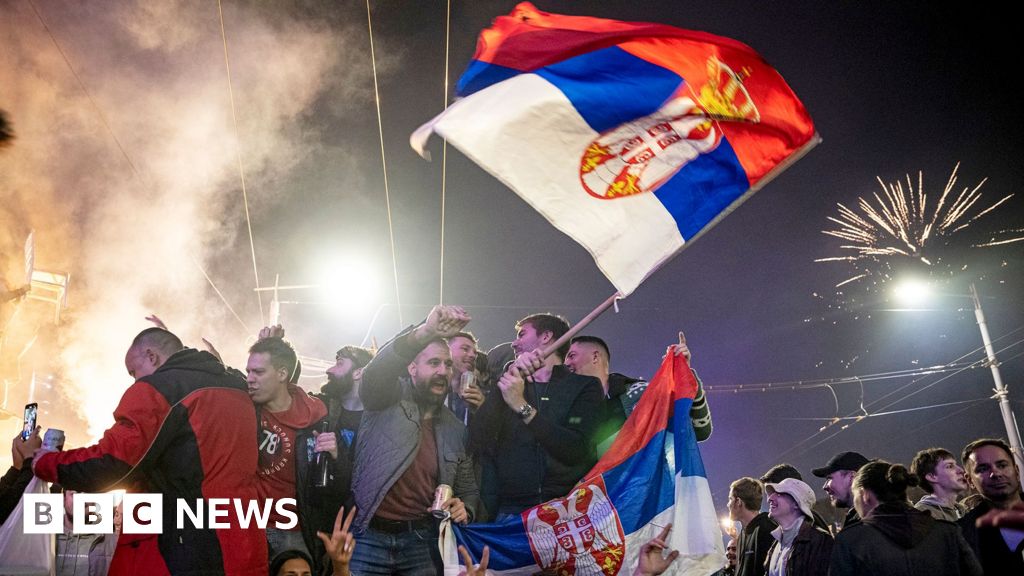
Serbia’s long-time leader Aleksandar Vučić has conceded defeat to a student-led protest movement in snap parliamentary elections. The result prompted mass celebrations in central Belgrade, Novi Sad and other cities.
The student movement, formed less than two years ago, emerged as a reaction to a disaster at the Novi Sad railway station, which was blamed on corruption and negligence. It ran candidates drawn from a wide spectrum of Serbian society. Vučić, the right-wing populist leader, accepted defeat late on Sunday, citing preliminary figures: 2.2 million votes for the students and 1.72 million for his party. According to CeSID, the students won 52.9% of the vote, with turnout at 69.34%, the highest in years.
Vučić, after two terms as president, had aimed to return to the post of prime minister, which he had left in 2017. He called the snap elections after two years of protests triggered by the collapse of a canopy at the Novi Sad station, in which 16 people lost their lives. The main candidate of the “Student List”, Ilija Srdanović, told BBC Serbian that “this will be a free state”, while Radomir Saicic stressed that Serbs had shown that “no obstacle was greater than their will”.

Celebrations on the streets of Belgrade included dancing, chants of “victory”, car horns and fireworks. A student told the BBC that “Serbia is free” and that it was “a miracle”. The student movement, with no visible leaders and members with no political experience, had attracted anti-government voters across Serbia. Its manifesto included purging officials who broke the rules, barring party loyalists from running public enterprises and freeing the public broadcaster from political control. Vučić and the SNS have consistently denied the corruption allegations.
Vučić’s defeat was welcomed by Hungarian Prime Minister Péter Magyar, who said his party’s victory had given strength to Serbian students. European Commissioner for Enlargement Marta Kos said that “a new chapter could begin for Serbia” and that “the door to the EU is open”. On election day, long queues were seen outside polling stations in Serbia and in Serbian communities abroad. The elections were held under high tension, with police having blocked roads around the Republican Electoral Commission in Belgrade. Attention now turns to who will lead the “Student List” as prime minister, while presidential elections are expected in December.
Taken from BBC News