







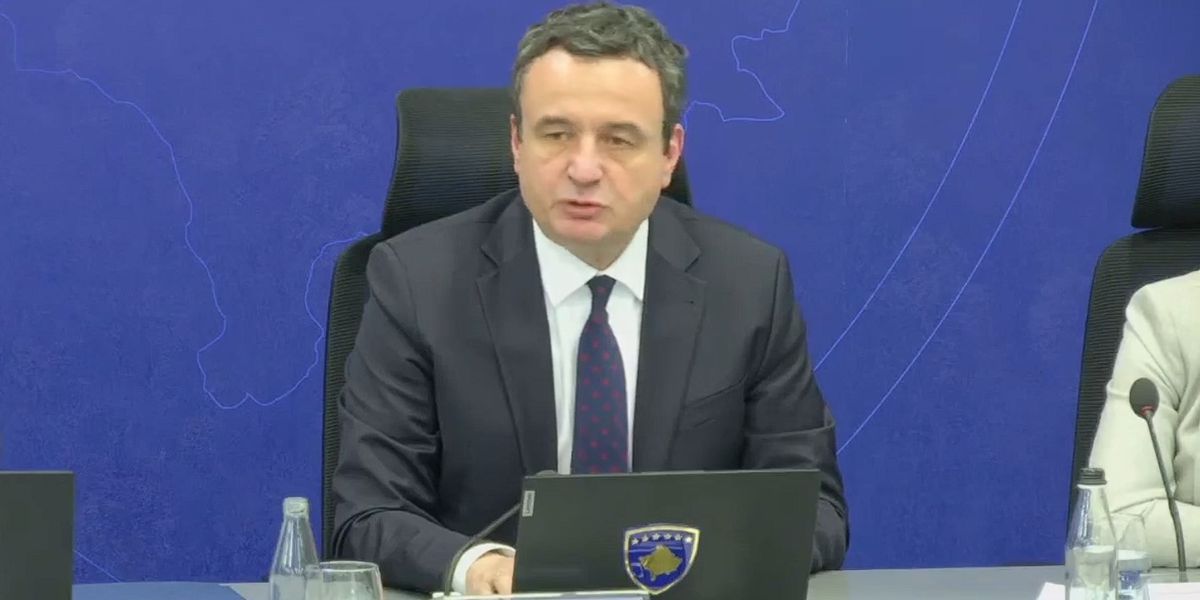
Kosovo’s government on Monday, at its ninth meeting, approved the draft law on budget allocations for the Budget of the Republic of Kosovo for 2027, worth €4.27 billion. After approval by the government, the draft law must be submitted to the Assembly of Kosovo for review and vote.
Prime Minister Albin Kurti said the budget projected for next year is €200 million higher than the revised 2026 budget and €300 million higher than this year’s base budget. According to him, €908 million of the total amount will go as direct financing to Kosovo’s municipalities.
“Of this €908 million budget, the municipalities will receive funds. It is a record budget for the municipalities,” Kurti said, noting that the continuous increase in government grants is behind the growth in financing for local government.

The head of government said Kosovo’s economy grew by 5.4 percent in the first quarter and 4.1 percent in the second quarter of this year. “This places us among the countries with the fastest growth in the region and beyond. This also means continuous budget growth and the sustainability of public finances,” he stated.
Kurti added that the draft budget for 2027 projects that the Kosovo Tax Administration will collect revenues amounting to 60 percent of those to be collected by the Kosovo Customs.
13th salary and coefficient increase from 1 July 2027
Minister of Finance Hekuran Murati said the draft budget provides for a 13th salary for public sector employees, as well as an increase in the salary coefficient. “From 1 July 2027, the salary coefficient for public sector employees will rise from 110 to 120,” Murati said.
According to Kurti, the total budget for salaries will reach €1.085 billion. Divided among some 85,000 public sector employees, this amount yields an average gross annual salary of over €12,000, or over €1,000 gross per month. He stressed that salary growth will not stop here but will continue in the coming years.
The official government announcement stated that from 1 July 2027 the salary coefficient in the public sector will increase, while from 1 January 2027 child allowances will rise by 25 percent.
Kurti said child allowances will increase gradually in four phases, with the aim of doubling them by January 2030. “So, from 1 January 2027, child allowances increase by 25 percent, then again on 1 January 2028 by another 25 percent, in January 2029 another 25 percent, and in January 2030 the gradual increase is completed, resulting in the doubling of child allowances within the mandate,” Kurti stated.
According to the example given, the allowance for one child is currently €30 per month, and with the 25 percent increase from 1 January 2027, it becomes €37.50, or €7.50 more per month. A family with two children that currently receives €60 will receive €75 from January, while a family with four children receiving €180 will receive €225.
Capital investments, support for defence teams and other decisions
Kurti said that for the first time the budget provides over €1 billion in the capital investment category. According to him, this includes the construction of the Outer Ring Road of Pristina, the Duhël–Banullë segment, the Dukagjini highway and many other roads, funding to complete sports infrastructure for the “Pristina 2030” Mediterranean Games, as well as the establishment of a national airline. He also mentioned the construction of dams and investments in tourism.
The Prime Minister announced that the budget also provides for increased support for the defence teams of four former commanders of the Kosovo Liberation Army, in line with the request submitted by the defence teams.
At the government meeting, a decision was approved allocating €300,000 for organising Kosovo’s participation in the World Economic Forum – Davos, with the “Kosova House”, as well as a decision allocating €24,000 to the German-Kosovar Economic Chamber for organising the third German-Kosovar Forum, held from 28 to 30 October 2026.
The government also approved the Nine-Month Financial Report of the Budget of the Republic of Kosovo for 2026, covering the period January–September 2026. According to the report, total revenues reached €2.83277 billion, while total expenditures reached €2.62351 billion.
The meeting also approved the Concept Document on Sign Language in the Republic of Kosovo, as well as the Ministry of Justice’s request for allocating €200,000 for implementing the Agreement with the United Nations bodies, which includes drafting sub-legal acts for establishing the Bureau for the confiscation of unjustified assets. The funds will be taken from subsidy expenditures, the Minister of Finance announced.
Minister of Foreign Affairs and Diaspora Donika Gërvalla said that from the €4.27 billion budget, €52.3 million has been allocated to the Ministry of Justice.
Criticism from the opposition and economic experts
Democratic League of Kosovo MP Hykmete Bajrami criticised the draft budget for 2027, saying that the nominal growth of the budget and of the Gross Domestic Product does not reflect the real economic situation of citizens. She wrote that since 2021 prices have risen by about 34 percent.
“Today, we may receive more euros, but we buy much less than in 2021. Growth in figures on paper does not necessarily mean growth in citizens’ well-being. After all, if there were well-being, some 250,000 citizens would not have left the country since 2021,” she wrote.
Former mayor of Pristina Shpend Ahmeti also criticised the government’s economic policies, saying that the increase in salaries, pensions and child allowances cannot be viewed separately from rising prices and citizens’ difficulties in coping with the cost of living. He raised concerns about the impact of state policies on the country’s economy and pointed out that Kosovo is facing a high level of inflation despite using the euro as its currency.
“It is hard to criticise the increase in salaries, child allowances and pensions. Few people are not happy about this news. But at the same time prices are rising, and coping with the cost of living is becoming harder every day,” Ahmeti wrote.