







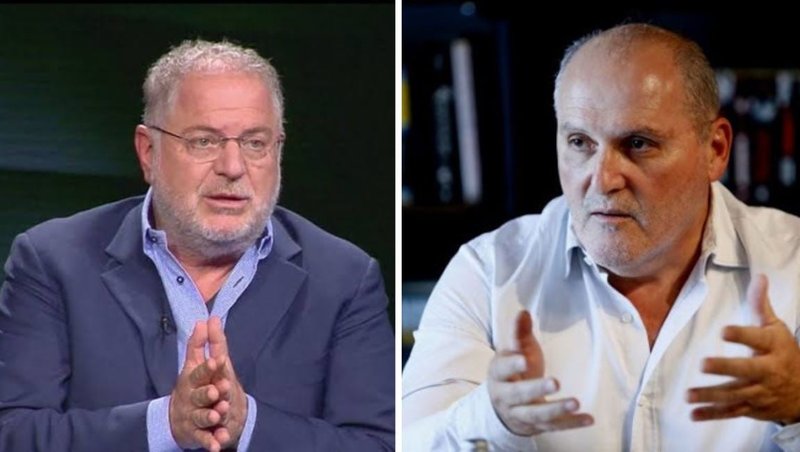
A fierce public debate has erupted between publicist Veton Surroi and analyst Baton Haxhiu, after the publication of a polemical article by Surroi on his website regarding two books by Haxhiu recently published in Tirana by UET Press. At the center of the polemic is a story by Haxhiu, included in the book titled “Kosovo, the History That Undid Yugoslavia,” about an alleged lunch in 1998 at the home of Surroi’s mother, Nahire, where Haxhiu says he saw a large photograph of Tito and had a conversation about it with the late Nahire.
Surroi, in his response, strongly disputes several statements made by Haxhiu on the “Pressing” show on T7 on November 12, stressing that the account of the lunch at his mother’s home, the presence of Tito’s photograph and the conversation with her is a complete fabrication. He categorically denies having accompanied Baton Haxhiu to his mother Nahire’s home, whether in 1998 or on any other occasion, calling this unsurprising given Haxhiu’s public conduct.
On the other side, Baton Haxhiu has reacted by insisting that the lunch happened exactly as he recounted, that Tito’s photograph was on the wall and that the conversation with Surroi’s mother, Mrs. Nahire, took place. He declares that he has nothing to correct in his account and that he will not remove a single dot or comma from the chapter in question, stressing that Veton can deny an event at which he himself was present, but he cannot change what he saw and experienced.

Surroi, in his post, expressed concern that Haxhiu has spoken about deceased members of his family, such as his mother Nahire and his uncle Zenel Kabashi, who cannot respond. He stressed that he cannot quote the words of the dead to Haxhiu or his father. However, Surroi raised accusations against Haxhiu’s father, Fazli Haxhiu, also known as Fazli Qeli, claiming that he was a collaborator of the Security Service designated to cover cultural activities, adding that Haxhiu should be responsible for his own actions and not his father’s.
Beyond this, Surroi has accused Baton Haxhiu that in 1998, when the latter claims to have been at his mother’s home, Haxhiu accepted an invitation to cooperate with Zoran Stijović, a leader in Serbia’s State Security Service for Pristina. The purpose of this cooperation, according to Surroi, was to open a channel of communication between the head of Serbia’s state security, Jovica Stanišić, and Mahmut Bakalli. Surroi claims that Haxhiu, in cooperation with Stijović, coordinated meetings of representatives of Serbia’s state security with Mahmut Bakalli, which were held at Mr. Bakalli’s home in Pristina and at the state security hotel in Brezovica.
Surroi added that during Slobodan Milošević’s trial in The Hague, in Mahmut Bakalli’s testimony and Milošević’s questions, Baton Haxhiu’s role did not turn out to be that of Jovica Stanišić’s interlocutor, as Haxhiu claims in various statements. On the contrary, Surroi emphasizes that during the one-on-one conversation between Stanišić and Bakalli, Haxhiu was on the lower floor together with operatives of Serbia’s state security, casting doubt on his claimed role as an important intermediary.
Another point raised by Surroi is the refusal by Albania’s Ministry of Interior in 2005 to grant citizenship to Baton Haxhiu. Surroi explains that the document on which this decision was based was of a secret nature, implying inappropriate relations with an intelligence service not friendly to Albania. He adds that this refusal by the Ministry of Interior was later overridden by the President’s discretionary right, after a media campaign led by TV Klan, suggesting that the process was not regular.
Surroi also expressed his pride in his maternal family, mentioning his grandfather Xhemal Kabashi, his children and sons-in-law. He emphasizes that throughout the 20th century, these individuals, with different and opposing political convictions, shaped the state of Kosovo. Surroi says he is proud of all of them and of each one individually, emphasizing that his pride does not claim to take credit from them, since it is entirely theirs, countering Haxhiu’s elaborations about his family.
In his reaction, Baton Haxhiu emphasized that Veton’s writings moved faster than his pain, implying that Surroi made logical errors in his writing. He clarified that he read Surroi’s reaction late, because after the book promotion in Tirana and Pristina, he was in Montenegro. Haxhiu repeated unequivocally that the lunch took place, that Veton was there, and that the large photo of Tito was on the wall, and that the conversation with Surroi’s mother, Mrs. Nahire, happened exactly as he recounted in the book. For this reason, he has nothing to correct and will not remove a single period or comma from that chapter.
Baton Haxhiu emphasized that Veton can deny today an event at which he himself was present, calling this his right. However, Haxhiu added that he cannot change what he saw and experienced just because, after so many years, Surroi no longer likes how it looks when put on paper, especially at a time when Yugoslavia no longer exists. He called Surroi’s reaction strange, since he is not disputing an interpretation by Haxhiu, but denying a lunch at which he himself was present.
Regarding Surroi’s accusations against his late father, Haxhiu stated that he will not argue on Instagram, but they will see each other in court. He emphasized that his father was imprisoned in May 1981, at a time when Fadil Hoxha was Kosovo’s main political figure, and that his story does not need the testimony of Veton Surroi or his own, since documents, prison records and witnesses exist. Haxhiu challenged Surroi to bring the documents with him to court, emphasizing that they are worth more than memories, insinuations and social media posts.
Haxhiu expressed his astonishment at what he calls