







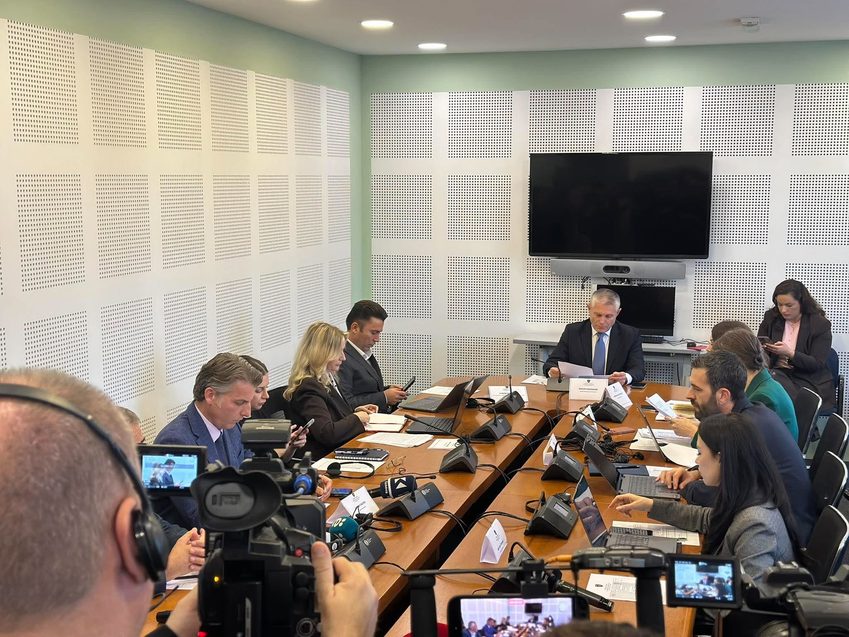
First meeting of the commission
The Parliamentary Inquiry Commission on institutional actions and omissions related to the murder of Arlinda Zekaj and the handling of domestic violence against women and children has been constituted and today holds its first meeting, at 11:30. The Assembly of Kosovo established this commission on 29 October, with 90 votes in favour, after adopting a resolution.
The commission consists of 11 members and has a maximum mandate of six months. Burim Ramadani of the Alliance has been appointed chair, while Adnan Rrustemi of the Vetëvendosje Movement is deputy chair. Other members are Armend Baloku, Arijeta Rexhepi, Osman Musliu and Adelinë Tërshani from VV, Besa Kabashi-Ramaj and Eman Rrahmani from the PDK, Doarsa Kica-Xhelili from the LDK, as well as Jovana Radosavljeviq and Emilija Rexhepi from the communities.
Ramadani: The commission will not produce a political report
The chair of the commission, Burim Ramadani, has publicly pledged that the work will be based on facts and real arguments regarding the murder of Arlinda Zekaj. “We recall that the murder of Arlinda Zekaj is an alarm for all of us, and therefore the aim is for this commission to work on the basis of facts, evidence and concrete responsibilities. This commission is not a farce; it is a commission that will not produce a political report, but will produce a report based on facts,” he said. Ramadani added that he expects the work of the commission not to be politicised.

He announced that the commission includes three phases: the investigation phase, which includes gathering evidence, assessing the findings and preparing the final report. “No woman in Kosovo should be left unprotected after turning to the state for help, and no institution should be above the responsibility it has to protect the life of every citizen of the Republic of Kosovo,” Ramadani said.
Rexhepi: To establish whether there were institutional failures
The Deputy Speaker of the Assembly of Kosovo, Emilia Rexhepi, who is a member of the commission, said that the process aims to establish whether there were obstacles or institutional failures in handling the case. “We will need to confirm all the circumstances that preceded Arlinda’s murder. The number of murders of our women is very high, and this shows that we, as a society as a whole, have problems that we must confront,” she stated. Rexhepi made it clear that the commission will work to analyse how the institutions acted in handling the case.
What is known about the case
Arlinda Zekaj, 49, was killed on 25 October in Vitomirica, Peja. Her former brother-in-law is suspected of the murder and was arrested on 27 October in Deçan. Just three days before the murder, she had sent a letter to institutions warning that her life was in danger.
On 16 October, the Basic Court in Peja had issued a six-month emergency protection order, which allowed Arlinda to use the shared home and granted her temporary custody of her son. On 23 October, a police officer sent an email to the Police leadership requesting additional security measures for her and daily patrol visits. On 25 October, Arlinda Zekaj returned to her home escorted by the Police and was killed shortly afterwards.
Following the murder, protests erupted in several cities across Kosovo as a sign of revolt. 11 police officers have been suspended in connection with the case, while the chief prosecutor and the prosecutor in Peja have also been suspended. The Director General of the Kosovo Police, Gazmend Hoxha, has resigned.