







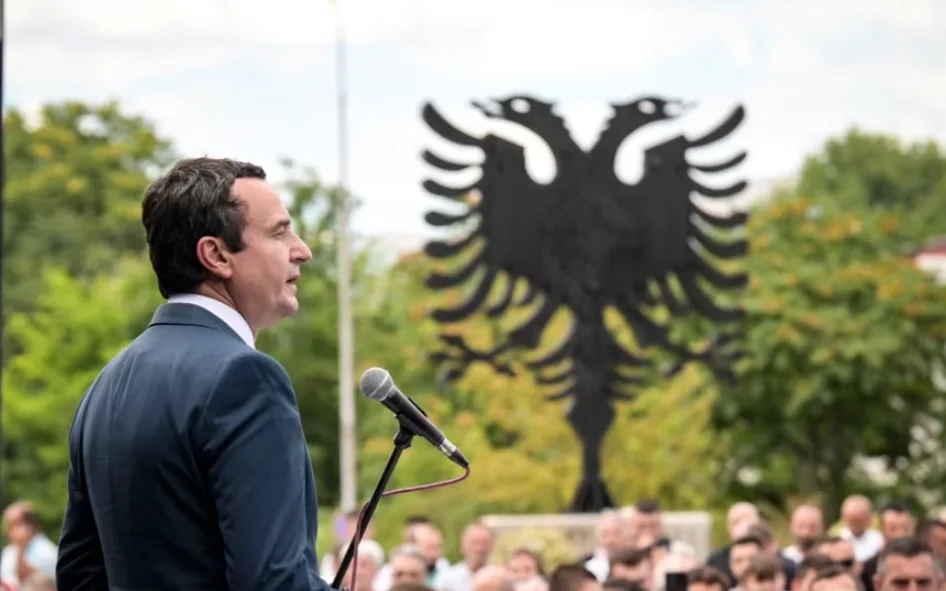
Kosovo Prime Minister Albin Kurti has congratulated 28 November, Flag Day and Independence Day, with a message that puts historical documents and the role of the telegrams that preceded the declaration of independence in 1912 at its center. According to Kurti, these telegrams can be called “little flags of independence”.
He recalled that Albania’s independence, before it appeared as a flag, was a chain of hundreds of telegrams that moved from one city to another and wove its declaration. The congratulatory message of the head of Kosovo’s government focuses on ordinary people, on telegraph operators and citizens who paid for every word sent in favor of independence.
For Kurti, state-building was achieved through perseverance generation after generation, word after word, from father to daughter and from mother to son. He stressed that freedom and independence did not fall from the sky and were not granted by any conference, but were conveyed with perseverance through the fires of countless battles and finally from one telegraph office to another.
According to the Prime Minister of Kosovo, whenever this marked day comes, the same image appears in all our minds: a flag unfurled from the balcony of the house in Vlorë where Ismail Qemali stood with other patriots. But he chose to speak of another image, of the string of telegrams that preceded that moment.
According to the historical data Kurti mentioned, the string begins on 9 November 1912, with thirty-two words from Vienna: “I am arriving on the first steamship. The future of Albania has been secured.” The telegram was sent by Ismail Qemal Vlora and, according to Kurti, lacked an address, but the address was the hearts of all Albanians, of all fallen martyrs and of the living and dead patriots who had worked for this day.
Nine days later, the notables of Vlorë sent the next telegram, of about seventy words, to the mayors of thirty cities, from Ioannina to Shkodra, from Kostur to Peqin: “Call them all. Until I arrive, keep calm and unity.” Under that telegram, Kurti noted, the note of the telegraph office of Elbasan has also been preserved, which received it at 10:40 and forwarded it at 12:15 to Struga, Ohrid, Korçë, Dibër and Manastir.
That same day the telegram went to Tirana, Krujë, Kavajë, Durrës and Shkodra, while to Peqin the next day, at 9:20 in the morning. For Kurti, these are the hours, minutes and seconds when the heartbeat of a state was beginning, synchronized with the beats of the telegraph apparatus. He described this as the entire infrastructure of independence: a copper wire and several people who did not stop passing words along thin paths of wires.
Meanwhile, Ismail Qemali continued his journey. According to Kurti, the telegrams of those days do not contain messages with grand ideas, but speak of carts and horses. He brought the example of Bektash Cakrani, who wrote to Aziz Pasha in Berat that carts were needed for Durrës “because the Vjosa has risen a lot and there is no ford.”
For the Prime Minister of Kosovo, it seems almost unbelievable, but this is how a state was being born, seeking to secure a cart, warning about the swollen river and asking for horses. And none of this happened in calm, he stressed, but within a ring of fire from foreign weapons that had gripped the borders of Albanian lands and were tightening the ring day by day.
Kurti mentioned another telegram, dated 25 November, from Qukës, at 10:25 in the morning, sent by the Serbian commander Simović: “The Muslim and Christian people of Ohrid and Struga have surrendered. Will you surrender or not? Our thirty thousand Serbian soldiers who are in Ohrid have been tasked with pursuing those who do not surrender.
I expect an answer without fail.” According to Kurti, this was the troubled atmosphere of those days, only three days before the raising of the Flag, when the Serbian commander demanded the surrender and submission of a people, while before the Albanians the first rays of Freedom were appearing. He noted that the flag was not raised once, in one place, as someone might think.
Two days earlier Tirana had announced: “today Tirana raised the national flag and declared independence in the name of all Albania.” The next day Durrës, Kavajë, Peqin and Lushnja declared it. Then came the Twenty-Eighth: on the telegraph line between Vlorë and Elbasan, Lef Nosi writes four words: “Raise it as soon as possible.”
Elbasan answers with three: “We are raising it right now.” That afternoon, at four o’clock, in Xhemil Bey’s house, forty men who had come on horseback, by steamship and on foot from Berat, Dibër, Ohrid, Gjirokastër, Peja, Gjakova and Durrës decided “with one voice” that Albania “from today shall become independent, free and sovereign.”
That same day, Luigj Gurakuqi wrote a telegram of about seventy words and sent it to fifteen European newspapers, among them Corriere della Sera, Le Temps, The Times and Neue Freie Presse: “The National Assembly… declared the Independence of Albania.” Kurti acknowledged that that day is remembered as the work of great men and women and that it undoubtedly was such.
But when the documents are read one by one, according to him, something else is also seen: a telegraph operator in Fier who counts eighteen words to say that Ismail Qemali arrived safe and sound, and the headman of a neighborhood in Ohrid who signed on behalf of all the neighborhoods. He also brought attention to the people who paid for every word and still spent them to say yes to independence.
According to the Prime Minister of Kosovo, the Flag was raised again after 469 years, again on 28 November, over a building in Vlorë, just as it had once been raised in Skanderbeg’s Krujë Castle. His message ends with the greeting “Congratulations!”.