







Three days before Arlinda Zekaja was killed, the custodial prosecutor had assessed that returning to the shared home with her ex-husband could endanger her life. This was announced by the Basic Prosecution in Peja on October 26.
According to it, the prosecutor and investigators had planned for a police patrol to remain near the house during Zekaj’s return.
Zekaj is suspected of having been killed by her brother-in-law on October 25, with blows from a heavy object. According to the Prosecution, she had just returned home escorted by police.

She had returned home after reporting domestic violence, when her ex-husband was arrested and detained.
On October 22, Zekaj had complained to the Chief Prosecutor of Peja, Lumturije Vuçetaj, about failures in handling her cases. She had also requested the enforcement of a court decision on the use of the shared home with her ex-husband, A2 reports.
A day later, the Prosecution had filed an indictment against her ex-husband for threats in a family relationship.
Following the killing, the Chief State Prosecutor requested on Monday a detailed report and analysis of the case. He asked for clarification as to “whether there were omissions and institutional or individual responsibility”.
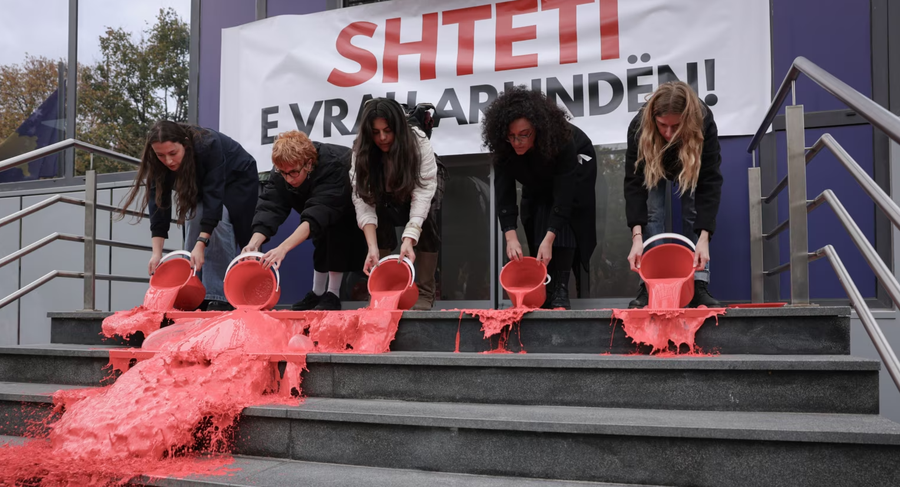
The Center for Information, Criticism and Action QIKA carried out a symbolic action by pouring red paint on the steps near the Government building in the capital, and hanging a banner reading “The state killed Arlinda” on the building’s gate.
At the request of the ruling party, the Vetëvendosje Movement, an extraordinary session of the Assembly regarding this killing is expected to be held today at 16:00.
How was Arlinda Zekaj killed?
Zekaj is suspected of having been killed by her brother-in-law in Vitomirica, Peja, on October 25, at around 21:00. Earlier that evening, Zekaj had reported domestic violence. According to the Prosecution, her ex-husband, J.S., had been detained for 48 hours. A procedure for contempt of court had been initiated against him.
Meanwhile, Zekaj had returned to the shared home with her ex-husband, as the Police said, “of her own will”.
Shortly afterwards, Zekaj was found dead from blows with a heavy object.
The latest statement from the Peja Prosecution does not clarify whether police had remained near the house after her return that evening. The suspect in the killing, her brother-in-law A.S., is still at large.
According to the Prosecution, Zekaj had been offered the possibility of going to a shelter, but she had refused, insisting on returning to the shared home, where her son and her property were.
During the day, the Chief State Prosecutor in Kosovo requested a detailed report and analysis to see “whether there were omissions and institutional or individual responsibility” in the handling of the case.
President of Kosovo Vjosa Osmani-Sadriu… Justina Shiroka Pula, also reacted to the killing, calling for “an urgent, complete and impartial investigation into the murder”.
“It must be clarified whether all necessary measures were taken to assess the risk and protect her,” she said.
At least 67 women have been killed in Kosovo since 2010. In most cases, the perpetrators were husbands or partners.
Victim had reported institutional failures three days before killing
Arlinda Zekaj had requested urgent action from officials of the responsible institutions three days before she was killed.
The Basic Prosecution Office in Peja announced on 26 October that Chief Prosecutor Lumturije Vuçetaj had received a request from the victim on 22 October, alleging failures in the handling of her cases, including the enforcement of a court decision.
According to the Prosecution Office, the Court had ordered on 16 October that Zekaj’s former husband allow her to return and use the shared home. A six-month protection order had also been issued, which took effect immediately.
According to the announcement, enforcement of the order and notifying the Court of any possible obstacles were the responsibility of the Police.
The Prosecution Office said that when Zekaj requested to return home, the case prosecutor assessed that an immediate return could pose a risk to her life and safety. He contacted the victim’s brothers and instructed that she stay with them.
After discussions, according to the Prosecution Office, Zekaj agreed to go to her relatives but asked that a police patrol escort her home the following day.
The prosecutor and investigators decided that during the planned return, a patrol would remain near the house. According to the announcement, these actions were documented in a record dated 22 October, for which the judge in the case was also asked to be notified.
The Prosecution Office also made known that on 23 October it had filed an indictment against Zekaj’s former husband for threats within the family relationship.
The announcement does not clarify whether police remained near the house after the victim’s return on 25 October.
Regarding Zekaj’s claims of institutional failures, the Prosecution Office said the chief prosecutor had initiated a case to investigate whether the actions or omissions of officials contained elements of the criminal offence of abuse of official position or authority.
Her request was also forwarded for urgent handling to the Police, the Basic Court in Peja, social welfare institutions and the Office for Victim Protection and Assistance.
Meanwhile, the Chief State Prosecutor authorized the national coordinator for domestic violence cases to analyze all actions taken in handling the cases in which Zekaj had been a victim.
Chief Prosecutor of Peja Lumturije Vuçetaj has been asked for a detailed report on the chronology of the cases, the prosecutors who handled them, the decisions and actions taken, including the handling of the 22 October request.
The Kosovo Police Inspectorate has been asked to investigate and verify how the police handled Zekaj’s reports.
Kosovo changed its legislation in 2023 to give priority to the investigation and trial of domestic violence cases, while in December 2024 it launched an electronic monitoring system that also aims to protect victims.
However, representatives of organizations for justice and women’s rights told REL in August that monitoring of reported cases, response to risk and implementation of protective measures remain challenges.
They also called for institutional accountability in cases where women are killed after seeking help./REL/