







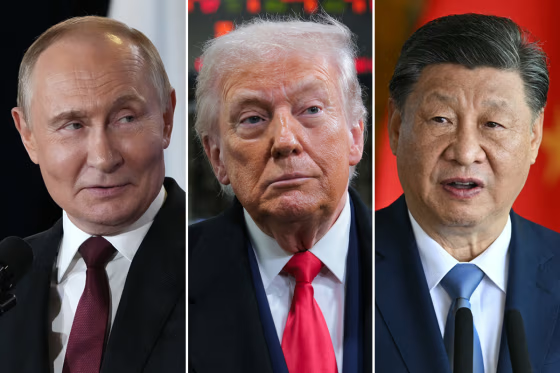
Beijing — China’s Foreign Ministry said Monday that this week’s trilateral meeting among Chinese, American and Russian leaders is of “crucial importance” and will promote world peace and stability. The meeting, to be held Thursday in the southern Chinese city of Shenzhen, where the APEC summit is also being held, will bring together Chinese President Xi Jinping, President Donald Trump and Russian President Vladimir Putin.
According to the White House, President Trump will raise the issue of efforts to reduce nuclear weapons during the meeting. China has previously refused nuclear weapons talks with Russia and the United States, which possess the largest stockpiles of these weapons. Chinese Foreign Ministry spokesperson Mao Ning told reporters in Beijing that this would be the first face-to-face meeting among the heads of state of China, Russia and the United States.
Mao Ning stressed that the leaders will exchange in-depth views on safeguarding world peace and promoting strategic stability in relations among major powers, describing this as an event of “crucial importance.” She added that under current circumstances, all three countries bear an important responsibility to cooperate in addressing global challenges and promoting peace and stability. Stronger communication among China, Russia and the United States, together with managing differences and stabilizing relations, serves the interests of all three countries and meets the expectations of the international community, helping to stabilize the global situation and advance dialogue and cooperation.

However, Mao Ning did not provide specific details on the exact agenda of the trilateral meeting. Meanwhile, speaking in Manila on Monday, UN chief Antonio Guterres said the United Nations is ready to support any denuclearization efforts that may emerge from the three-country summit. China has argued that it is more appropriate for Russia and the US to talk directly because of their large arsenals. The UN has long advocated nuclear disarmament, warning that rising geopolitical tensions and rivalry among major powers have increased global nuclear risks.
Source: NBC News