







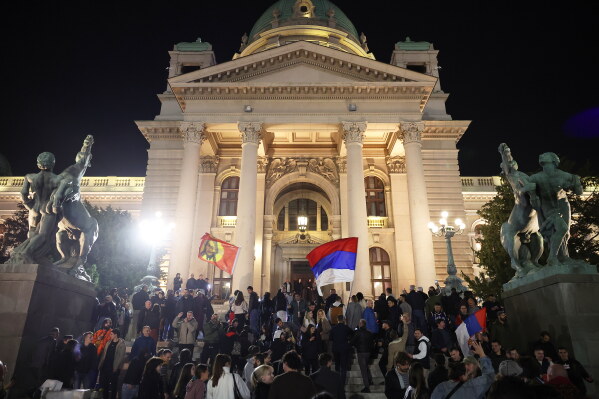
BELGRADE, Serbia (AP) — A new youth-led movement that won Serbia’s elections last month will take its parliamentary seats this week, with a chance to deliver a promised overhaul of the system. They will face the deep legacy of a party founded and long in power. The “Student List” group defeated former leader Aleksandar Vučić’s right-wing Serbian Progressive Party on October 25 in snap parliamentary elections that followed two years of anti-corruption protests. The inaugural session of parliament on Tuesday marks the first step toward forming their future government.
The students have promised to restore democracy and the rule of law, and to dismantle deeply rooted corruption, clientelism and suspected links to organized crime that, according to them, flourished under Vučić. Observers say they will have a difficult job that leaves little room for mistakes. Zarko Korac, former deputy prime minister in Serbia’s first democratic government after the fall of Slobodan Milosevic in 2000, said he does not envy them, because the new authorities “will face major problems.” He hopes they will succeed, because otherwise “it will be bad for all of us.”
The “Student List” group will have 140 lawmakers in the 250-member parliament. They are mostly professors and experts with respectable careers but little or no political experience. Korac believes the lack of experience could be both an “advantage and a disadvantage” in reforming the state administration, the security system and public companies, which are highly politicized. He stressed that the new authorities will have to “enter every institution, one after another, and make the changes.” At Tuesday’s session, lawmakers will elect the parliament speaker and his deputies, as well as various bodies. A new government must be voted in within 90 days.

Vučić will be one of 103 opposition lawmakers from his SNS party, who are experienced in parliamentary battles. The SNS is known for harsh language, although Vučić promised “dignified and civilized” behavior. Student representatives have already made their first international contacts, meeting with EU officials, U.S. Assistant Secretary of State Brendan Hanrahan, and Russian Ambassador to Serbia Alexander Botsan-Kharchenko. Serbia’s next government is not expected to immediately address key foreign relations, as the country seeks EU membership but has not joined sanctions against Moscow and depends on Russia for energy. Vučić also developed close ties with China.
EU Enlargement Commissioner Marta Kos stated readiness to help the new government with rule-of-law reforms. U.S. Assistant Secretary of State Hanrahan stressed readiness to work with Serbia toward shared goals, including regional security and economic cooperation. The U.S. Bureau of International Narcotics and Law Enforcement Affairs (INL) also stressed that the students’ efforts to fight organized crime complement its work in Serbia.
Korac, whose government after Milosevic inherited a devastated country, said the systems had been formed to suit those in power. He called for the dissolution of the state intelligence agency (BIA), accused of surveilling Vučić’s critics. The BIA denied the accusations as “absurd.” Among those suspected of being monitored were the rector of the University of Belgrade, students, opposition politicians and journalists. A wave of arrests after the elections included officials and a bank owner. Vučić has accused the students of “revolutionary terror,” suggesting his party might not take part in presidential elections. Korac predicted the rhetoric would continue, hoping the new authorities would have “strong nerves” and preserve the strength shown during the protests.
Taken from AP News