







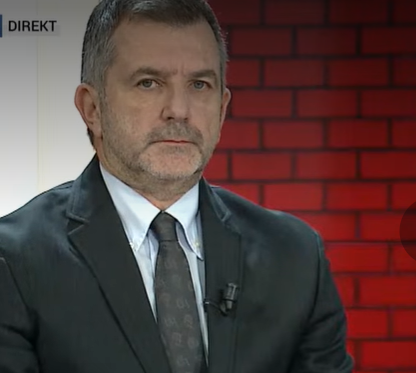
Guest on the show ‘Çim Peka Live’ on Syri TV, analyst Andi Bushati declared that Edi Rama’s clashes with Erion Veliaj, Elisa Spiropali and other figures within the Socialist Party demonstrate the prime minister’s autocratic nature, as he accepts no opposition to his power.
Bushati stressed that Rama is sending a clear signal to all those who dare to oppose him, while the rejection of Veliaj’s requests for a motion within the PS and an investigative committee shows that the prime minister treats his own people the same way as the opposition.
The analyst said that the clashes within the majority have highlighted that the problem is not with the Democratic Party or political opponents, but with Rama himself, whom he described as an autocrat who does not recognize the rules of democratic play.
Excerpts from the interview:
Andi Bushati: Of course it is this latest one, so it is a signal that anyone who dares to oppose me, whether in words or actions, will have the same fate. But here I think the question is not what frightened Rama. Here is the same Rama we have known for 13 years, but seen from different angles. So it depends on where you put the camera to see the same character. In what sense? If you look at two things from Erion Veliaj. What is Erion Veliaj asking of Rama? I believe we do not have a very positive opinion of Erion Veliaj, including a large part of us here. But what is Erion Veliaj asking for? One, he asked for a motion within the party, politically, and personally he asked for an investigative committee to look into his persecution in prison. And here Erion Veliaj serves us only for one thing: to see how open Rama is and how well he knows the rules of the game. Because if you look at what Erion Veliaj has asked for, they are the same things the opposition has been asking for for 10 years.
What is the opposition asking for? Committees and motions in parliament that Rama ignores. But when the PD, Berisha, others were asking for them, it looked like an opposition-government fight. Meanwhile, now a man within the party, his “dolphin,” is asking for them, and again Rama has the same behavior. And what does this show us? This shows us that his clash with the opposition was not about the opposition being at fault or Rama being right. Rama behaves the same way toward the rules of the game, whether it is a member of his own family asking or his political opponents asking.
Because the essence of the character is the essence of an anti-democratic character, the essence of an autocratic character. And in this sense Veliaj’s requests have value, because Veliaj’s requests being rejected today illuminate for us why the opposition’s requests were not accepted yesterday by the same autocratic man who does not recognize any rule of democratic play. And from this point of view this is the good thing about what has happened in the last six or seven months. Because for 13 years, since Rama sat in the prime minister’s chair, we have had a match: the match of the head of government with the opposition, and here people were divided, are you with the government or are you with the opposition. Now Rama, in addition to the cameras and the focus that the traditional opposition has put on him for 13 years, is also seen from two other angles: from the angle of the protest, where he has again shown himself to be thuggish, violent, with his ears closed, unresponsive, but also from the angle of his political family.

So, maybe in one case the PD is to blame, but the PD, your political family, and the citizens cannot all be to blame. When from all three cameras you appear to be the same, the essence of the evil lies with you and not with others. In this sense, it is interesting for us who are not members of the Socialist Party to see Rama’s quarrel with Veliaj, with Elisa, with Ndreca and others, to see from another angle that we are dealing with the same autocrat as the opposition has shown us here for ten years.