







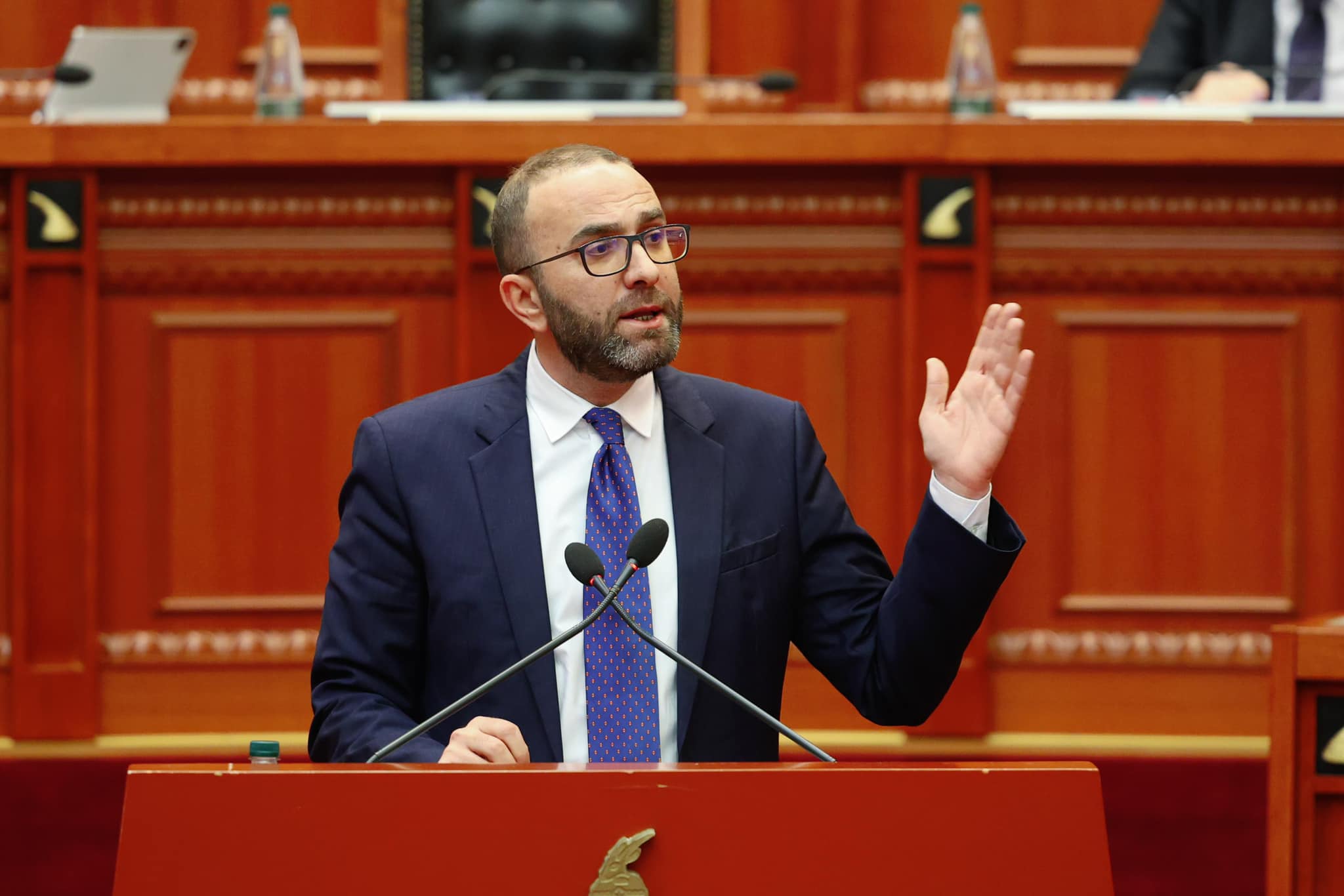
Head of the Democratic Party parliamentary group Gazment Bardhi has reacted to the latest developments in the Belinda Balluku case, accusing Prime Minister Edi Rama of political interference in justice and SPAK of applying double standards.
In a public statement, Bardhi claims that sending Balluku’s file to court, without a new request to Parliament for authorization to arrest her, shows that the special prosecution body was influenced by the decision-making of the parliamentary majority. “Edi Rama decides who is arrested and who is not. This is more than a double standard! It is a surrender of justice to corruption,” Bardhi says.
According to the head of the Democratic parliamentary group, SPAK has submitted new charges and evidence in the file against Balluku, among which he mentions two villas worth 1.8 million euros. Bardhi also claims that investigations into the Llogara tunnel tender have identified damage of about 60 million euros.
Full post
BELINDA BALLUKU, EDI RAMA’S TWO-STANDARD JUSTICE!
The sending of Belinda Balluku’s file to court today confirmed an important truth: Corruption is directed from the top of government. Belinda Balluku is the official with the most serious charges since SPAK was established: corruption, money laundering, concealment of assets and inequality in tenders, 15 crimes. For the Llogara tender alone, SPAK says the damage (theft) is about 60 million euros and that only two of the villas documented so far as part of her corruption cost 1.8 million euros. However, SPAK chose political bargains with Edi Rama over the fundamental principle of a democratic state: equality before the law. SPAK sent the file to court with 4 new charges and new evidence, including the two hidden villas worth 1.8 million euros, but did not bring a new request to Parliament to lift her immunity for her arrest, submitting to the corrupt and anti-democratic will of Edi Rama and Belinda Balluku.

Klodian Braho admitted today that in order to make such a decision SPAK relied on the reasoning of the parliamentary majority, when this majority, under Edi Rama’s leadership and with Belinda Balluku holding it hostage, rejected SPAK’s request to lift her immunity and arrest her. This means neither more nor less than that Edi Rama decides SPAK’s criminal policy. Through decisions in Parliament and their implementation by SPAK, Edi Rama decides who is arrested and who is not. This is more than a double standard! It is even more than a violation of equality before the law. It is a surrender of justice to corruption and a sharing of corrupt power with Edi Rama and Belinda Balluku.
The Constitution clearly states that Parliament is not the prosecutor and Edi Rama is not the head of SPAK! The political decision of the majority cannot dictate the investigations and decision-making of an independent judicial institution, always, if justice puts the law before political interest. The Belinda Balluku case has undone a 10-year investment by Western partners and has branded SPAK as an institution dependent on Edi Rama, because, for the same file, justice cannot have one standard for Evis Berberi and another for Belinda Balluku. At a minimum, this means that the investigations into Belinda Balluku are incomplete.
When Parliament sets the limits of an investigation, the independence of justice is violated! At the moment when Parliament sets for SPAK the standard and limits of law enforcement and prosecutors accept this as normality, the principle of separation and balance of powers suffers a severe blow. If the prosecution conditions its activity on the will of the parliamentary majority, then a serious problem arises for its independence and for citizens’ trust in justice.
Failure to lift Belinda Balluku’s immunity has prevented SPAK from using all the procedural means necessary for a full and comprehensive investigation. This raises a fundamental question: was the same investigative standard applied to all defendants? If the evidence was obtained mainly through the personal search of the defendant Evis Berberi, why was Belinda Balluku not subjected to the same procedural measure? If the investigation data was obtained through the search of Evis Berberi’s home, why was the application of the same standard not sought for Belinda Balluku’s home?
These are not secondary questions. They are fundamental questions about equality before the law, the impartiality of the investigation and the credibility of SPAK itself. The answer sought is clear: why was the same procedural standard not followed for both defendants? Why did SPAK not again request from Parliament authorization to lift Belinda Balluku’s immunity, so that the investigation could continue with all the procedural means provided by law? When an investigation is limited by political obstacles and the prosecution body does not take all institutional steps to overcome them, the public has the right to demand explanations. The independence of justice is not proven by statements, but by concrete decisions and actions, especially when people with political power stand before the law.
And there is another issue on which SPAK must give a clear and public answer: Has the box with bundles of euros been found at Belinda Balluku’s holiday villa? If not, has her residence been searched to verify whether the money could have been moved there? These are questions that cannot remain unanswered. If this is money suspected to originate from corruption or from abuse of public funds, the obligation of the institutions is to investigate its origin, identify those responsible and, if illegality is proven, ensure its confiscation and return in the interest of Albanian citizens. The law cannot be strict for those who have no power and negotiable for those who exercise it. Immunity cannot be turned into a shield from investigation, and the independence of SPAK cannot depend on the will of the parliamentary majority. Albanians are not asking for selective justice. They are asking for the law to be applied equally to everyone. No exceptions, no double standards and no political shields.