







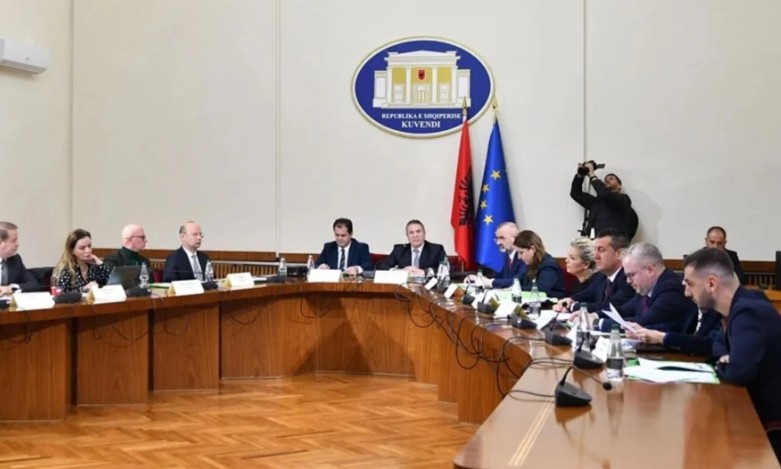
Two days before the end of the Electoral Reform Committee’s mandate, the Democratic Party has officially approached the Parliament to request an extension of the deadline by 2 to 3 months.
In the letter addressed to the Speaker of the Parliament, Niko Peleshi, the committee’s Democratic co-chair, Oerd Bylykbashi, argues that the work has not progressed at the pace needed to fulfill the tasks within the deadline expiring on 30 November.
One of the reasons the DP gives for the extension is that a considerable portion of OSCE/ODIHR recommendations remain unaddressed or not reflected in legislation.
Excerpts from the letter
The Parliament, with the aim of achieving a comprehensive and inclusive electoral reform, by Decision No. 74/2025, dated 27.10.2025, approved the establishment of the Special Parliamentary Committee for the Implementation of Electoral Reform, with equal representation of the parliamentary majority and minority.
The current term of this Committee’s activity ends on 30 November 2026.
Despite the work carried out to date, the discussions, consultations and engagement of technical experts, the Committee’s activity has not advanced at the pace needed to fully meet the objectives and tasks set by the Parliament.
Currently, the Group of Technical Experts is at an important stage of work in drafting and finalizing several draft laws, some of which have already been submitted to the Committee. These draft laws aim not only at amendments to the Electoral Code, but also at interventions in the Criminal Code, improvement of the legal framework for political party financing, as well as other legislation directly or indirectly related to the electoral process.
The review of these draft laws, discussion at technical and political level, consultation with stakeholders and reaching agreement between the parties require additional time.
At the same time, a considerable portion of the OSCE/ODIHR recommendations identified in the reports on the local elections of 14 May 2023, the parliamentary elections of 11 May 2025 and previous electoral processes remain unaddressed or not reflected in the relevant legislation. The same need for review and reflection also applies to the recommendations of the Council of Europe and to the technical assistance of the Venice Commission and other international partners.
In this regard, we appreciate the continued readiness of OSCE/ODIHR, the European Union, the Council of Europe and other international partners to assist the Parliament of Albania in carrying out electoral reform, including the engagement and presence of international experts in Albania during these days.
Ending the Committee’s mandate at this stage of work would risk leaving an important part of the legislative process unfinished and would not allow full use of international technical assistance.
Extending the Committee’s term of activity would make it possible to:
Complete the drafting, review and discussion of the draft laws prepared by the technical experts;
Fully address and respond to the recommendations of OSCE/ODIHR and the Council of Europe;
Improve the legal framework for preventing and combating electoral crimes, political party financing and misuse of state resources in elections;
Continue consultations and cooperation with experts and international partners;
Create the necessary time for discussion and reaching political agreement on the fundamental issues of electoral reform.
For the foregoing, in my capacity as co-chair of the Special Parliamentary Committee for the Implementation of Electoral Reform, on behalf of the Democratic Party and the opposition representatives on this Committee, I request the extension of the Committee’s term of activity for an additional period of about 2-3 months.
This extension is considered necessary to enable the fulfillment of the mandate entrusted by the Parliament, the addressing of international recommendations and the realization of a comprehensive, inclusive electoral reform in line with international standards for free and fair elections.