







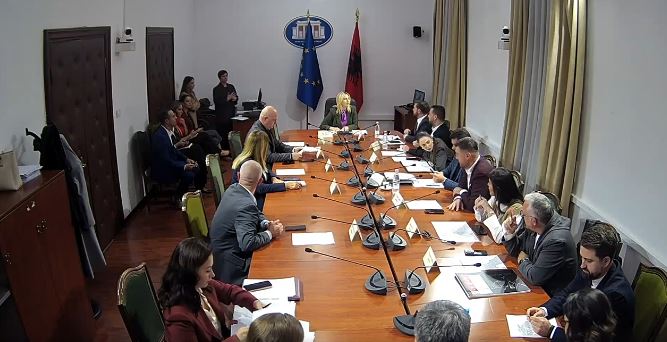
A heated debate between the Minister of Culture, Blendi Gonxhja, and Democratic Party MP Ina Zhupa took place in the Committee on Culture, focusing on the blocking of roads in Tirana during protests. Gonxhja objected to small groups of protesters obstructing traffic on the capital’s main arteries, suggesting that gatherings be moved to “Skanderbeg” Square, which, in his view, provides the space needed to protest without disrupting citizens’ daily lives.
“For a number like the one we have seen in recent days, I would like to recall that in Tirana we have a main square called Skanderbeg Square, a pedestrian square that allows for gatherings, celebrations, activities, protests, and can accommodate an endless number of people,” the minister said. He stressed that protests should not become an obstacle for the rest of the citizens, adding: “The daily life of all other citizens cannot be held hostage because 10-50 people want to block the city’s main roads.”
However, the minister’s proposal was rejected by Democratic MP Ina Zhupa, who argued that protests are an expression of civic outrage and cannot be determined by the government, either in terms of location or timing. “A protest is not a party with invitations where you organize the day and place yourself. That’s how the Socialist Party holds its parties. This is civic outrage,” Zhupa replied, further mocking the minister’s suggestion: “No, let them go to Vorë, to Kanye West’s stadium.”
The Democratic MP insisted that citizens have the right to protest near the institutions of power and that the boulevard cannot be excluded from protest spaces. “The boulevard belongs to Albanian citizens and it belongs to the protest. No permission is needed. In every country in the world, people protest where the seats of power are,” she said. The clash between them later shifted to the protests of the 1990s, when Gonxhja recalled his involvement during a period when, according to him, fundamental rights were lacking.

“I protested when fundamental rights were absent,” the minister said. This statement prompted an immediate reaction from Zhupa, who challenged him by asking whether, even at that time, he had been told where to protest. “Were you told back then to go protest here or there, or did you protest wherever you pleased? You toppled the statue?” she asked.
Gonxhja disputed the comparison of the current situation with that of the 1990s, arguing that the political and social circumstances are different. “Are you comparing the eras of those protests? ’90, ’94, ’96, ’98? Can we speak of the same context today? We fought when there was no vote. Today the vote is right there.” he stated. Finally, the minister also raised the issue of young people’s participation in the recent protests, claiming that some of them have not voted and do not want to vote.