







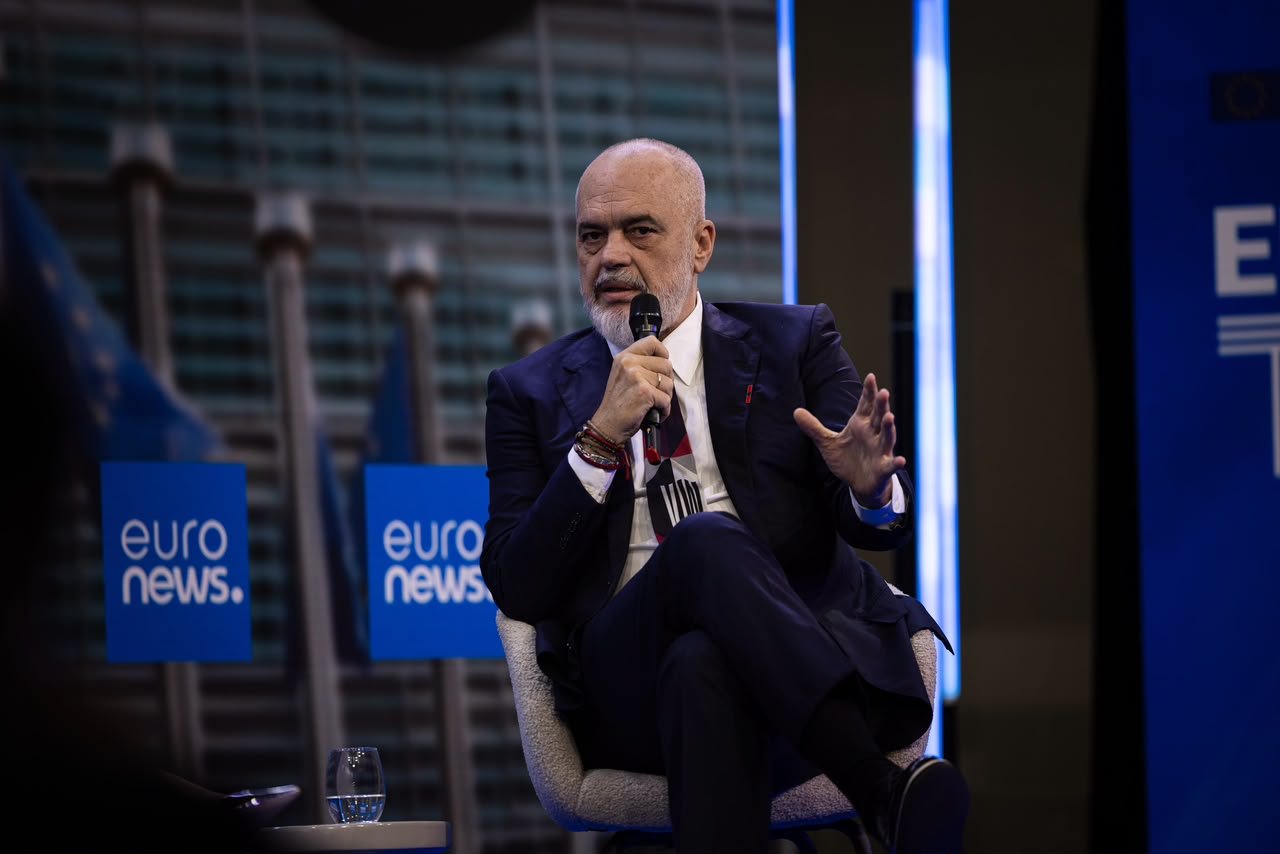
Prime Minister Edi Rama spoke this Tuesday in Brussels about the European integration process, the challenges facing the Western Balkan countries and developments in the region. During an interview with journalist Maria Tadeo, as part of the “Euronews Enlargement Summit”, the head of the Albanian government commented on Serbia’s relations with Kosovo and the European Union, and also addressed Albania’s European perspective. The focus of the discussion was the progress of membership negotiations, for which Rama reiterated the Albanian government’s goal of concluding them by the end of 2027.
Rama: There are many complex issues, but in the end there is nothing better than the EU.
Tadeo: Serbia has a change in leadership, what more complications will there be after this?
Rama: But you don’t know, how would I know? I expect to learn it from Euronews. What I do know is that the winner in Belgrade shows no openness on the issue that is dearest to me, which is the issue of Kosovo. They are completely closed, which means the tune will not change. I don’t give lectures to anyone; we are part of a region that is still not a full part of the EU. Here we listen to lectures. Serbia is an important part of the Western Balkans, but I have always been an advocate of the fact that we must not let Serbia go in the wrong direction. But if you want to enter the EU, you have to achieve things in several aspects. Serbia has had a different stance not only on Kosovo, but also regarding Russia and other things. Serbia must show results and must fully deserve this belonging.
Tadeo: Montenegro could join the EU in two years, because it is small and doesn’t disrupt things, or is there something else? It is also said that after this, Albania will be in “pole position”…

Rama: I am not so new in this role and I have seen things you wouldn’t believe. I see deadlines that have been thrown by the wayside, how the EU has not fulfilled its own tasks, but also how the EU has done more than expected. One never knows with the EU. We are working hard in a common plan to close the negotiations at the end of 2027. This will be essential, because it shows that we have done our job.