







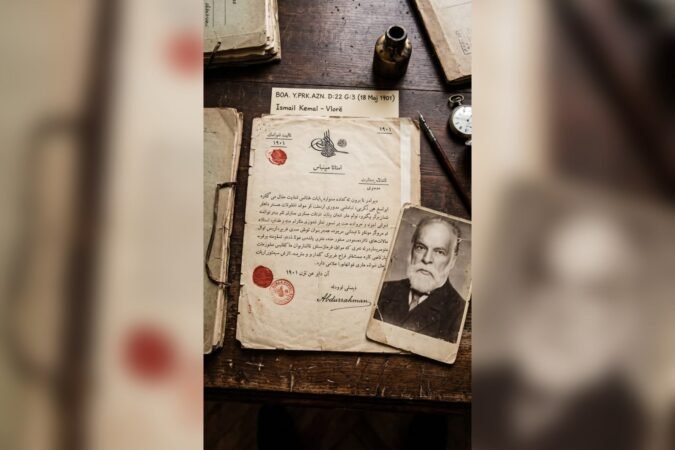
Albania’s independence, a foundational event in national history, unfolded as a fierce legal and geopolitical confrontation between a visionary statesman and the Ottoman Empire. New documents from the Ottoman Archive shed light on an important truth: Istanbul was aware of Ismail Qemal Vlora’s plans to create an Albanian state as early as 1901. This reveals the depth of his commitment and the vigilance of Ottoman authorities toward separatist movements.
On May 18, 1901, the Criminal Court of Istanbul issued a severe sentence against “the fugitive from Vlora.” According to an official document of the Ministry of Justice, signed by Minister Abdurrahman Nureddin Pasha, Ismail Qemali was sentenced to death in absentia, based on Article 54 of the Penal Code. This decision was accompanied by exclusion from civil service and the confiscation of all his assets, aiming to isolate and financially destroy his figure.
The prosecution’s reasoning constitutes a capital finding for Albanian historiography, bringing to light the true dimension of Ismail Qemali’s activity. Based on secret intelligence reports stretching from Berlin to Egypt, the Ottoman Court of Appeal found him guilty of several serious crimes: attempts to create a principality in Albania; efforts to detach Albanians from the administration of the Sublime Porte; building regional alliances and distributing subversive materials in Europe. The charges also included a call to Albanians for a strategic alliance with the Greeks, with the aim of curbing Slavic expansion, proving his cold geopolitical calculation and his vision for regional balances.

For Constantinople, Ismail Qemal Vlora was not merely a salon diplomat but the brain of a national separatist movement. He was exploiting political asylum and international networks to isolate Ottoman diplomacy and promote the Albanian cause. The death sentence, far from isolating the Founder, forced him to intensify his activity on the European diplomatic stage. Without wealth and without posts, Ismail Qemali used his strongest weapon: public diplomacy.
He launched an intensive campaign in major European media, explaining to Western chancelleries that Albania was not merely a loyal Muslim province of Turkey but a nation with a clear European identity seeking autonomy and fundamental reforms. During the years 1900-1908, he published a series of writings sharply condemning Ottoman misrule in the Balkans. This death sentence significantly raised his prestige among Albanians in the diaspora, turning him into the central point where Albanian committees scattered across Europe converged.
From major European centers such as London, Paris, Brussels, Vienna and Rome, to the Arbëresh communities and the diaspora in Bucharest and Sofia, Ismail Qemali transformed the Albanian question from an internal problem of the Ottoman Empire into a fundamental issue for the European balance. At the heart of Europe, he created the connections and gained the necessary experience that would serve him 11 years later to persuade the Great Powers to recognize Independent Albania. The act of November 28, 1912, therefore, is not merely a festive date but the triumph of the political realism of a leader who agreed to live under the threat of the death sentence in order to impose the project of Albanian statehood on the West, marking victory over the legal terror of despotism.