







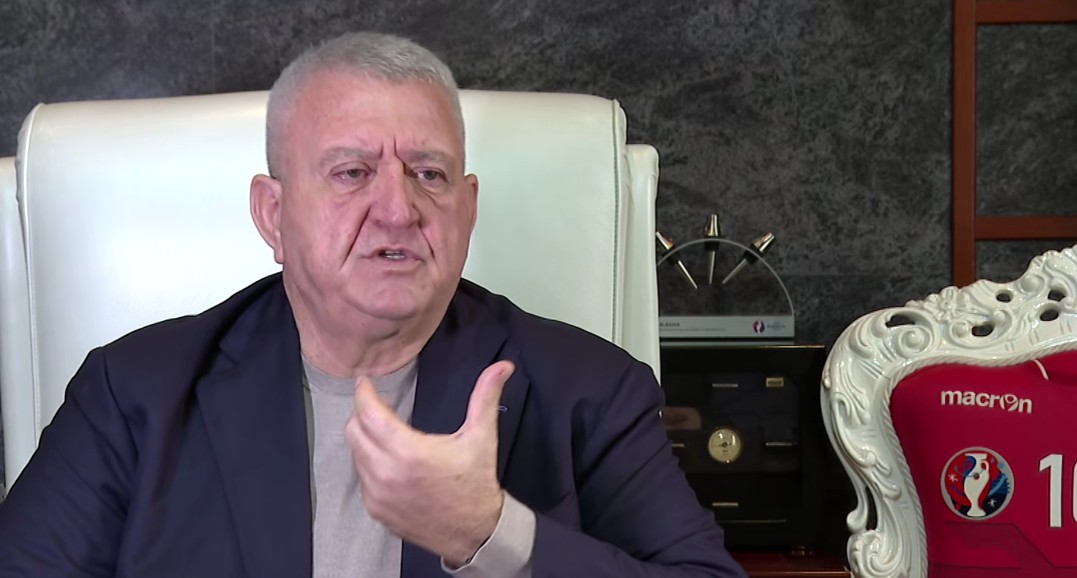
The President of the Albanian Football Association, Armand Duka, has given an interview to “Top Channel”. He spoke about the most important developments in Albanian football, the progress of the national teams and the challenges facing sport in our country.
A particular focus in the interview is the draft law on sponsorships and donations, which President Duka considers an important opportunity for the development of Albanian sport, but which, according to him, must be improved in order to be genuinely functional.
He emphasises the need for less bureaucracy, more security for businesses investing in sport and a mechanism that guarantees sustainable support for clubs, academies and sports infrastructure.
The head of football’s governing body also addresses the positive results of the national teams during November, assessing Albania’s first place in the Nations League, the performances of the age-group teams and the progress of Albanian football at all levels. He speaks about the work of coach Maran, the recruitment of young talents, the upcoming European draws, as well as changes to the format of the Albanian championship.
In this interview, the FSHF President also shares his view on the future of Albanian football and the importance of creating better conditions for the development of new generations.
– President, first place in the Nations League. Was it a test passed successfully? Should we consider it a great achievement or simply the fulfilment of the objective we had?

– I would consider it a successful campaign and the achievement of the objective. After all, this was our aim: to finish in first place. Was it a difficult objective or a very difficult one? I think, as it turned out, it was achievable. However, achieving it requires work and commitment from everyone.
I want to thank first of all the players for their commitment during this campaign, the staff and all the fans. We must especially thank the fans, who supported the team even in a competition that previously had not been widely followed and in matches that in Albania were considered not very important.
I recall the match against San Marino. We thought the fans might be disappointed by the game and the result, but they supported the team until the end, until the result came.
So, objective achieved. I would not consider it an extraordinary success, but an objective fulfilled. Of course, there are things that could have been done better. I think there could have been more playing time for young players with less experience, so that we would have a greater number of options for the European Championship qualifiers.
– The appointment of the current coach, Sylvinho earlier and now Maran, has been a process with different choices. At first there were questions and not much enthusiasm for Maran, but later he showed he could do more than expected. Are you satisfied with the choice? How do you view the national team’s transition period, with experienced players and the arrival of young ones?
– The appointment of the current national team coach, Maran, was perhaps not initially received as the best choice. The team’s performance in the first two friendly matches raised questions, both for me and for everyone who followed those matches, and perhaps even for the coach himself, as to whether he could take this project forward.
But with the start of the official matches, things changed. The team put in a good performance and showed better football. In fact, I said this from day one: we did not choose the coach by chance. Even though the result does not always come, I am convinced that with this coach we will see beautiful football, a more aggressive and more attacking Albania.
I believe we have seen this during this campaign, even in the match with the worst result, the one in Finland. For long stretches the team produced an excellent performance. Even after the red card it continued to play well, but the result punished us.
I am satisfied with what the coach has brought to the team’s game, to the players’ motivation, and to the most objective possible selection of the players called up and those who get playing time.
However, we may also be in a transitional moment. Some of the players who until yesterday were leaders are today at a more advanced age, and the coach must introduce young players.
– How do you see this transitional moment and the need to bring in young footballers?
– I said it at the beginning as well. Perhaps more young players could have been given playing time. We have players of great quality, both in the U21 national team and in the U19s. The latter put in a very good performance in the European Championship qualifiers in Cyprus, with two 4-0 wins.
Perhaps some of these names could have been brought in, to have more alternatives for the future.
I am not concerned by the fact that some players are at a relatively advanced age for football. In the national team, as long as you have the ability and strength to contribute, you should continue. They, regardless of age, are contributing fantastically. The most beautiful thing is the combination between the oldest player and the youngest one. They create a harmony and a very good group.
– Perhaps November has been one of the most successful months we have had in a long time with the national teams, considering the performances of the U17, U19, U21 and the senior team?
– We have had positive results with all the national teams during November. We have won almost all the matches.
Starting with the U15 World Festival in Azerbaijan, where our team won eight of nine matches and ranked 17th among 181 participating teams.
The U19 team won both qualifying matches against Cyprus and Armenia with convincing 4-0 results. The U17s also qualified for the Elite Round.
So these have been very good results, which have pleased us all and made us experience a beautiful November. November is the month of holidays, and these results have made this period even more beautiful for us.
– Soon we will have the U21 draw for the 2027 European Championship and then the big draw for the 2028 European Championship qualifiers. What can you tell us about these two draws?
– On 26 November, the draw for the U21 European Championship, which will be held in Albania and Serbia, will take place, while the ceremony will be held in Belgrade.
I have looked at the teams and Albania’s positioning. It is very difficult to choose an opponent that could be considered easier. All the teams are at a very high sporting level, with experience and a history of good results.
Therefore, what I should wish for is that our team prepares as well as possible for any opponent the draw brings. I cannot express any particular wish for the U21 draw.
As for the draw in Belfast for the first team, the pot allocation is already known. Albania is in the third pot. Half of the groups will have five teams and the other half four.
The four strongest teams will be in groups of four teams, which will start the qualifiers in September.
For us, it would be better to be in a group of four teams and to start the qualifiers in September, because we would have more time to prepare. Since we will not play play-off matches in March for the Nations League, as a result of first place, we would have the opportunity to play four friendly matches until September.
So, we wish ourselves a group of four teams. But this also has a downside, because one of the four teams will be among the strongest teams in Europe.
– Another important development in November has been the sponsorship law. How important is this law for Albanian football and sport?
– We have been discussing legal changes for at least 10 years, which would help the development of sport in general in Albania and football in particular.
Ultimately, we should, in a way, be grateful that this year the law has come to the table. Recently, the government’s proposal for the sponsorship and donations law was also discussed in the parliamentary committee.
We should thank those who initiated it, both the ministry and MPs from all political sides. If you followed the discussion in the parliamentary committee, despite the remarks and criticisms, there was a positive approach.
But now this law must become functional. We have remarks and believe that those who support it should think about how to make it functional and not superficial. They should not accept it if there are tricks from departments, ministries or the bureaucracy of the state apparatus.
– Specifically, what problems do you see in the current draft law?
– First, the objective is for business and sport, or business and art, to independently create a relationship to help the development of sport. Sponsorship should be an alternative payment of tax and not an additional expense for business.
The law must clearly and explicitly determine that this is an alternative way of paying tax, so that business is sure about the funding it gives.
Second, there is no reason the Ministry of Sport should need to command or pre-approve these sponsorships. I am not saying there should be anarchy. Of course, they should be checked according to the criteria that will be set, but the check should take place after the sponsorship has been carried out, not before it.
What authorization should a football club seek for a public activity? It is known that Partizani is a football club and a public activity. Why should both the sponsor and the sponsored party go to the ministry?
We should remove these bureaucracies and check law enforcement at the moment it happens. Business is also not checked before carrying out a financial transaction, but after it is carried out, to see whether it complies with the law.
If this is to be something commanded and controlled by the state bureaucratic apparatus, we have done nothing. We will again be in the same situation, where the government sets a budget and distributes it as it wishes. The grants given to football have amounted to zero for 30-50 years.
Third, and very importantly, the law provides for an extremely small limit: 2 billion lek. What will all sport and art do with 2 billion lek?
When this amount starts to be distributed, when the Erseka club goes to be sponsored, it may find the fund at zero. It is not only professional clubs such as Tirana, Partizani, Dinamo or Teuta that matter. All Albanian football and all academies matter.
We ask that the limit be five times higher. Also, the law should provide that a good part of these sponsorships goes to infrastructure.
What sports infrastructure can we build with 2 billion lek in total, when part of this amount will go to art and other sports? With what remains for football, we cannot build even one football pitch, because a pitch costs 400,000 euros.
Football must have a secure share from this mechanism. How much of this money will go to football? If we leave things as they are, it may end up going to concerts, election campaigns and other things.
The law should think about how to function, not how to be controlled. I repeat: I am grateful that the law has come to the table, but I kindly ask all actors, MPs and the government to take our remarks into account. We have sent proposals and suggestions to make a functional law that helps the development of sport, not its control.
– Why is this sponsorship mechanism so important for football?
– The Ministry of Finance considers it as if sport is seeking to put its hands into the budget, but this is not true. Sport gives a lot to the budget. The impact of sport on the country’s economy over a year is approximately 70 million euros.
I am not asking that football take these 70 million euros from the budget, but that a part of them be returned to it. And not for luxury or anyone’s pleasures, but for the future, for children’s football, for pitches, gyms and everything else.
I invite the Ministry of Finance not to see this as an effort to take money from the state coffers, but as the request of one of the largest taxpayers and of an activity with considerable impact on the country’s economy.
– Have you made concrete proposals for amending the draft law?
– Of course we have asked. We have engaged the best domestic and foreign experts to adapt the law. The current drafts are different from the proposals we agreed on at the table. I hope it does not go on like this until the end and that what is best for sport is done.
– Returning to the Albanian championship, the change of format and the Final Four experiment have now ended. Do you think it was the right moment to try something different? How do you see the future of the championship?
– Things have evolved and one must always adapt to development. The time has come for Albania to be able to organize more than 10 teams in Kategoria Superiore, due to the improvement of infrastructure at clubs and the expectation that the sponsorship law may bring.
Why did we stick until now to the format with 10 teams and four round-robin phases? The main problem was infrastructure, but also the dead rubbers that are created when there are more than 10 teams.
For this reason, we contacted one of the best companies in the world that deals with sports formats. We explained that we wanted to have 12 teams, but at the same time to eliminate matches without major sporting interest.
Several formats were proposed and, together with the clubs, we chose one of them, which in the end divides the teams into play-off and play-out.
The current 2026-2027 season is a transition season, because we have 10 teams and they will be divided into the top six and the bottom four. In the following season we will have 12 teams, divided into the top six and the bottom six.
The goal is to eliminate dead rubbers. Even the first team that plays in the play-out, in the second group, will have the right to play in the play-off to secure participation in the European cups.
In this way, all teams remain in competition and the excitement stays alive until the final minutes of the championship.