







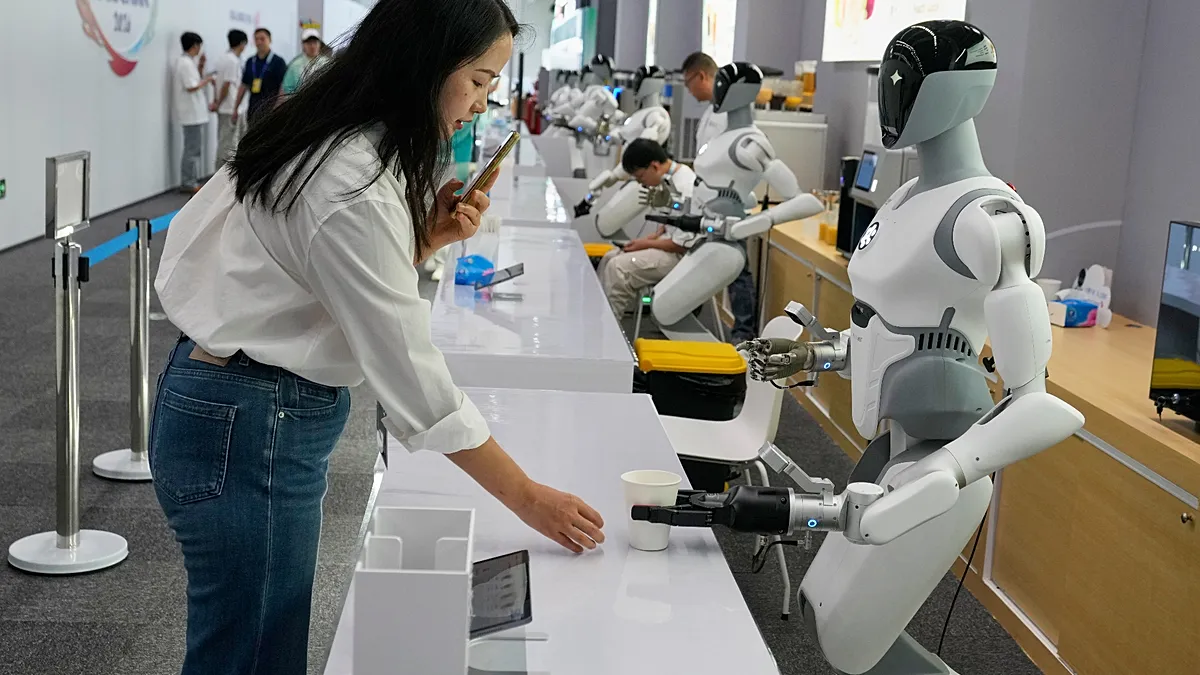
Robots in Shenzhen are being used to serve ice cream and coffee at a refreshment stand in a city park, attracting curious visitors who film them as they work. Both operate on artificial intelligence, while staff continue to restock supplies and empty coffee waste.
One robot prepares the ice cream and another makes the coffee, according to Euronews, which reports on this technology testing ground in the southern Chinese city. Shenzhen, the country’s tech hub, is serving as a testing ground for these devices aimed at bringing AI into everyday tasks.
The introduction of robots in public spaces shows how companies are seeking to bring machines closer to ordinary consumers, even though human intervention remains necessary for their maintenance. Developers are working precisely toward this goal: moving artificial intelligence from the laboratory into people’s everyday tasks.

In addition to customer service, Chinese companies are using data collected by workers wearing cameras and sensor-equipped gloves to train robots. These recordings help the machines learn tasks such as handling packages and stocking shelves, as well as adapting to different environments.
Training robots with real-world data from human work is seen as the main path to making them useful outside controlled environments. Despite progress, humanoid robots still struggle with complex household tasks, while increasingly taking on repetitive work.
This division of tasks leaves people to handle those requiring judgment and higher skills, while machines perform the same actions repeatedly. The role of Shenzhen’s manufacturing network proves crucial in this process, as it enables developers to quickly test and improve their technology.
Proximity to manufacturing and suppliers allows companies to test prototypes, collect data and make changes in short cycles. For park visitors, the result is a direct view of what technology can do today, while for developers it is another step in the continuous improvement of machines.