







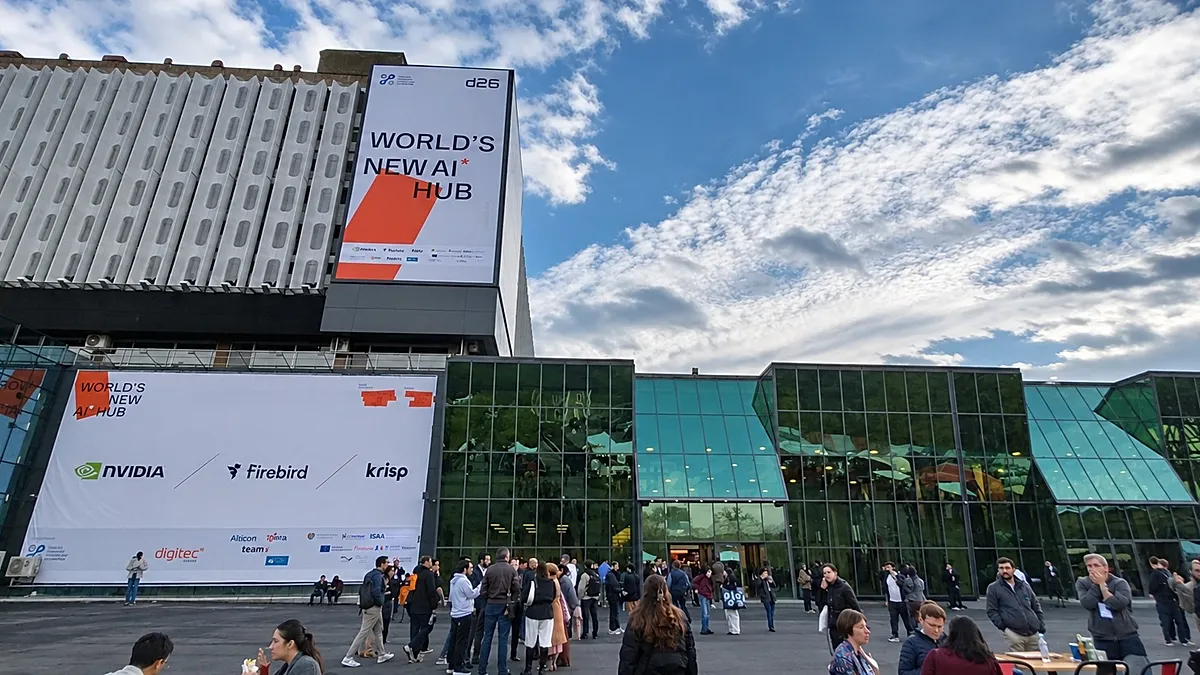
Armenia’s technology industry is building what its leaders call the AI Silk Road, a network aimed at connecting countries through infrastructure for the development of artificial intelligence. Rev Lebaredian, NVIDIA vice president responsible for physical AI simulation, presented the idea at the DigiTec conference in Yerevan.
According to him, what is being rebuilt is the ancient Silk Road. It is taking a new form as a kind of AI Silk Road, Euronews writes. Lebaredian argued that Armenia and Kazakhstan could become the main pillars of this corridor.
Countries in the region contribute at different levels of the AI economy: energy, microprocessors, computing infrastructure, models and applications. The vision goes beyond building data centers, as it aims to connect markets, researchers, businesses and capital across borders.

This creates a role for smaller economies in an industry dominated by much larger powers. “We must work hard to create as much interdependence among us as possible,” Lebaredian said, adding that this helps everyone’s prosperity and strengthens security. The new corridor is already taking physical shape.
Firebird, an American AI infrastructure company with Armenian co-founders, opened a computing center in Armenia in August and is building another in Kazakhstan. With more than 6,100 NVIDIA Blackwell processors, the Armenian facility provides the computing power businesses need to train and run artificial intelligence systems.
NVIDIA itself is among its clients, while Perplexity also cooperates with it, linking the small country to international AI players. The ambition runs through the entire DigiTec conference, held from November 20 to 22 at the Meridian Expo Center in Yerevan. Organizers announced 125 speakers, including representatives from NVIDIA, OpenAI, Dell Technologies and Mozilla.
They brought together international technology companies with governments and entrepreneurs from the region. For the Armenian tech community, the event is also a space to present the position the country seeks to secure. Armen Kocharyan, president of the Union of Advanced Technology Enterprises (UATE), which organizes DigiTec, described it as a “living platform” that connects governments, investors and businesses from Europe, the Gulf, Central Asia and North America.
“A true center never stops at borders,” Kocharyan said, emphasizing that all five layers of artificial intelligence are promoted together. This connects people, technology, capital and markets in real time. Armenia relies on specialization and cooperation. For a country of about three million people, these connections are essential, as Armenia’s domestic market cannot sustain the growth of the AI industry on its own.
The opportunity lies in specialization and cooperation with neighbors and partners, members of the Armenian tech community emphasize. Political interest is also clear, as the DigiTec program includes a discussion between Armenian Prime Minister Nikol Pashinyan and Nvidia’s Lebaredian on turning the vision of an AI center into reality.
The country is building on an already developed technology sector. Arto Minasyan, co-founder of the AI companies Krisp and 10Web and an investor in tech startups, said the sector accounts for 7% of the Armenian economy. He described an ecosystem with its own unicorns, investment funds and research labs.
“The dream of building a technologically advanced Armenia pushed me to found the company and move from academic research to entrepreneurship,” Minasyan said. He added that the same dream pushed his co-founder David to return from Silicon Valley. Many researchers from renowned universities come to Armenia to join forces.
The international network is a key element of the strategy, as the Armenian diaspora provides connections through which knowledge, information and business opportunities circulate. The first steps to attract Nvidia to Armenia also had a personal motivation. Lebaredian recounted that, after opening Nvidia’s office in Moscow in 2004, he began to dream of something similar for Armenia, waiting for the right conditions.
The Armenian office opened in 2022 and today has more than 100 employees, according to him. Attracting an international company was only part of the ambition. The bigger question was how Armenian researchers and entrepreneurs would get the tools needed to develop technology themselves.
Lebaredian recalled a meeting at Nvidia’s headquarters in California in 2019, when Pashinyan asked the company’s co-founder Jensen Huang what Armenia should do to attract a company like Nvidia. According to Lebaredian, the answer was to build an AI supercomputer for its people.
Initial efforts to secure state funding were halted by the pandemic and the war. The commercial project took shape later, when partners, capital and clients came together, with DigiTec 2024 as a meeting point. This path matters because the Armenian proposal relies on more than access to imported chips.
The country has a tradition in computing dating back to the Soviet era, as well as expertise in semiconductor design and in the software used to develop them. Minister of High-Tech Industry and Artificial Intelligence David Tadevosyan focused on the same challenge: how to turn successes in software and technology services into domestic research, engineering and production of internationally competitive products.
He emphasized human capital, modern infrastructure and cooperation between science and business as necessary conditions. The minister said the government had approved, about two weeks before DigiTec, an education program in physical artificial intelligence, with international-level experts.
The goal, he explained, is for technological development to boost the productivity and competitiveness of the entire economy. The Firebird center in Hrazdan and expansion plans. The Firebird facility in Hrazdan is the most visible expression of this strategy. An AI factory provides the computing power businesses need to train and run artificial intelligence systems, without having to build their own data centers.
In a conversation with Euronews, Firebird co-founder and CEO Razmig Hovaghimian described a project that from the outset was driven by the ambition to go beyond the country’s borders. “Why build it only in Armenia? Why not build it with Armenia as a starting point, expand it globally and attract talent and investment here?” he said.
An Armenian originally from Egypt with experience in creating and selling technology businesses, he saw in AI an opportunity to leverage the country’s human capital. Implementation, however, required more than good engineers: financing, licenses for exporting American technology and investor confidence in a market they did not usually associate with such large infrastructure.
“We knew we had the talent. We just had to convince the rest of the world that this is the right place to build and grow,” Hovaghimian said. According to him, the first phase has about 6,200 GPUs, while demand was for about 25,000.
“Everyone said we would probably have one client that would take all the capacity. We have 15,” he said, adding that 12 of them are Armenian companies. Among the clients he mentioned are Nvidia and Perplexity, as well as Krisp and Activeloop.
The presence of local firms shows that the facility can also serve as infrastructure for the local ecosystem, beyond international clients. The second phase is already under construction, he said, with the aim of the infrastructure in Armenia reaching about 70,000 GPUs by 2027. “Today we are at 6,200. We are already building the second phase. Next year we will be around 7,” according to his account published by Euronews.