







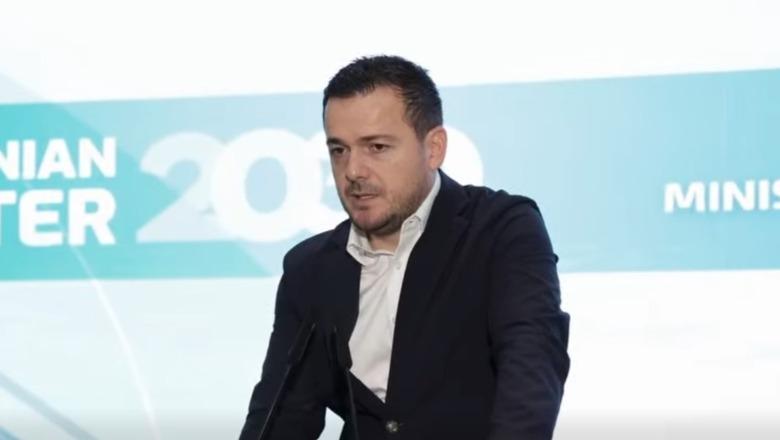
Investments in irrigation, drainage and flood protection in Albania reach 10 billion lek for the 2025-2027 period, while more than 3 billion lek are financed annually for these three areas. The figures were announced by the Minister of Agriculture and Rural Development, Andis Salla, during the international conference “ALBANIA WATER 2030”.
The conference, attended by Minister of Environment Sofjan Jaupaj, the Ambassador of Spain, the rector of the Agricultural University of Tirana, representatives of CIHEAM Zaragoza and field experts, discussed water resource management, improving irrigation systems and the challenges that climate change poses for agriculture. Salla said that modernizing the sector requires long-term investments, supported by studies and scientific expertise, so that farmers receive better services and agricultural production becomes more sustainable.
”Modernizing agriculture requires a long-term vision, sustainable investments and policies based on scientific knowledge and expertise. Each year, we finance more than 3 billion lek for these three areas, with the aim of improving services and increasing the sustainability of agricultural production”, Salla said. The minister stressed that investments should not focus only on rehabilitating existing infrastructure. According to him, scientific studies, analyses of water balances and technologies adapted to the conditions of each area are also needed.

He emphasized increasing water harvesting capacities and the transition to modern pressurized irrigation systems, citing as examples projects supported by the World Bank in Divjakë and in the Mursi-Konispol area, as well as interventions in drainage systems in Maliq and Torovicë. Another issue discussed was cooperation between the Ministry of Agriculture and the Agricultural University of Tirana, with the aim of basing investments and sector policies more on scientific research and needs identified in the field.
”Together with UBT, we are building a more structured partnership that will include joint studies, identification of field problems, assessment of technical alternatives and monitoring of investment results. This will help us make safer decisions, use public funds more efficiently and ensure that our policies respond to the real needs of the sector”, Salla stressed.