







A decade ago, the victory of former U.S. President Donald Trump triggered a wave of populist shock across the West. Now, Europe is asking whether the deep defeat of his Republican Party in the midterm elections will turn this wave back. European opponents of right-wing populism see the American vote as the latest sign of its faltering advance. Since April, voters have removed Hungary’s Viktor Orbán, ended Aleksandar Vučić’s long grip on power in Serbia, and blocked the return of the Bolsonaro family in Brazil. This points to a clear trend against populist forces in power.
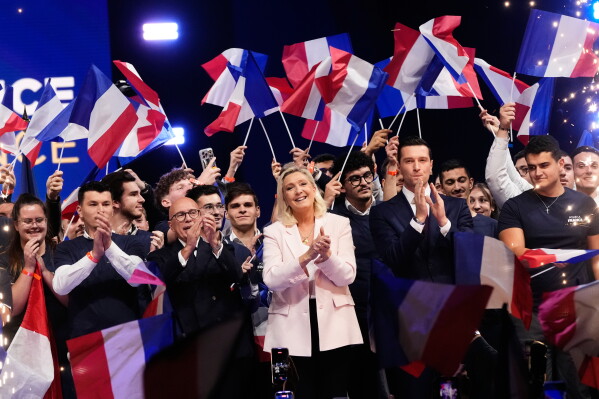
Péter Krekó, director of the Political Capital Institute in Budapest, stressed that “when cracks in power become more visible, this can cause a cascade effect.” Nowhere would such a cascade matter more than in France, where nationalist Marine Le Pen is the leading candidate in the presidential election due to be held in six months. A victory for her would place the European Union’s only nuclear arsenal, and a veto in the UN Security Council, in the hands of the far right. The recent losses of the populist right could unsettle the woman aiming to become France’s first “Madame la Présidente.” Yet the anger punishing populists in power from Budapest to Belgrade could carry her to power, precisely because her party, the National Rally, has never governed France.
Le Pen also faces a legal challenge. France’s highest court intends to rule on her appeal against a conviction for embezzlement of funds by early April, just weeks before the first round of voting. If the ruling goes against her, she could campaign and face voters while wearing an electronic tag. Carmen Artaza, a Paris resident educated in the United States, said that “she could still be barred from running, and now Americans have delivered this kind of rebuke to Trump’s populism. This will shake her – it will disrupt her campaign.” However, in France, “the far right still has the wind in its sails,” said Sciences Po political scientist Gilles Ivaldi.

Analysts suggest that voters who gave Democrats control of the U.S. House of Representatives and Senate may have punished Trump’s record, particularly on the economy, more than his “America First” ideas. Populists are still winning some elections, as shown by the presidencies won in Poland, Chile and Colombia since mid-2025. Daphne Halikiopoulou, professor of politics at the University of York in Britain, stressed that “the trend toward the far right has been the defining feature of 21st-century politics.” However, recently, losses for the illiberal populist camp have piled up. She added that “the midterm elections are a very favorable result for the centre-left, and this may hold back the far right.”
Leaders or parties backing nationalist and anti-immigration policies have suffered at least eight setbacks in national elections in about 18 months: in Romania, the Netherlands, Portugal, Hungary, Sweden, Serbia, Brazil and now the United States. Many of these defeats were pronounced: Portugal chose moderate socialist António José Seguro over right-wing populist André Ventura by a two-to-one margin; Hungary ended Orbán’s 16 years in power; Serbia’s Vučić conceded defeat last month to a student-led protest movement; and Romania chose pro-European centrist Nicușor Dan over nationalist George Simion. Last month, Brazilian President Luiz Inácio Lula da Silva narrowly defeated Flávio Bolsonaro, son of former President Jair Bolsonaro.
Other votes thinned the ranks of anti-immigration parties, as seen in the loss of 11 seats by Geert Wilders’ party in the Netherlands and by the Sweden Democrats in Sweden. These results “clearly show that far-right politics is not popular,” said policy expert Aurélien Mondon. Even some in the populist right see a pattern, with AfD’s Markus Frohnmaier writing that the U.S. midterms “join the defeats of Bolsonaro and Orbán.” Krekó stressed that each defeat can make the next one easier to imagine, creating the sense that “an increasingly authoritarian regime with large resources can be defeated.”
The French left seized on the result as “a message of hope,” while Le Pen’s National Rally, which welcomed Trump last year, is now keeping him at a distance. The party’s president, Jordan Bardella, said that “what happens in other countries is not my business,” while Sébastien Chenu called the vote “a rejection of Donald Trump’s policies,” blaming inflation and fuel prices. The message from Europe’s nationalists is that the defeat was Trump’s, not theirs. For Le Pen, the lesson of the midterms may be less that populists lose than that those in power lose. Anger at governments has built up for years, potentially making Le Pen, as an opposition figure, the favorite. France will show whether voters can stop a populist from gaining power, or whether it will experience its “Trump moment”.
Taken from AP News