







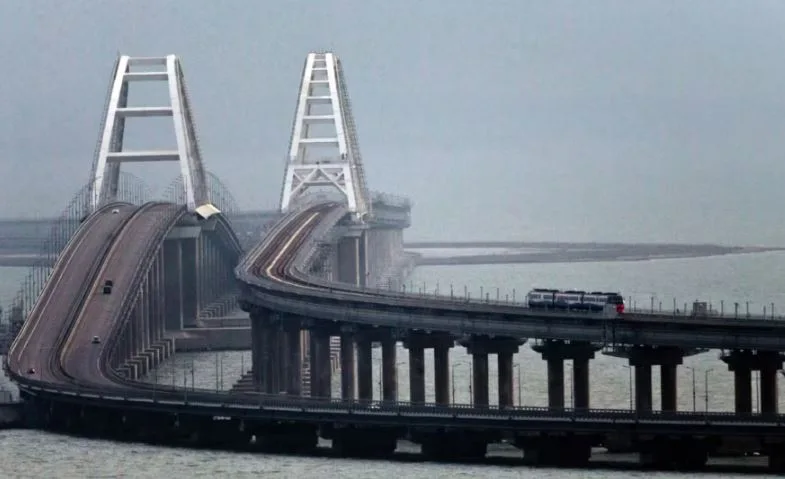
More than 200 meters of the Crimean Bridge have been destroyed and ended up in the water, at a depth of nine meters, after a missile and drone attack carried out in several waves on November 16 and 17. Asphalt and steel debris has blocked the shipping channel of the Kerch Strait.
This development deals a blow to Russia’s efforts to keep Crimea under occupation and functional, Radio Free Europe writes. This is the most destructive attack on the bridge since the start of the full-scale war, which enters its fifth year in February, according to the same sources.
During the latest attack, only the road section of the bridge was destroyed, while rail traffic has resumed, although it is not known to what extent. According to Ukraine’s military command, the attack marked the end of the myth Moscow had built around the bridge as a symbol of a “forever Russian” Crimea.

“Now, part of the structure is underwater,” the command’s statement says, stressing that this 19-kilometer structure over the waters of the Black Sea, worth $4 billion, strengthened Moscow’s control over the peninsula occupied in 2014. Kremlin spokesman Dmitry Peskov vowed that the bridge would be rebuilt “even better than before.”
Completed in 2018, the metal-construction bridge, also known as the Kerch Bridge, includes a railway and a road. It was the only land route enabling the movement of people and supplies from Russian territory to Crimea, until the full-scale invasion of Ukraine in February 2022.
Russian President Vladimir Putin himself sat at the wheel of a truck and crossed the bridge in May 2018 to inaugurate it. Earlier, only ferries operated in this sea strait, but their capacity was limited and navigation depended on weather conditions. On November 18, all ferry traffic was suspended due to bad weather, authorities said. ## Experts: damage may have compromised structural integrity “I think the damage is quite extensive,” said Brian Clark, a former US Navy officer and expert in maritime operations at the Washington-based Hudson Institute.
According to him, the damage caused appears to have compromised the structural integrity of the bridge, and it is entirely possible that crossing it is no longer safe. Sam Rigby, a professor of engineering at the University of Sheffield in England, noted that this attack differs from previous attacks because it targeted a much larger segment, with significantly higher structural complexity.
Ukrainian aviation engineer Konstantin Kryvolap explained to Current Time that the bridge can only be hit by targeting its weak points, the connecting elements that join both sides of the bridge: “The points where these arches are connected are the weakest parts of the bridge.” According to infrastructure engineers who spoke to Radio Free Europe, the most optimistic scenario for repairing the road section is that the works last about a year.
Kryvolap assessed that the work could not be completed in less than six months and is very likely to take more than a year. David MacKenzie, a senior technical director at the British engineering consultancy COWI, told Radio Free Europe that the new bridge segment would have to be assembled on the coast of the Sea of Azov, then transported over water to the designated site and put into position.
According to him, this is because the road bridge is located inside the railway bridge, which prevents the transport of an entire segment from the Black Sea. The entire coastline of the Sea of Azov is at a distance of less than 300 kilometers from territories under Ukraine’s control.
According to MacKenzie, this means that any project to build the bridge arches, which would take months, would be a relatively easy target for Ukrainian drones and missiles. The bridge debris, which currently blocks maritime traffic in the Kerch Strait, could be cleared within one or two weeks, provided that seaborne cranes and dredging equipment are not hindered by bad weather or Ukrainian threats, MacKenzie assessed.
However, the Kremlin will have to choose whether to first restore maritime or road traffic, since, as he said, it would not be possible to ensure temporary road traffic over the bridge and at the same time keep maritime traffic open. Mike Petersen, a former senior adviser to the U.S. Navy and an expert on the Russian military at the Center for Naval Analyses in Washington, said it is difficult to determine how long it will take to reopen the waterway.
“Ukraine can hinder any effort to clear the channel, and this could prolong the closure almost indefinitely,” he told Radio Free Europe, recalling that U.S. authorities needed 76 days to clear a channel in 2024, after the collapse of the Francis Scott Key Bridge in Baltimore.
According to Petersen, geography, hydrography and weather conditions are all obstacles to a rapid debris removal operation, not to mention the fact that the operation itself is likely to be hindered by attacks. ## Military logistics and the alternative route As for general maritime traffic through the Kerch Strait, the impact will be limited in any case, since Russia has already redirected a large part of it toward the Baltic Sea or the Pacific Ocean, due to the intensification of Ukrainian attacks on ships and ports, Petersen said.
In this situation, for a long-term and unpredictable future, only trains will transport people and goods to and from the Crimean peninsula. Russian military commanders will now be forced to also rely on a land route, the M-14 coastal highway, which is exposed to Ukrainian drones, according to David Gendelman, an Israeli military expert.
The highway can handle only a limited amount of traffic, both civilian and military, he noted. “If traffic is shifted there, first of all, this will slow and complicate military logistics, including the part of transport that was already passing through land corridors and not across the Crimean Bridge.
Nevertheless, from the point of view of military logistics, this attack on the Crimean Bridge complicates the supply of the entire military grouping in the south,” Gendelman said. The M-14 highway became another important supply route, directly from Russia itself, after the capture of Mariupol in spring 2022, where Ukraine’s largest port on the Sea of Azov was located, and the consolidation of Russian control over Ukraine’s coastline.
But since the beginning of this year, Ukrainian forces have intensified the so-called medium-range drone strike campaign, launching drones against freight trucks traveling on the coastal road, as well as against some rail traffic. This has made the Crimean Bridge even more essential for ensuring food and electricity supplies for the peninsula’s two million residents, not to mention the hundreds of thousands of military personnel who must be equipped with weapons and supplies for attacks on Ukraine.
Adding even more trouble to the land route, Ukrainian forces reportedly damaged on November 17 another important bridge, which provides a direct road link between Crimea and Rostov-on-Don, through the port of Taganrog, a city that is an important staging point for military forces near the Ukrainian border.
The latest attack is not the first time Ukraine has targeted this structure during the full-scale war launched by Russia. A truck bomb explosion, orchestrated by Ukrainian military intelligence in 2022, damaged the road section of the bridge, which was fully repaired in less than five months. In 2025, a Ukrainian underwater drone struck the bridge supports at water level, but the structural damage was minor.