







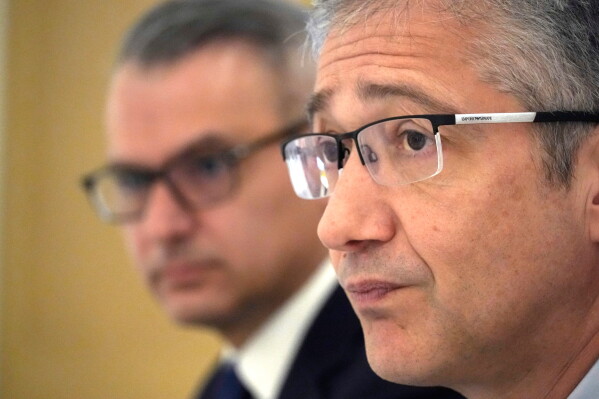
European leaders have chosen Pablo Hernández de Cos, former head of Spain’s central bank, as the next president of the European Central Bank (ECB), succeeding Christine Lagarde. This decision comes at a time when the EU’s key institution faces inflation, concerns about high government debt and borrowing costs in Europe. Leaders from the 21 European member states that use the euro also filled two other senior posts at the ECB, which sets borrowing costs for 359 million people in the eurozone. European Council President António Costa confirmed the agreement on the three appointments at a summit in Brussels. De Cos’s appointment must still pass scrutiny by the European Parliament and the ECB’s governing council, but these steps are considered formalities.
The appointment places an experienced central banker, known for supporting lower interest rates and monetary stimulus, at the head of the ECB at a time when several European governments are grappling with heavy debt burdens and rising borrowing costs. De Cos, 55, served on the ECB’s rate-setting council from 2018 to 2024 through his post as head of Spain’s central bank. An analysis of his speeches by Commerzbank analysts suggests that De Cos is among the “doves” of monetary policy, meaning policymakers who lean toward lower rates to support economic growth. He prevailed over another leading candidate, former head of the Dutch central bank Klaas Knot, who was considered a “hawk” (favors higher rates to curb inflation). In 2020, De Cos joined the majority of the council under Lagarde, backing a €1.85 trillion ($2 trillion) pandemic stimulus to keep rates low and support the economy during lockdowns and travel restrictions.
Commerzbank analyst Marco Wagner emphasized that “especially against the backdrop of rising government debt in many countries… many governments are likely to prefer a ‘dove’ ECB president.” France, in particular, is struggling with high debt and heavy interest costs. However, with inflation currently at 4%, above the bank’s 2% target, the ECB may still raise rates at its December 17 meeting, chaired by Lagarde. De Cos is currently general manager of the Bank for International Settlements, an international organization of central banks in Basel, Switzerland.

Lagarde, 70, announced on October 30 that she would resign on February 7, nine months before the end of her eight-year term. She said she decided to leave early so she could speak more freely on issues unrelated to monetary policy, but her resignation also allows EU leaders to choose a successor while France’s pro-EU President Emmanuel Macron is still in office, avoiding the possibility that far-right candidate Marine Le Pen could win the elections and influence the choice. Eurozone leaders also filled two vacancies on the bank’s six-member executive board. They chose German economist Markus Brunnermeier, a professor at Princeton University, to replace Philip Lane, whose term ends in May, and Laurence Boone, head of corporate and investment banking in France for Spanish bank Santander, for a seat left vacant by Germany’s Isabel Schnabel, who resigns in January. The ECB sets interest rates for the 21 countries that use the euro, influencing borrowing rates across the economy. Lower rates can spur a flagging economy, while higher ones curb inflation when it is above the bank’s 2% annual target. Lagarde is considered to have followed a pragmatic middle course, building consensus among national bank chiefs. She called herself an “owl,” the bird associated with wisdom, avoiding being labeled a “hawk” or “dove.” She congratulated De Cos, praising “his intellect, warmth and good humor.”
From AP News