







The luxury car maker is expected to open its first factory in the US, a decision that Trump attributes to his tariffs. Reactions are critical in Germany, because the domestic industry is facing job cuts.
1. What does Audi’s plan for the $4 billion investment in the US involve?
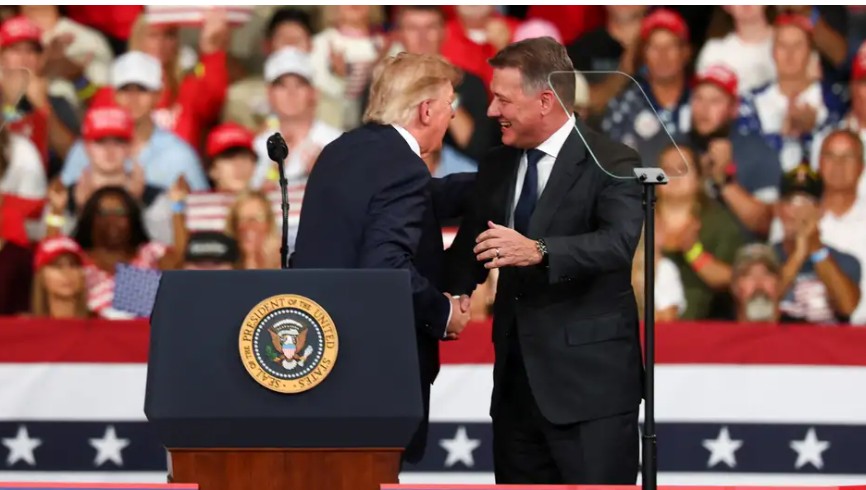
US President Donald Trump announced the investment on Saturday (24.10.2026) during an election rally in Georgia, a key state for his Republican Party in next week’s midterm elections.
Audi immediately confirmed the plan, announcing that it will build its first factory in the US near the city of Macon, Georgia. The investment will cost about $4 billion (3.6 billion euros) and is expected to create around 4,500 jobs.

The German carmaker said construction will begin next year. Production, with a planned capacity of up to 200,000 vehicles per year, is expected to start in the early 2030s.
At this factory the company plans to produce premium SUVs for the American market. Audi described this as a “long-term commitment” to what it considers “one of the most important markets in the world for premium vehicles”.
The investment in the US comes at a time when German carmakers are facing unprecedented pressure from China, rising costs and two conflicts.
Backed by large state subsidies, Chinese competitors have gained an advantage in the transition to electric vehicles (EVs), increasing production of new models that are quickly winning market share in a highly competitive global automotive market.
BMW, Mercedes-Benz and Audi’s parent company, Volkswagen, the world’s second-largest carmaker, have warned in recent months of falling profits, while profit margins are under pressure.
The companies have also announced major cost-cutting measures. VW is preparing to cut up to 100,000 jobs by 2030, while Audi’s factory in Neckarsulm, where around 15,000 people work, is one of four factories at risk of closure.
2. Why is Audi investing in car production in the US?
Trump said Audi’s investment was the result of the 15% tariffs he has imposed on vehicles produced in Europe, saying the investment “would not have happened without the tariffs”.
Although this commitment is in line with Trump’s goal of bringing production back to the United States, Audi said the large investment aims to grow and strengthen the sustainability of its business.
“We have much greater ambitions for Audi in America,” said the company’s chief executive, Gernot Döllner, who appeared alongside Trump at the Republican election rally.
“The United States is one of the most important markets in the world for premium vehicles and we have still not fully exploited our potential. We are determined to change that… It is about building a stronger Audi business in America, not just building a factory,” he said.
However, Trump’s tariffs have undoubtedly added to the carmaker’s problems.
Audi, which currently exports to the American market from Europe and Mexico, said additional costs last year reached about 1.2 billion euros (1.3 billion dollars).
With more than 160,000 vehicles sold, Audi’s sales in the US fell by 16% last year, amid strong competition and after Trump removed subsidies for electric vehicles in the company’s second-largest market.
According to industry analysts, building a factory in the US should allow Audi to avoid or reduce Trump’s tariffs.