By Elona Elezi, DW
For ten days, young people in Albania have been involved in violent clashes with the police. Prime Minister Edi Rama claims that Antifa stands behind these events.
Broken windows, fire stains on the walls: the Ministry of Education in Tirana bears the traces of the protests of recent days. Nevertheless, students and faculty of the University of Tirana have gathered here again to protest.For about five months, protests against the government in Albania were peaceful. They first started against the construction of a luxury hotel complex by Trump’s son-in-law, Jared Kushner, inside the Zvërnec nature reserve.

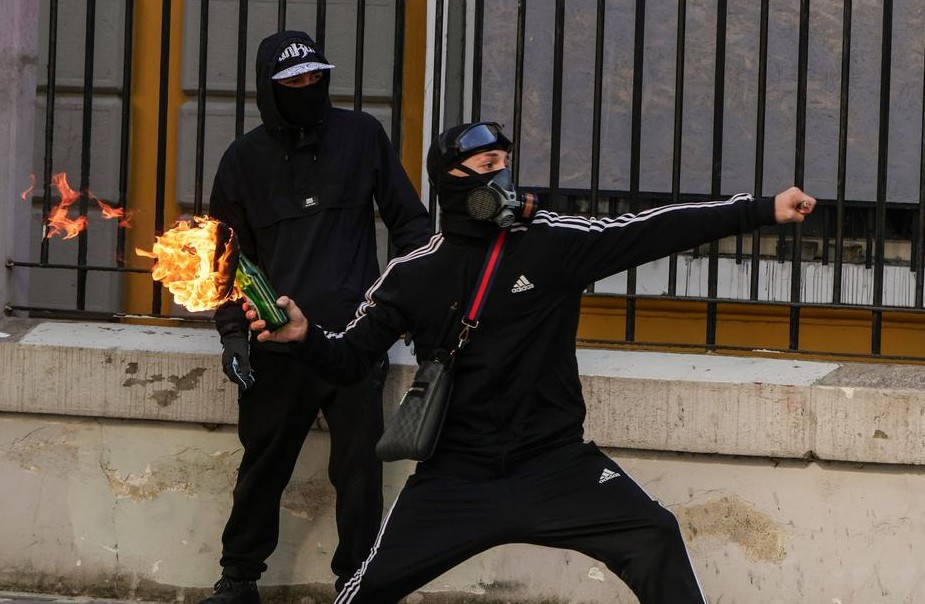
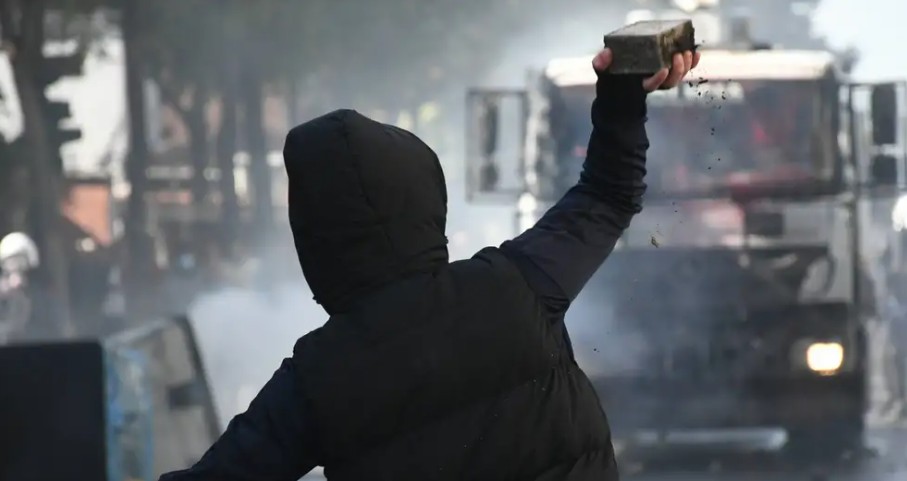
Since then, the protests have continued to spread. Violent clashes between students and high school pupils on one side, and the police on the other, happen every day.
On 13 October, the situation escalated. Demonstrators denounce corruption, the miserable conditions in universities and the rising cost of education. They demand the resignation of Prime Minister Edi Rama, who has been in power since 2013.
A young girl dressed in black and wearing a hooded jacket stands in the crowd. When we ask why she is taking part in the protests, she covers her mouth with a colorful mask. “Please wait a moment, I would like to cover my face” – says Sara* (name changed by the editorial staff). She prefers to remain anonymous.
Sara says she has regularly gone to the protests since they began. She coordinates with other students via phone. “We communicate only through messages” – she says. Then we have to end the conversation with her. Demonstrators are again throwing stones toward the Ministry of Education, and the police are pushing demonstrators and journalists outside the cordon they have set up, using water to disperse the crowd.
Decentralized, horizontal organization
“Social networks are today the first public ‘square’, before the physical square fills up” – says Besmir Semanaj, cybersecurity expert.
“Young people no longer organize through classic structures: parties, associations or public announcements. They organize where they live every day, on the phone”.
According to Semanaj, the main communication channels are Instagram groups, such as stories and direct messages, WhatsApp groups by class, faculty and dormitory, Telegram channels for mass announcements, and TikTok for sharing videos. “Signal is used by those who are most aware of security”.
“This is a horizontal model of organization, without a single leader and without a command center. That is exactly why power finds it so difficult to understand and control it” – he told DW.
Prime Minister Edi Rama: “Hybrid war”
Semanaj stresses that the Telegram messaging service offers several useful functions in the current situation: “Channels can reach tens of thousands of people at the same time, announcements spread within seconds, and control from outside is more difficult than on traditional platforms”.
Prime Minister Edi Rama – well known for his use of social media – blames algorithms for the current situation. He describes the youth uprising against his government as a “hybrid war.” In a recent media appearance, he launched a harsh verbal attack on the protesters.
“This does not mean that the girls and boys who think life is TikTok, and that with TikTok and without being able to put seven words together they can make Albania better, are terrorists. Not at all! But they are hostages of a spirit, of a new ideology, which has only one mission: destroy, turn everything upside down, tear everything down,” Rama said.
“Radicalized by Antifa”
Since the beginning of the initially peaceful protests against the government nearly five months ago, Rama has consistently tried to publicly expose the “real” organizers behind the protests. In recent months, he has accused countries such as Greece, Russia and Iran of interfering in the protests.
Recently, he named a new culprit: Antifa, a global, decentralized movement of the radical left that has no leader. “They are young men and women who are ideologized and extremized, under the pressure or inspiration of that dark and new force that has emerged in Europe and in the United States, which the President of the United States has declared a terrorist organization, Antifa,” the Albanian prime minister stated.
Redion Qirjazi, an expert on security and radicalism, disagrees. “This is a serious accusation, which requires equally serious evidence. To date, no verifiable evidence has been publicly presented documenting the existence of an organized Antifa structure in Albania, much less its involvement in coordinating the protests,” analyzes Qirjazi.
“Terrorist structure?”
Rama’s reference to the decision of U.S. President Donald Trump to classify Antifa as a terrorist organization is also problematic, according to expert Qirjazi. “Antifa is not a single international organization with a centralized structure and command, but a name that encompasses various movements and groups, essentially anti-fascist.”
Student Sara also firmly rejects the accusation of “terrorist” structures. “There are groups that use violence, that is true, but I have nothing to do with them at all. As soon as I see violence, I leave. I am against it,” she told DW.
Arlind Qori, chairman of the new opposition party “Lëvizja Bashkë” (Lëvizja Bashkë), which has been active against the government since the start of the protests against the luxury resort in Zvërnec, considers Rama’s claims “meaningless.”
Resignation instead of revolution
“Young people are embittered by socio-economic conditions: by poverty, by the fact that many of them have their parents in emigration because they cannot afford to support their families, by the degradation of the school system, by the lack of economic opportunities after graduation to work in their profession,” Qori said.
These factors, he explained, have pushed young people into the streets and not any other ideology of any kind. It should also be emphasized that the students’ main demand is Rama’s resignation, “not a socialist revolution.”
Qori continued: “People are not demanding anything radical, only the resignation of the corrupt head of government, a basic and moderate demand. Yet Edi Rama continues to respond with police violence and arrogance,” he told DW.
Who is “pulling” the strings?
Security expert Qirjazi says the timing of these statements should also be analyzed. “When a government faces protests and public discontent, linking protesters to extremism and foreign influence can serve to shift attention away from the causes of the protests toward a narrative of national security,” he believes.
“This may serve several political purposes: to delegitimize the protesters, to weaken public support for them, and to justify a harsher approach in the name of order and security.”
Cybersecurity expert Semanaj recognizes this pattern from other crises. “The protest is portrayed as violence, the young people as manipulated, and their legitimate demands – conditions in universities, tuition fees, corruption, lack of prospects – disappear from the narrative.”
Instead of discussing why thousands of young people took to the streets, the focus shifts to who “sent” them there. Semanaj believes this is not a coincidence but rather an orchestrated communication campaign.
“It aims to create a specific narrative: that the protest is synonymous with violence, that young people are being manipulated and that someone else is pulling the strings,” says Semanaj.