







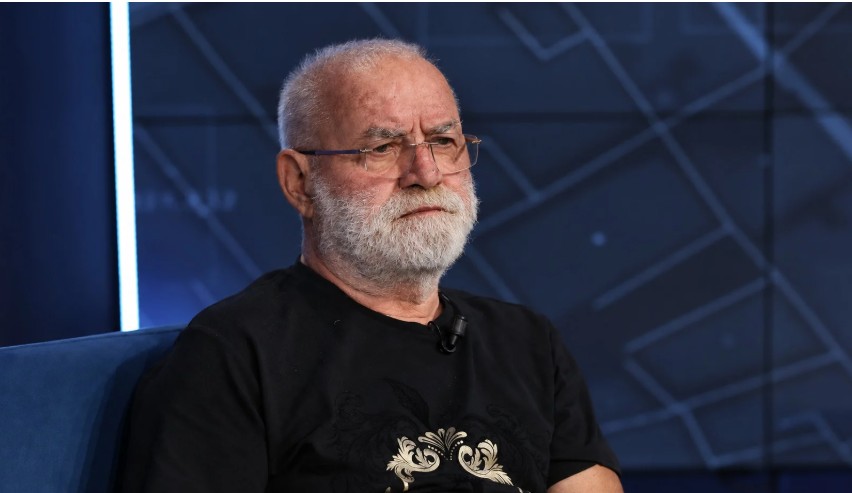
By Filip Çakuli
(On the occasion of the marked day of the Albanian alphabet)
We have police for everything. Only Albanian has been left unprotected.
Albania is a safe country. At least as far as police forces are concerned. We have the State Police. We have the Border Police. We have the Municipal Police. We have road, forest, military police…
Each one guards something. One the border, another traffic, another the forest. Only one thing has been left without a guard: the Albanian language.

So perhaps the time has come to create a Language Police too. Not with pistols. With dictionaries. Not to stop citizens on the street, but politicians on television.
-Documents, please!
-Here you are.
-You said “maxhorancë”?
-Yes.
-Albanian has the word shumicë. Five thousand lekë fine.
-And “minorancë”?
-Pakicë. Another five thousand.
-“Implementim”?
-Zbatim.
-“Suport”?
-Mbështetje.
-“Draft”?
-Projekt, projektligj, variant, as the case may be.
-“Impakti”?
-Ndikimi.
-“Event”?
-Ngjarje, veprimtari, aktivitet.
-“Prioritet”?
Here the police officer thinks a little.
-Go on. We have forgiven you that one long ago.
Because the problem is not that Albanian should not take words from other languages. All languages take and give. The problem starts when the Albanian word exists, is clear, beautiful, and even the grandmother in the village understands it, but we throw it away because the foreign word seems more elegant to us.
Not all foreign words are replaced. Some Turkish words have acquired a pejorative meaning. For example, “surrat” means “fytyrë”, a word of Latin origin. But “surrat” has acquired a pejorative meaning.
Of course, there are efforts to replace foreign words with Albanian words. But, not rarely, this leads to meaningless names. As, for example, in the anatomy dictionary, where the foreign word “klavikul” has been renamed in Albanian “parzmokularthorthimthak”.
“Shumicë” seems provincial to us. “Maxhorancë” makes us European. Say “shumica parlamentare” and you look as if you are speaking Albanian.
Say “maxhoranca parlamentare” and you immediately gain a couple of political ranks. If you also say “implementimi i prioriteteve në funksion të impaktit”, you are practically ready to be a minister.
We have created a strange public Albanian, where the sentence is no longer constructed to be understood, but to look important.
The less the citizen understands, the more serious the speaker looks.
Politics especially has turned into a customs point for importing words.
The politician no longer says: “We will implement this measure and see its impact.”
That is too simple. There is a risk the people will understand it. He says: “We will implement this package to see the impact it will generate.”
Now yes. We did not understand anything more, but at least we understood that the speaker has studied abroad. Or has spent two weeks in Brussels.
Televisions then finish the job. Moderators have “feedback”, journalists do an “update”, guests talk about “target”, parties have “lidership”, businesses do “performancë”, institutions have “staf”, and together they all wait for an “event” to do “networking”.
Albanian sits in the corner and asks: Why did I come?
Once the Albanian language was threatened by the occupier. Today there is no need. We bastardize it ourselves, voluntarily, even thinking that this way we look more knowledgeable.
In the cemetery of a village in Mirditë I read an epitaph; Sarmonela Preng Dod Lleshi.
Those who baptized her, to look modern, gave her a foreign-sounding name, but it is the name of a disease. I believe some boy these days has also been named Konvid.
Of course this comes from ignorance and not by mistake. As happened with the Indians of America, when Columbus thought he had discovered India. Or Australia’s kangaroo, which the first Englishmen named. After asking the indigenous people about this unknown animal, they said in their language, “kanguru”, meaning, we do not understand. And so the name stayed with the animal.
In our foreign names there are no such mistakes. They are given deliberately, so that they look a bit European or American.
But this phenomenon is a topic of its own. This time I will deal with foreign words that desecrate Albanian. And there is no care about this, whether from society, the Academy of Sciences, much less from the state…
Therefore the Language Police would have a lot of work.
The first patrol should be placed at the entrance of the Assembly. The second at the Prime Minister’s Office. The third in television studios.
And a rapid intervention unit should always be kept near conferences, because there the situation can get out of control within a few minutes.
Of course, no one should be imprisoned for a foreign word.
But sometimes a whistle would be enough.
Fiiiiit!
-Stop! What did you say?
-“Maxhoranca ka implementuar një strategji me impakt pozitiv…”
-Hands on the table! Slowly and without sudden movements!
-But what did I do?!
-Three foreign words when you had them in Albanian.
And the punishment should be exemplary:
One week reading the Dictionary of the Albanian Language.
For repeat offenders, the punishment should be heavier:
Naim Frashëri, without a phone in hand.
Because Albania’s borders are guarded by the Border Police.
The roads are guarded by the Road Police.
The forests, at least on paper, are guarded by the relevant structures.
But who guards the border of Albanian?
Because if we continue like this, one day we will no longer say that we speak Albanian.
We will say:
“We communicate locally in an Albanian-based linguistic format.”
And that day, the Language Police will have arrived too late. TCH