







By Lorenc Vangjeli
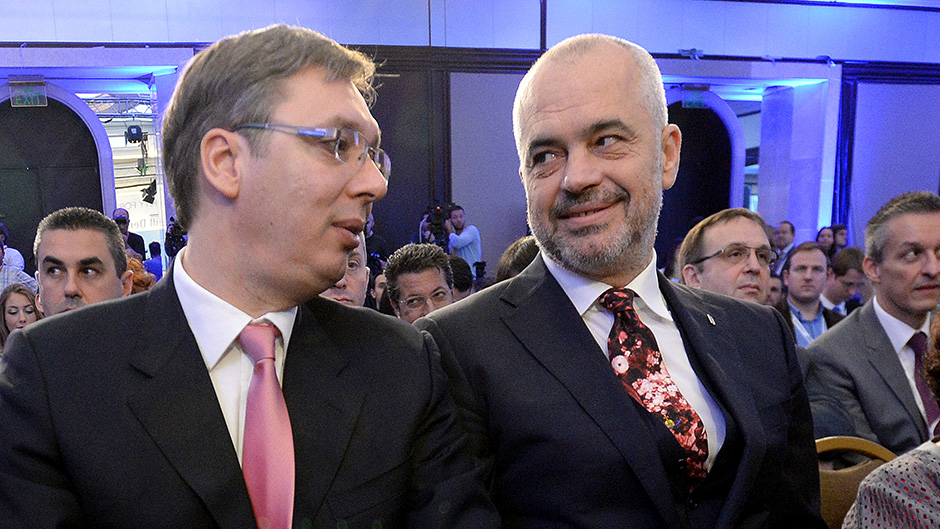
The first memes that spread in Tirana after Aleksandar Vučić’s electoral defeat in Belgrade portrayed Edi Rama as deeply despondent. Their creators’ instinct had caught the visible side of the relationship between two strong Balkan leaders, but perhaps not its core. Rama and Vučić have never liked each other. On the contrary, they have quietly despised one another. Two personalities as alike as they are, like one pine tree resembling another in the forest, have no chance of getting along. Interest brought them together. Over the past 12 years of their relationship, together they have been far more than they would have been apart. They have been two horses pulling each other’s cart of power, each looking after his own private interest. Two twins who have shared the same boundless love of power.
Only by seeing them as a binomial of interest can one understand not only their political longevity in Tirana and Belgrade, but also the symbiosis and the unusual chemistry of two strong leaders with absolute influence not only in their own countries but across the whole Balkans. Most likely, they also influenced the shaping of a new, non-traditional approach that the West has had toward the region. Rama and Vučić were aspirin for the West’s headache whenever it had to deal with Balkan stubbornness, in which every stone of its history built a wall of isolation between its nations. They can be explained and understood neither by political psychology, political history, nor the games of circumstance alone; their portrait comes to light only if light is cast on them with the fantastic tools of literature. Political literature and psychology give both of them an almost common costume in color, shape and model.
How alike the “part-time” Europeans of the Balkans are
Both leaders, Vučić, just defeated, and Rama, under pressure to leave, share the same deep personal and political narcissism. Both see themselves as messianic gifts that a divine fate has reciprocally bestowed on Albania and Serbia. The first, as the sacrificed savior, who does not sleep and does not even take vacations on the coast for the sake of his country, without access to the sea and surrounded by enemies; the second, as the only offer to make Albania an aesthetic and European oasis. Both have identified themselves with the state and all its institutions; both consider themselves infallible unitary figures, to whom everyone else need only submit and follow their vision and dream. They describe themselves as the only hope for a future staged like a set; a hope that could be realized only if they themselves remain in power.

Both Balkan leaders are obsessed with the need for control. They do this in a capillary way, by concentrating and centralizing power in one hand on the one side, and by being increasingly intolerant and extreme toward criticism. Whether it comes from the opposition, civil society or even traditional media and social networks, or when it comes from the street. By closing this door of external influence on their will, together, with a somewhat strange symmetry, strangely flexible to the extreme, neither of them is held hostage either by their past or by the positions they have held over time.
The so-called anarchist Rama, an ideologue of the far right but without any Albanian tradition, has moved across an extremely broad spectrum. He has moved from the desire to “hang the communists by the rope” in the early 1990s and the need to free himself from the spiritual hostage-taking that had made society “the underwear of Violeta Manush,” to becoming a father to the many poor and unfortunate of Albania. And now, in a more modern way, to return to self-nomination as the chief executive of a handful of VIP businesses in the country and guardian and guarantor of local and transnational occult interests.
Vučić found it easy to make a similar leap, replacing the harsh Balkan image of the ultranationalist and minister of Milošević with that of a pro-European leader and a delicate dancer between the US and Europe on one side and Russia and China on the other. With one foot in the bed of the Western lover, appearing Western in front of the Russo-Chinese East, and the other foot in the bed of the Eastern spouse, appearing Eastern in front of the West, Vučić was first understood as such by Rama himself. Vučić is the example of how, for an autocrat, ideological affiliation has no value before staying in power with anyone at any price.
This shared psychological background, common interests and mutual ambitions, the two authoritarian leaders of the Balkans have blended fantastically. Their shared egoism and the need to stay in power were an irresistible invitation to build bridges for each other, even where normal logic would have required building temporary walls. Pragmatism led them into a political brotherhood, creating a personal relationship that became ever more so, the more they were stripped of any role and possible influence by traditional institutions of foreign policy. In this way they increased their personal stakes. Less within the local political scene and much more in the international arena. Rama placed Vučić in the showcase of the Serbs differently, of the Serbs of peace who did not a priori hate Albanians; Vučić gave Rama the opportunity to appear as a leader with the stature of a supra-regional statesman and a role that exceeded the natural borders of the country where voting took place.
The alliance of peace between men of war
If the axiom “Without peace between Albanians and Serbs, the Balkans itself cannot have peace!” is accepted as true, the Rama–Vučić symbiosis was the dream offer of the West. With the diligence of an ant and the persistence of a bee, they gave the West what it wanted, the easiest and most direct solution. They demonstrated to the West that if Albanians and Serbs found the right leaders – and by this they meant each other – the Balkans could have a tomorrow different from what the recent and distant history of the region suggested. This, and only this, has been the main reason why the two of them together were, for a long period, the West’s favorites. This, and only this, has been the reason why local and regional stability made it possible to turn a blind eye and refuse to see the violations, the erosion and the gradual, unstoppable undermining of democratic standards in Albania and Serbia. By creating a new balance between them, one that is not fair, not compatible with the spirit of the West, and to the detriment of local democracy, to the point of electoral autocracy and hybrid democracy.
Vučić lost the elections and went into opposition after 14 years in power. Under pressure from protests for nearly two years, the autocrat of Belgrade could not survive any longer. It is not known what role the international factor played in this defeat. Vučić himself has accused European states and the Deep State in the US of bringing him down. In fact, the elections were a broad popular referendum against endemic corruption and against Vučić himself. Just as had happened earlier in Hungary with another long-lived autocrat.
Vučić’s fall, what will happen to Rama?
For at least five months, since protests against him began in Tirana, turning violent this October, Rama has seen himself at the center of an international conspiracy. On his list of enemies he lines up everyone from President Trump’s enemies in America to America’s Iranian and Russian enemies. This is an unverified claim, but it is one of the many signs that proves Rama has lost the controversial charm with which he was seen in the West. The darling of the international media, who had created a lazy cliché about the former basketball player from Gjirokastër and the best painter among all the prime ministers of the world, has now become the preferred target of precisely those same outlets. Vučić’s fall is now for Rama like a body temperature drop in a person who needs to keep running.
Rama was never Belgrade’s hireling, as Berisha accuses him of being. On the contrary! Vučić has tilled, with longing, desire and passion, the field of Rama’s power in Tirana, but for his own personal interest. And in return, Rama has done the same for Vučić in Belgrade. Together they are two atypical horses that have pulled the same yoke of power. Now that the Serbian horse has fallen, Rama needs much more strength to pull his cart alone. He faces against him the circumstances, fatigue, the uphill climb of a fourth mandate, and a people angered by endemic corruption and poverty that seeks revenge with boulevard stones. How long will it last? Paradoxically, Rama himself holds this in his hands. Perhaps the fantastic song of the sirens of power prevents him from hearing the alarm bells ringing to the rhythm dictated by the philosophy of the early tirons peasant:
Don’t yield to the first bargain!