







By Skënder Minxhozi
In short, the people are watching Tirana burn from their balconies, while students have no accurate information. Most likely, after the universities closed two weeks ago, they returned home to wait for this madness of stones and violence to end.
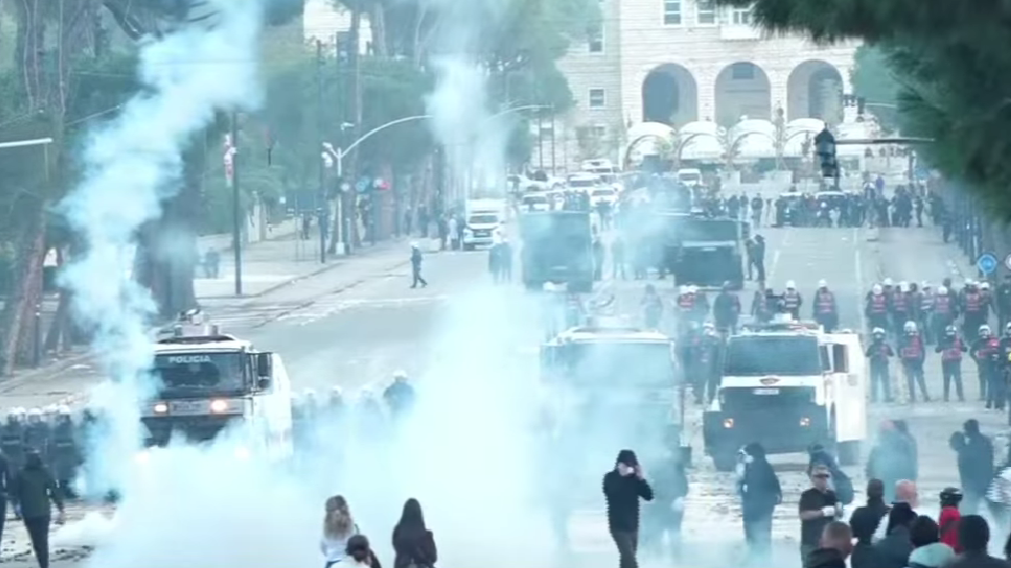
For two weeks, the violent protest by a minority of opposition supporters and young people has plunged the capital of Albania into a tunnel of smoke and flames. A crowd that does not exceed two or three thousand people, led by a masked commando that spreads destruction through the streets, burning and destroying private property, banks, state institutions and road signage. A commando that has become a nightmare for a city whose collective memory is heavily burdened by acts like these.
For four consecutive months, from June to September, the capital was in the hands of protesters. More than 130 days of daily protests that started and ended by the exclusive decisions of the organizers. Total freedom in a space also lived in by hundreds of thousands of others, who had to find a way through every day. Protesters blocked roads, parks and urban centers at will, harassed customers in bars and restaurants, and had built routes that completely disregarded the traffic jams they caused and people’s movement around the city. Tirana lived to the pulse of a daily protest that was shrinking, yet was still accepted as such, by citizens and by authorities alike. It had been agreed that it would coexist with the protest, and so it did.

For 14 days, the “music” has changed. The plastic flamengos have been thrown into the Lana, while the protest itself has put on a mask and calls itself a revolt.
As usually happens, with the shift from peace to violence, it has shrunk and dwindled, no longer drawing more than a few thousand people, including opposition supporters and people of the second and sometimes third age who come out to the squares. For instance, on a Sunday like today, there are more police and media people on the boulevard than protesters.
The protest has put on armor but has not become more attractive. The opposite is true. Beyond the general sympathy it created among citizens at its beginning, it has left Tirana’s 700,000 residents practically indifferent these months. In these dramatic hours, as the city center catches fire and streets, institutions and businesses burn, Tirana’s residents are watching the protest with despair from their balconies and televisions in their homes. And this is a simple and great truth that can be easily proven.
Saturday’s protest de facto contained three protests within itself: teachers, the opposition and students and high school pupils. For the opposition, it was even described as a “national” protest. A great irony, when you saw how few people Berisha had gathered on the boulevard.
There are two figures no one talks about, yet they are in fact the key to understanding what is happening. According to those who work in education in Tirana, around 80 thousand university students are enrolled, spread across public and private institutions of higher education. There are also about 19 thousand high school students registered. So, a community that in principle would have ties to the protest, of nearly 100 thousand young people. An extraordinary potential of civic, intellectual and transformative energy, in the face of which any government would capitulate.
Yet, facing this potential that is impressive on paper, at the protests called in the name of students and high school pupils, participation usually does not exceed two or three thousand people. Even assuming that all participants are students or high school pupils (in fact there are quite a few 30-50 year olds there too), this figure represents only 2% of their community in the capital. Where are the other 78 thousand students? Why haven’t they also come down to the boulevard to topple the dictatorship? Why aren’t they also tearing up paving stones and throwing Molotov cocktails at the 100-year-old buildings in the center of Tirana?
The paradox is telling: in a capital with 99 thousand university and high school students, 97 thousand of them apparently are not drawn to the protest. Of course, participation in a protest is not a referendum. Just as non-participation does not automatically imply opposition to what the protest demands, nor political indifference. Still, this large gap in figures calls for an answer. And above all it calls for a reading that is not that of those who shout to the heavens about state violence, when, while in power themselves, they used violence in far more extreme and bloody forms.
In fact, the two thousand young people who take to the square are not the problem. They are exercising a right, of course up to the moment they abandon the slogans and pick up petrol bottles. The real problem is the claim of them and others who join the protest while removing themselves as students although their hair is white, that they represent the entire Albanian people. When you hear it said that today the people demanded Rama’s departure, you feel like asking, “Where is the people?” And why not also ask, “Where are the 78 thousand students?” High school students we are not putting into the equation, because they are a temporary presence at the protests.
To overthrow the entire political system at once, and to send both Rama and Berisha to prison hand in hand, people are needed. Many people, in fact. Numbers have weight and importance because numbers create the atmosphere and frighten the political elite. Without numbers there is no spirit of change. A protest that claims sublime objectives and historic proportions cannot achieve this with a few hundred or a few thousand people in the square. The ruling political class does not take into account a few hundred and a few thousand, however cynical this may sound. It takes into account tens of thousands and above, even in a small country like ours.
The protest lost its moment when it brought tens of thousands of people into the square in June. It said it has no desire to enter politics and no intention to create a challenging project. It aimed to tear things down without getting its hands dirty with the mortar and bricks of the builder. In this way it lost the interest and trust of the people of Tirana and Albanians, degenerating into violence and a total lack of direction and perspective./JavaNews