







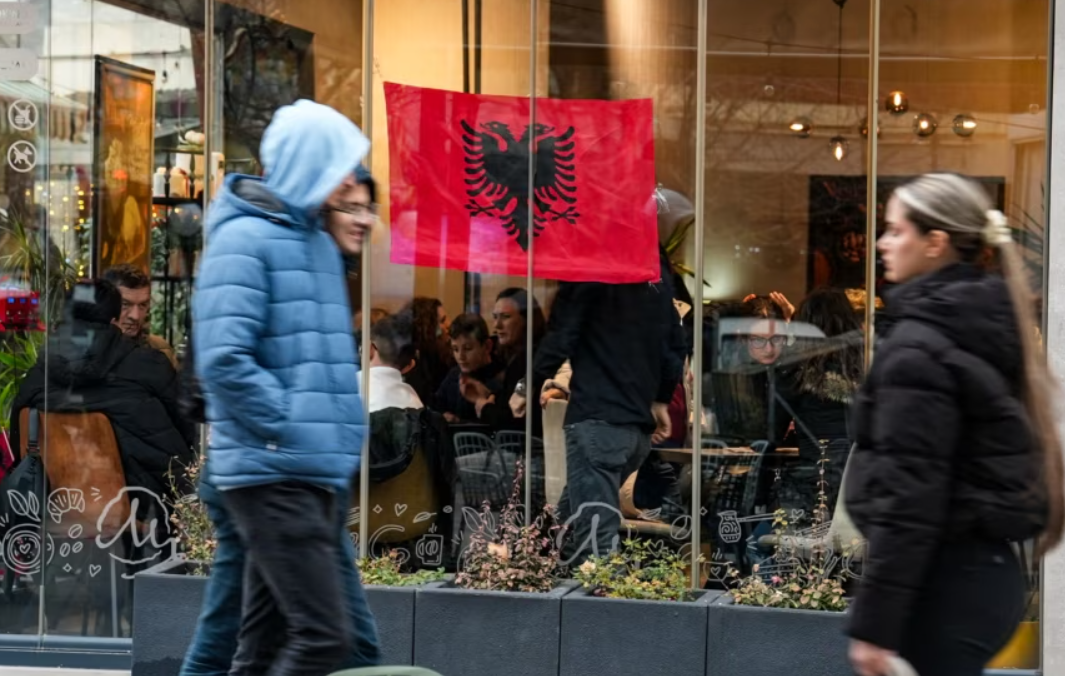
For Albanians in Kosovo, November 28 marks the anniversary of Albania’s declaration of independence, but the symbolic and emotional significance this date retains is also tied to the historical aspiration for national unification.
“On a symbolic level, Flag Day and Independence Day merge into a single feeling for us in Kosovo, because they represent our national survival and identity after a long period of occupation,” political scientist Dritëro Arifi tells Radio Free Europe (RFE).
What meaning has the idea of national unification taken on since Kosovo’s declaration of independence, and what place does it occupy in the country’s politics today?
The Vetëvendosje Movement (LVV), which is in power, includes national unification in its party program. Representatives of opposition parties, meanwhile, speak of completing Kosovo’s statehood, cooperation with Albanians in the region and the possibility of rapprochement within the framework of the European Union.
According to some of those interviewed, this aspiration, once tied to the creation of a single state, today may take shape through the rapprochement of Kosovo and Albania as two states of one nation, with cooperation and Euro-Atlantic integration, but it is often used as electoral rhetoric.
How did the idea of national unification change?
The idea of the political unification of Albanians had begun to take shape earlier, in the 19th century, with the National Renaissance and the Albanian League of Prizren, explains historian Durim Abdullahu, a lecturer at the University of Prishtina.
According to him, the idea took a different direction after the determination of Albania’s borders in 1913 and their confirmation in 1921. During the 20th century, he says, it was kept alive through political and armed resistance.
But in the late 1990s, according to Abdullahu, this idea gave way to the cause of the country’s liberation.
“The 1998-1999 war in Kosovo is another key and pivotal period when the idea of ‘national unification’, namely the political unification of Kosovo with Albania, was quietly set aside in a passive manner, with emphasis placed on its first part: the liberation of Kosovo,” Abdullahu tells Radio Free Europe.
After the war, and especially after Kosovo’s declaration of independence, Abdullahu says NATO and the European Union began to be seen as spaces where Kosovo and Albania could draw closer politically.
Shemsi Krasniqi, a sociologist, links this change also to the creation of Kosovo’s state institutions, which opened the way for cooperation between the two countries through institutional actions and through interstate and intergovernmental policies.
“If in the past various illegal organizations and movements operated with the aim of using various means to realize this idea, today many of the ideas and desires related to national unification have become reality,” he tells RFE.
Today, as the idea of national unification continues to carry historical and symbolic weight, political parties in Kosovo give it different places in their programs and priorities.
Among the Albanian parties in Kosovo’s political scene, only the LVV includes national unification in its party program.
Before it came to power, LVV used the red-and-black flag at rallies and opposed Kosovo’s state flag.
After LVV’s first election victory in 2019, its leader, Albin Kurti, speaking about national unification, told Top Channel that “we have not given up; we have not changed the concept, but the method and strategy, yes.” After taking office as prime minister, Kurti appeared in several interviews with Albania’s flag alongside Kosovo’s.
LVV MPs have occasionally used the red-and-black flag in the Assembly as well. It has also been used at some of Kurti’s party rallies with the diaspora, where Kosovo’s flag was absent.
LVV representatives did not answer Radio Free Europe’s question on whether the party still supports Kosovo’s unification with Albania. Nor have Kurti’s latest statements clarified this position.
“The Republic of Kosovo is separate, but not detached from the Albanian nation,” Kurti declared on November 24, during a solemn reception in Pristina organized by the Albanian Embassy on the eve of Albania’s Independence Day.
Highlighting that so far around 190 cooperation agreements have been signed, implemented or are in the process of implementation between the two countries, Kurti described relations with Albania as “fraternal and strategic for the entire nation, but at the same time also for peace and security in Southeastern Europe.”
Unlike LVV, the two largest opposition parties do not have political unification as part of their current programs, although some of their representatives link this idea to possible developments in the future.
Elmi Reçica, a member of the presidency of the Democratic Party of Kosovo (PDK) and an MP of this party in the Assembly of Kosovo, says that neither the parties nor the citizens have emotionally given up on this idea, although this cause is not part of their program.
“PDK’s current commitment is the completion of Kosovo’s statehood, to be a state within Euro-Atlantic structures, first and foremost in NATO and the EU,” says Reçica, adding that national unification can be experienced under the EU umbrella when all countries where Albanians live become part of it.
Nor does the Democratic League of Kosovo (LDK) place political unification at the center of its orientation.
LDK deputy chairman Lutfi Haziri says that in this party’s mission and policies, inter-Albanian cooperation is seen at the level of regional cooperation: with Albanians in North Macedonia, the Presevo Valley, Montenegro and Albania.
He describes politicians’ rhetoric about unification as something done for “domestic consumption and electoral gains.”
Haziri recalls that Kosovo’s statehood is the result of international compromises and the principles of the 1991 Badinter Commission, according to which the internal administrative borders of the former Yugoslav republics were transformed into inviolable international borders.
“This means that Kosovo cannot, in any form or under any circumstances, return under Serbia, but this also conditions its unification with Albania. We have preserved, are preserving and will continue to preserve these principles,” Haziri stresses for REL.
According to political scientist Arifi, national unification is no longer treated by parties as a political cause, while its electoral potential has also faded. He says that even where this idea appears in party documents, it is not accompanied by concrete steps for its realization.
“It is true that only the Vetëvendosje Movement has formally articulated it, but in practice this has remained at the theoretical level. Indeed, even after its coming to power, we have not seen more advanced relations between Kosovo and Albania,” says Arifi.
Sociologist Krasniqi sees this issue also from the perspective of social support. According to him, precisely because national unification is a “consensual value of the nation,” parties and interest groups can use it to secure political support.
But Krasniqi assesses that state realities do not change quickly, therefore he describes statements about national unification as insincere.
“Party or group leaders often abuse this idea because of the benefit it brings, primarily the benefit in support and legitimacy. Statements and references to this idea are not always sincere, because historical realities are not created easily and quickly,” Krasniqi tells Radio Free Europe.
According to historian Abdullahu, the idea of national unification is used for political purposes outside Kosovo as well. He says that Serbia continually presents the unification of Kosovo with Albania as a threat to the region and uses this argument to oppose the two countries’ rapprochement with the EU and NATO.
“The Serbian state has denounced every idea of the political unification of Albanians, presenting it in the form of an accusation called ‘Greater Albania,’ a designation that in reality has never existed as a political project among Albanians,” assesses Abdullahu.
Albanian identity in Kosovo and cooperation with Albania
The debate on national unification is not only about the possibility of creating a single state, but also about the relationship between Albanian national identity and Kosovo’s state identity.
Sociologist Krasniqi assesses that these two identities do not exclude each other, but have developed in harmony.
He opposes the practice of some public figures in Kosovo who refer to Albania as the “mother state,” emphasizing that Kosovo is the state of its citizens, while both countries have common historical and national roots.
“It has happened that we hear even politically active Kosovars refer to Albania with the concept of ‘mother state.’ This is like not seeing the mountain for the trees. Our ‘mother’ or ‘father’ state is Kosovo,” Krasniqi tells REL.
He adds that, despite Kosovo’s multiethnic constitutional arrangement, the strengthening of Kosovar identity does not diminish Albanian belonging.
“There is a certain subordination between these two identities, and Albanian identity includes the Kosovar one within itself. The simple and clear truth is that we are one nation with two states. On the contrary, being Albanian and the need to preserve Albanian identity in Kosovo as well has also created the Kosovar state,” argues sociologist Krasniqi.
For political scientist Arifi, the question raised today is how Kosovo and Albania, as two states of one nation, can deepen cooperation between them.
He criticizes the lack of state pragmatism in relations between Pristina and Tirana. According to him, although dozens of intergovernmental agreements have been signed since Kosovo’s declaration of independence, accountability for their implementation and a stable integrative policy that does not depend on changes of government have been lacking.
Referring to the 2007 platform, “Sketch for Common Welfare,” by the late Albanian intellectual from North Macedonia, Arbën Xhaferi—which proposed integration through common democratic, economic and cultural standards without touching borders—Arifi says the solution lies in the unification of public policies.
“According to this approach, the Albanian nation can truly evolve only when it unifies standards in all dimensions of public policy, without this needing to conflict with the reality of two separate states,” explains Arifi.
He adds that this process does not hinder integration into the European Union and NATO, but complements it.
“These two processes, Western integration and the unification of national standards, do not exclude each other; they complement and accelerate our internal development as a nation within the Euro-Atlantic architecture,” he assesses.
On the future of national unification, positions differ depending on how Euro-Atlantic integration developments and possible geopolitical changes are viewed.
Sociologist Krasniqi, meanwhile, links the future of this aspiration to historical developments that cannot be fully determined by political parties. According to him, under today’s conditions of freedom and democracy, which Kosovo is claimed to have, the realization of the aspiration for national unification is expected to occur within Euro-Atlantic integration./REL/
Bekim Bislimi