







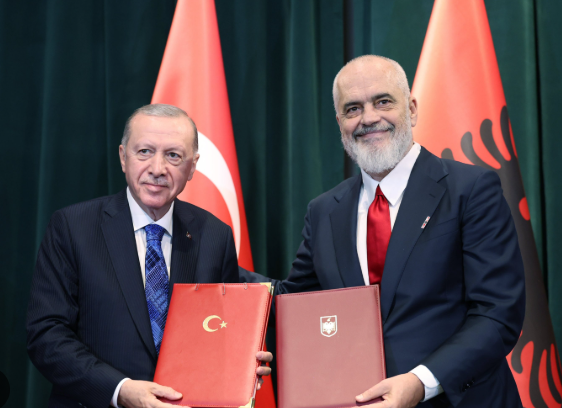
Berat Buzhala-
Mediat e afërta me Erdoganin e godasin Ramën për lidhjet me Izraelin. Nga përplasja për kontrollin e KMSH-së, te Xhamia e Namazgjasë, shteti bektashi dhe protestat në Tiranë: çfarë fshihet pas tensioneve dhe çfarë na zbulon rasti i Azerbajxhanit?
Partia në pushtet e presidentit Ilham Aliyev i kërkoi publikisht Turqisë që të mos ndërhynte në punët e brendshme të Azerbajxhanit.
Madje, në reagimin e saj, ajo i kritikoi edhe mediat turke të afërta me partinë e Erdoganit, duke i akuzuar për shpërndarje të informatave të pavërteta dhe për përpjekje për të ushtruar presion politik mbi Bakunë.
Tash, kush i njeh sadopak marrëdhëniet ndërmjet Turqisë dhe Azerbajxhanit, e kupton se sa e pazakonshme është një gjë e tillë.
Këto dy vende nuk janë thjesht aleate.
Ato e konsiderojnë veten një komb, dy shtete.
Turqia e ka ndihmuar Azerbajxhanin në aspektin diplomatik, politik dhe ushtarak. Marrëdhëniet e tyre janë shumë më të thella sesa marrëdhëniet që Turqia i ka me pothuajse cilindo shtet tjetër.
E megjithatë, ja ku jemi.
Azerbajxhani po i thotë Turqisë: mos na ndërhyni në punët e brendshme.
Po çfarë ndodhi?
Në Azerbajxhan, autoritetet kishin vendosur rregulla të reja për uniformat shkollore, duke u thirrur në karakterin laik të shtetit dhe të sistemit arsimor.
Rregullat nuk e përmendnin shprehimisht shaminë, mirëpo në disa shkolla ato ishin zbatuar në atë mënyrë që vajzave dhe mësimdhënëseve me shami nuk u ishte lejuar hyrja.
Në këtë debat u përfshi edhe këshilltari i Erdoganit, Oktay Saral, si dhe disa deputetë të partisë së tij.
Ata e kritikuan ashpër Azerbajxhanin.
Pastaj erdhi reagimi i partisë së Aliyevit.
Ju mund të mendoni se reagimi kishte të bënte vetëm me shaminë.
Jo tamam.
Në atë reagim kishte edhe një pjesë interesante, por familjare me zhvillimet e fundit në rajonin tonë.
Zyrtarë dhe media turke e kishin kritikuar Azerbajxhanin edhe për raportet që po i ndërtonte me Izraelin.
Partia e Aliyevit e mbrojti shprehimisht të drejtën e Azerbajxhanit për të pasur marrëdhënie me Izraelin.
Ajo tha se këto marrëdhënie bazohen në interesat e Azerbajxhanit, në të drejtën ndërkombëtare dhe në sovranitetin e shtetit.
Tash, më lejoni ta shtroj një pyetje.
Nëse e gjithë kjo histori filloi për shkak të shamisë, pse doli Izraeli në mes?
A ishte shamia vetëm shkas?
Dhe, sipas meje, ky është një detaj që na ndihmon t’i shikojmë pak më ndryshe disa zhvillime edhe në Shqipëri.
Çfarë po shkruajnë mediat e afërta me Erdoganin për Shqipërinë?
Sot, gjatë ditës, jam interesuar për të parë se çfarë shkruajnë për Shqipërinë mediat turke që janë të afërta me presidentin Erdogan.
Si e kanë trajtuar krizën? Kush po proteston dhe pse po proteston, sipas këtyre mediave?

Në Turqi ekzistojnë disa grupe mediatike me ndikim të madh, që kanë lidhje të ngushta me presidentin Recep Tayyip Erdogan dhe me partinë e tij AKP.
Njëri është grupi Turkuvaz, ku bëjnë pjesë Sabah, A Haber dhe Daily Sabah.
Në drejtimin e këtij grupi është Serhat Albayrak.
Serhati është vëllai i Berat Albayrakut, ish-ministrit turk të Financave dhe dhëndrit të Erdoganit.
Pastaj e kemi gazetën Yeni Şafak.
A major newspaper with influence on Turkish conservative opinion, owned by a different Albayrak family that has no familial ties to Erdogan’s son-in-law.
But it has long-standing political closeness to the Turkish president.
Now, look at what these media have written.
On June 7 of this year, Türkiye Gazetesi published an article with this headline: “Revolta e shqiptarëve kundër Izraelit” (“The Albanians’ Revolt Against Israel”).
Please, read this headline once more.
The Albanians’ revolt against Israel.
Not the revolt over the flamingos.
Not the revolt over Zvërnec.
Not the revolt against corruption.
But the revolt against Israel.
In that article, journalist Yılmaz Bilgen argued that Israel was trying to draw Albania into a strategic axis that would encircle Turkey through Greece, Cyprus and the Adriatic.
An Albanian protest was interpreted through the lens of Turkey’s strategic interest.
On June 12, Daily Sabah published an analysis by Canan Tercan titled: “Loja e Re e Madhe në Ballkan” (“The New Great Game in the Balkans”).
That analysis mentioned Jared Kushner’s investments in Albania, Edi Rama’s ties with Israel, security issues and, strangely for those who have not followed these developments, the project of a Bektashi state.
All of this was presented as part of a larger geopolitical race for influence in the Balkans.
On July 4, A Haber published another article.
“Partneriteti i përgjakshëm në Shqipëri” (“The Bloody Partnership in Albania”) was the title.
The article dealt with Albania’s military cooperation with Israel, with the training of special forces and with the links between Albania’s defense industry and Israeli companies.
The language was extremely harsh toward Rama.
The same article also addressed the protests against Kushner’s investments.
Then, on October 13, Yeni Şafak published another piece with a headline that, in translation, reads: “Kthetrat e atyre që kryejnë gjenocid mbi Shqipërinë” (“The Claws of Those Committing Genocide Against Albania”).
It criticized the deepening of cooperation between Albania and Israel despite the protests taking place in the country.
Now, what do I mean by these articles?
That Erdogan dictated the headlines to journalists?
No.
Do I mean that these newspapers are organizing the protests?
No.
What we can say is that part of the media close to Turkish power features a recurring narrative that portrays Edi Rama’s Albania as a country where Israel is expanding its influence to the detriment of Turkish interests.
And this narrative did not start yesterday.
It has been building for months.
Indeed, some of its elements are older than the protests.
The question here is not whether criticism of Israeli policy is fair or unfair.
We are talking about a completely different issue here.
Who should determine Albania’s foreign policy? Albanians, or the geopolitical preferences of another state?
And here the story becomes even more interesting.
What problem does Turkey have with a Bektashi state?
Edi Rama has proposed the creation of a sovereign Bektashi state in Tirana.
An unusual project, about which there may be many debates.
I myself am not sure that this is a good idea.
There are constitutional, institutional and religious questions that deserve answers.
On September 22, Yeni Şafak published an exceptionally interesting analysis titled: “Against religious engineering in the Balkans.”
The author argued that the Bektashi state project was not merely a religious initiative.
According to her, it could be part of a strategy to weaken Turkey’s historical and spiritual influence in the Balkans.
Indeed, that analysis also mentioned Baba Mondi’s relations with Israel.
Now, notice what is happening.
An Albanian prime minister proposes an initiative within the territory of Albania.
That initiative may be wrong. It may be unconstitutional. It may even be completely unnecessary.
But in a newspaper close to Erdoğan, one of the main questions is this: what influence would Turkey lose if this project is realized?
Why should this be the decisive question?
Why should Turkey’s influence over the religious life of Albanians be treated as a right that must not be touched?
Because Albania is not a province of Turkey.
It has never been one, and it should not become one.
And here I come to an even more serious story.
In October 2024, journalist Vladimir Karaj published an investigation into the Namazgjah Mosque in Tirana.
The mosque had been built with financial support from the Turkish state institution Diyanet.
But although the works had been almost entirely completed many years earlier, the inauguration was repeatedly postponed.
Why?
According to the investigation, one of the reasons was the clash between Turkish authorities and the leaders of the Muslim Community of Albania over the administration of the mosque.
Now, listen carefully to this part.
Former chairman of the Muslim Community of Albania, Skënder Bruçaj, had told BIRN that problems with the Turkish institution Diyanet had begun as early as 2014.
According to him, the Turks had asked that KMSH end its relations with the Sema Foundation, which financed and managed madrasas in Albania.
They then also demanded the appointment of several Turkish imams.
But the most interesting demand was that imams could be appointed or paid by Diyanet.
Do you understand?
We are no longer talking only about a state that wants to build a mosque in Albania.
We are talking about a foreign state institution seeking a role in the appointment or financing of imams.
If an imam is paid by an Albanian religious institution, he has an institutional relationship with that community.
But if he is paid by an institution that depends on the Turkish government, then there is at least the possibility that the financing could become a tool of influence.
This does not mean that every imam financed from abroad is a political instrument.
But it is a very serious question about the autonomy of a religious institution.
Bruçaj had said that KMSH could not accept such a demand, precisely because Diyanet is a state institution, while KMSH must be an autonomous institution.
And this was only the beginning.
Because in this story there is another person.
Bujar Spahiu.
The current chairman of the Muslim Community of Albania.
For years, circles close to Erdoğan have accused the leaders of KMSH of links with the movement of Fethullah Gülen.
Gülen was Erdogan’s biggest political enemy after the failed coup attempt of 2016.
Turkey has declared his movement a terrorist organization, calling it FETÖ.
This was the context in which Erdogan was exerting pressure on Albania.
In January 2022, during his visit to Tirana, Erdogan publicly demanded concrete measures against the structures he called FETÖ.
And this is where Edi Rama’s diplomatic game begins.
Rama between Erdogan and the Americans
Edi Rama has had very good relations with Erdogan; he even seemed like a vassal, seemed like Erdogan’s lackey, and for this I personally have written countless times.
It seemed to me that Albania was selling its sovereignty, which it is paying for today.
Rama and Erdogan have met many times.
They have cooperated in economy, security, the military and diplomacy.
But it seems that in the matter of the Muslim Community, Ankara’s interests and demands did not always align with the positions supported by American partners.
Because the Americans have also had continuous relations with KMSH.
In 2023, during a joint activity, Bujar Spahiu said that the Muslim Community, in partnership with the American Embassy, had carried out several projects against violent extremism.
In December of that same year, the chargé d’affaires of the American Embassy, David Wisner, visited Spahiu and praised the cooperation with his institution.
These are public facts.
Politically, Rama has tried to maintain relations with both sides.
On one hand, Erdogan demanded measures against those he considered Gülenists.
On the other, the Americans had institutional relations with KMSH and supported religious autonomy.
And Rama, for a long time, managed to keep a certain balance.
Until the issue of the Namazgja Mosque arose.
In October 2024, Erdogan went to Tirana and inaugurated the mosque together with Rama.
But Bujar Spahiu was not at the ceremony.
The top leaders of the Muslim Community, which was the legal owner of the mosque, were not invited.
Instead of direct administration by KMSH, the formula of a joint foundation to manage the facility was found.
So, a compromise was found.
Spahiu remained head of the Muslim Community.
Erdogan inaugurated the mosque.
Rama was there.
And Namazgja opened.
But the question of the extent of Turkish influence over its administration remained open.
For me, this is the most significant part of the whole story.
Because it shows that the Rama–Erdogan relations have also included disagreements that were not always displayed at press conferences.
It is hard to say that Erdogan is irritated with Rama precisely because of Bujar Spahiu and all the things I have noted above.
But I can say that there is a documented history of attempts to influence the direction and administration of Albanian religious institutions.
And this history did not begin with the flamingo protests.
From Namazgja to the streets of Tirana
Now, knowing all this, I want to return once more to the protests in Tirana.
Because there is one element that has struck me since their beginning.
In photos and footage of the protests, the very large presence of women wearing headscarves and men with beards was noticeable even to the naked eye.
In my judgment, their participation was even noticeably disproportionate compared to the percentage these groups represent in Albanian society.
I am not talking about any official participation statistics.
I am talking about what I have seen myself.
But there is also something much more concrete.
Active participants in the Tirana protests have also included most of the staff of the Namazgjah Mosque.
And I am not saying this based on rumors.
I have seen their photographs.
I have seen members of this mosque’s staff actively involved in the protest.
So, we are not simply talking about some believers who, after performing prayer, decided to join a civic protest.
We are talking about organized participation, or at least a visible mobilization of people who work in a religious institution, whose administration has for years been the subject of clashes between Albanian and Turkish authorities.
And there is something else.
According to information I have, sermons have been held in some mosques spreading the message that Israel is taking over Albania.
Not because the environment is being destroyed.
Not because universities lack good conditions.
Not because there is corruption.
But because Israel is taking over Albania.
Now, doesn’t this coincidence seem interesting to you?
Türkiye Gazetesi reports on the outrage of Albanians against Israel.
A Haber reports on the “bloody partnership” between Albania and Israel.
Yeni Şafak reports on Israeli influence and on the danger that, according to its authors, the Bektashi state poses to Turkish influence.
And in Tirana, according to information I have, the same idea is repeated in some religious sermons: Israel is taking over Albania.
In my view, these are developments that cannot be ignored.
Of course, a headscarf or a beard is not evidence of political affiliation, nor of any illegal action.
But here we are not passing judgment on people’s faith.
We are analyzing a political mobilization and asking whether within it there are structures, interests and networks that pursue objectives different from the declared demands of the protest.
Does this mean that Erdogan organized the protests?
I cannot say that.
Does this mean that everyone who has taken to the streets in protest are instruments of Turkey?
Absolutely not.
But, knowing Turkey’s foreign policy, seeing its earlier efforts to influence religious institutions in Albania, seeing what is happening in Azerbaijan, and reading media close to Erdogan, it seems entirely credible to me that Ankara has concrete interests in today’s Albanian developments.
It would be difficult to prove that Turkey stands behind this entire protest. But, for me, it would be just as difficult to believe that Erdogan’s Turkey has remained completely neutral toward these developments.
And this is where the difference lies.
A foreign state does not necessarily need to create a protest in order to exploit it.
There can be genuine protests.
There can be genuine dissatisfaction.
There can be students, environmentalists and citizens protesting for entirely legitimate reasons.
But at the moment when a government weakens, when its authority wavers and when the street gains an ever greater political weight, the possibility opens for other actors to try to steer developments in their favor.
And this is exactly what we as journalists have the obligation to investigate.
I have nothing against Turkey as a state.
Quite the contrary.
We Albanians of Kosovo have many reasons to value Turkey’s role in the security of our region.
Turkey is a NATO member state. It has supported Kosovo in important processes and is an economic and strategic actor with weight in the Balkans.
Albania has no interest in having bad relations with Turkey.
But good relations between the two states cannot imply subordination and restriction of Albania’s right to an independent foreign policy.
After all, why isn’t Turkey upset with Serbia when the latter develops close military relations with Israel?
If Turkey is Albania’s ally, then it must also respect Albania’s right to have relations with Israel.
To cooperate with the Americans.
To decide for itself about its religious institutions, within the Constitution and the autonomy of communities.
To examine a Bektashi project without making it the final criterion whether Ankara likes it or not.
Just as it must respect Azerbaijan’s right to determine its own foreign policy.
Now, someone may say:
But the United States also exerts influence in Albania.
Of course.
Israel also has interests in Albania.
Naturally.
Even Jared Kushner’s investments must be looked at carefully because of his family ties to the American president.
But this does not automatically make every Kushner investment an operation of the Israeli state.
Just as criticism of an American investment does not make one an enemy of America.
And criticism of Israeli policy does not make one an instrument of Turkey.
Have a nice day.