







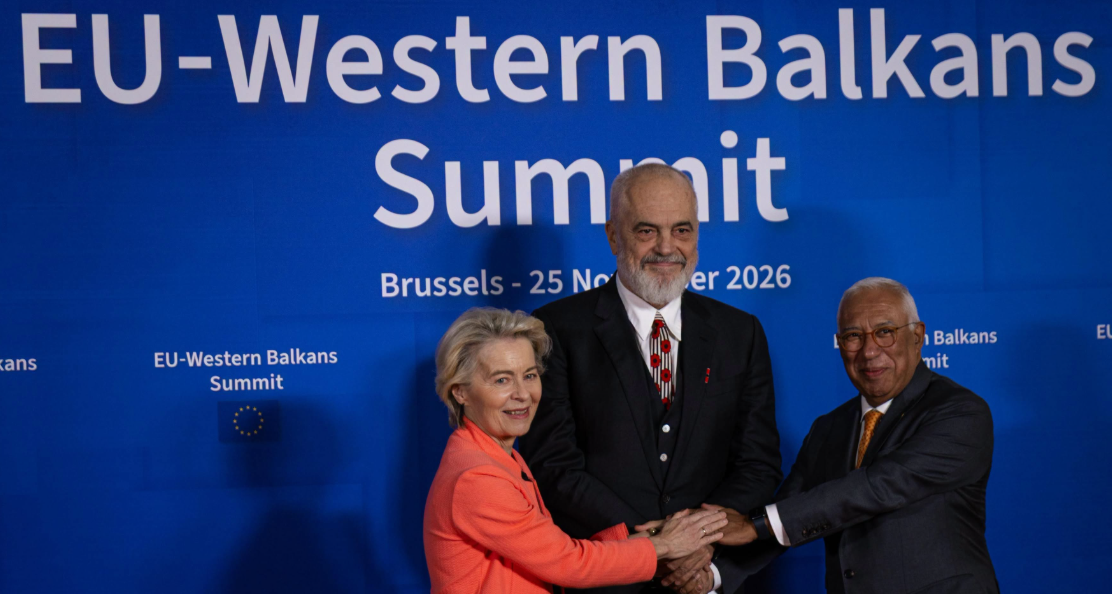
EU leaders and leaders of the Western Balkan countries gathered today at a summit in Brussels, which is seen as another opportunity for the institutions of the European bloc to reaffirm their commitment to the open-door policy for the countries of the region, if they advance in the reforms needed to move closer to European structures.
Hosts of this meeting are the heads of EU institutions: the President of the European Council, Antonio Costa, and the President of the European Commission (EC), Ursula von der Leyen.
According to reports, the leaders of five of the six Western Balkan countries will take part in the summit.
The summit is being held about six months after the summit in Tivat, Montenegro, which is the country with the greatest chance of becoming the next EU member. This could be the last EU-Western Balkans summit that Montenegro attends as a candidate country.
Podgorica is working intensively to close all negotiation chapters. The country hopes to complete the negotiations by the end of the year, so that it becomes an EU member during 2028. According to EC assessments, the Accession Treaty could be signed in June next year, when Montenegro will receive the status of an acceding country.
However, open issues with Croatia could become an obstacle to achieving this goal. Croatia is currently blocking the closure of three chapters in the accession negotiations between Podgorica and Brussels. The opening and closing of each chapter requires the approval of all EU member states. Podgorica is also under time pressure, as only about 20 working days remain in the EU calendar until the end of the year to achieve the set goal.
Meanwhile, after Montenegro comes Albania, which is moving rapidly toward the EU. Prime Minister Rama is at the summit.

Rama stated that Albania is working intensively every day in cooperation with the European Commission and that the process is proceeding according to plan.
“We are still waiting for the green light from the Commission, because, as everyone involved in this process knows, the Commission must always approve in advance the tasks we have to prepare,” Rama said.
Asked by journalists whether SPAK investigations into senior officials constitute a test for Albania, the prime minister assessed that the fight against corruption underway in the country is unprecedented in the region.
Rama emphasized that Albania has moved from a reality where corruption and a culture of impunity were considered systemic problems to a situation where the institutions themselves are fighting these phenomena.
“What Albania is doing against corruption is unprecedented in the region and is exactly the reason why Albania should be regarded as a very serious candidate country. If until not long ago Albania was always the country treated as the place where a culture of impunity had taken hold and where corruption had become systemic, today Albania is the country where the system is fighting corruption…Corruption or no corruption, everything of course must go through the proper process, but it is very clear that there is no longer anyone above the law in Albania. This is precisely the reason why Albania should be viewed positively,” Rama said.