







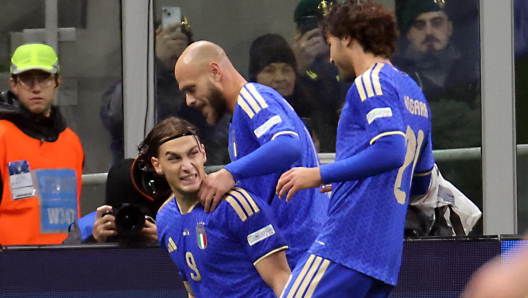
Roberto Mancini, as a reliable dispenser of talent, operates nonstop, 24 hours a day, seven days a week. In this second spell in charge of the Italian national team, as in the first, “Mancio” is building a team by relying on young players, undervalued players and those in difficulty. This is not just a statement but a reality proven in deeds: he gives them minutes and responsibility on the pitch. It is always a pleasure to see how these lads quickly repay his trust. The Italy-France match served as clear evidence, highlighting three names and three stories of personal regeneration, which confirmed the accuracy of the coach’s choices.
One of them was Nicolò Cambiaghi. On 9 July 2006, aged five and a half, he was with his father in Berlin at the “Olympiastadion” for the World Cup final. Twenty years later, he appeared again in another Italy-France match, this time wearing the national team’s blue, as Cannavaro once did. Mancini gave him a starting place, even though few would have put him on the pitch, since Nicolò had little “hype” and was almost unknown in France. Mancini’s plan was clear: one winger – Seba Esposito – could narrow to play between the lines; while the other, Cambiaghi, would stay wide to attack from the left. He did this perfectly, even better than he usually does with Bologna. He worked hard without the ball and, when his teammates gave him the ball, he challenged Malo Gusto. His moves were decisive: once he beat his opponent and provided the assist for Pio Esposito, another time he won a penalty. French journalists in the conference room looked at each other puzzled: “Where is this guy from?” From Vimercate, gentlemen, not far from here.
Antonio Vergara is not Max Allegri’s favorite player, which can be understood from Napoli’s rotations. Antonio started the match on the bench, got injured, found space in emergency situations, but did not play his best football. The San Siro crowd, when it saw that Mancini had included him on the bench rather than Cisse, turned up its nose. “How come, Alphadjo, the lad of the moment?” Not Alphadjo. After the penalty missed by Seba, “Mancio” decided to risk everything. Among all the players he had on the bench to change the course of the match, he chose Vergara. Then he explained: “I needed a player with good feet, quick.” And so it happened. Vergara, who in his soul is perhaps an attacking midfielder, deployed wide on the right, won the penalty for the 3-1 score, taking out Upamecano, who plays for Bayern Munich and has been a starter in a World Cup final. For one October evening, that is enough.

Going against the grain also worked with Federico Dimarco. “Dimash” is not the one from last season: he scores less, is less decisive in an Inter that has not changed that much. However, for some weeks he had looked brighter and Mancini knew it, saw it, even though the system with which he had built this new Italy did not help him. The left-back is more blocked – like Calafiori – and a versatile wide midfielder is not envisaged. For Dimarco, Mancini thought of a small revolution: to use him high, as a left winger. Federico entered that role when San Siro, his stadium, was still holding its head after the penalty missed by Seba Esposito. There was that inevitable feeling of defeat in the air. But no, Dimarco from the left sent a perfect ball – low, strong, to Frattesi’s foot – and the San Siro faithful turned to hug their neighbor. If one had to choose the most important move of the match, it was exactly this. These three stories clearly demonstrate Mancini’s vision of building a strong team by trusting players whom others may have overlooked, giving them the chance to shine and regenerate on the international stage.
Taken from La Gazzetta dello Sport