







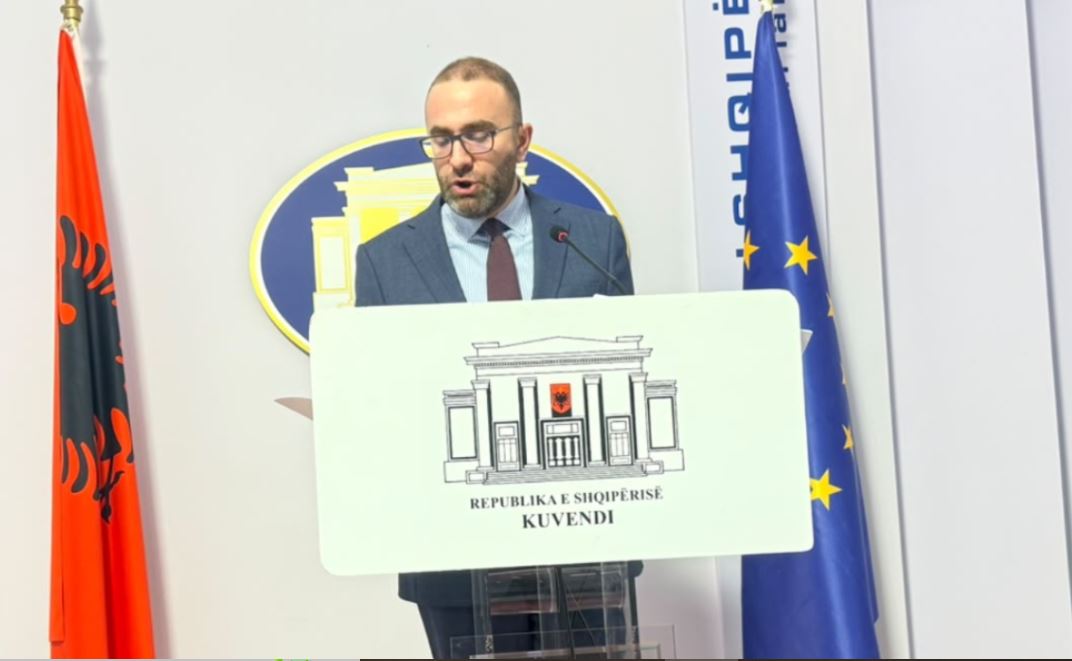
Gazment Bardhi announced that the Democratic Party has appealed to the Constitutional Court to repeal two normative acts and a decision of the Council of Ministers, which, according to the opposition, restrict citizens’ right to protest.
In a statement to the media from the Assembly leadership, Bardhi said that suspension of the implementation of these acts until the final review of the case has also been requested.
Bardhi’s full statement:
The right to peaceful protest is a fundamental right, guaranteed by the Constitution of the Republic of Albania and international conventions. It cannot be violated, intimidated, or extinguished through police violence, illegal escorts to police stations, or the imposition of fines in contravention of the law. Any attempt to prevent citizens from exercising this right constitutes an unacceptable violation of fundamental human rights and freedoms.
Today we are here to make public a clear political and constitutional position of the Democratic Party Parliamentary Group in the face of a government effort to bring citizens’ fundamental rights and freedoms under control.
We have filed a request with the Constitutional Court to repeal Normative Act No. 5/2026, Normative Act No. 6/2026 and Council of Ministers Decision No. 815/2026, dated 28 October 2026, and to suspend their implementation until the final review of the case.
This is not an attempt to give immunity to anyone who breaks the law. Nor is it opposition to the state’s obligation to guarantee public order and security.

It is a battle to protect the Constitution from a government that, falsely, in the name of public order, seeks to expand its powers beyond constitutional limits, with the aim of silencing the voice of citizens, effectively eliminating a constitutional right, the right to protest.
Because in a democratic state, public order cannot be established against fundamental freedoms. Security cannot be used as a justification for arbitrariness. And power cannot decide by itself which rights citizens may exercise and which must be taken away from them.
What we have before us is not an isolated legal intervention. These are three acts that, taken together, create an unacceptable, unconstitutional and arbitrary mechanism for restricting protests, punishing organizers and controlling citizens who take part in gatherings.
For this reason, the Democratic Party Parliamentary Group has decided to take two actions:
A request to the Constitutional Court to repeal all three acts adopted by the Government on protests.
A summons, before the Committee on Human Rights, of the General Director of the State Police to a accountability hearing, for the grave abuse of office in detaining and fining peacefully protesting citizens, as well as for the unprecedented violence the State Police has used against protesting citizens over 3 weeks.
We hope that the Constitutional Court will not only protect the Constitution, but will deliver this protection in a short time and with the urgency this case demands.
The three acts approved by the Government are clearly in conflict with the Constitution and the European Convention on Human Rights.
First, Normative Act No. 5/2026.
This act gives the State Police powers that directly affect citizens’ constitutional right to assemble and protest.
Under this act, the Police may ban or restrict gatherings in certain perimeters, for periods that can reach up to 72 hours and may be repeated. In other words, a fundamental right of citizens is placed under a regime of administrative restrictions, with direct consequences for its exercise.
But the problem does not end here. The act also gives the Police the power to order a person to leave a specific area for up to 48 hours.
I want to pause here, because this is a fundamental issue.
In Albania, measures that restrict personal liberty cannot be imposed at the discretion of an administrative body. The Constitution and the law have defined the competences of the court and the guarantees that must be respected before a measure affecting an individual’s freedom is taken.
It is not acceptable for the Police to take on powers that, by their nature and consequences, belong to the judiciary.
We cannot accept that a citizen be removed from an area, restricted in their movement and face such consequences without the necessary procedural guarantees and without effective judicial oversight.
The Police must enforce the law. They cannot be police, prosecutor and court at the same time.
Another extremely worrying element of this act is the power to demand the removal of content on social networks and online spaces when it is considered to incite violence.
No one can be opposed to punishing genuine and concrete incitement to violence. But who defines the line between incitement to violence and political criticism? Who guarantees that a position against the government, a call to protest or a harsh criticism of power will not be treated as prohibited content?
When the law does not clearly define the limits of this power and does not guarantee effective mechanisms of appeal, the door is opened to abuse.
As a result, these provisions undermine freedom of expression and create a chilling effect on citizens.
Citizens must have the right to speak, to criticize and to protest. We cannot live in a country where people have to think twice before publishing a political position, for fear that they may face punitive administrative measures.
A government that does not tolerate criticism cannot solve this problem by restricting freedom of expression.
Second, Normative Act No. 6/2026.
With this act, the government has built a mechanism that risks imposing collective responsibility for the actions of individuals. The act provides for joint liability for damages caused during gatherings, creating the possibility that responsibility extends to organizers and organizations as well.
This is an intervention with serious consequences for democracy.
Because a protest is organized by citizens, political parties, organizations or trade unions, this does not mean that the organizer can automatically be held responsible for every action carried out by every person who takes part in it.
We have heard from the Prime Minister that responsibility in a state governed by the rule of law is individual. It must be proven. It must rest on concrete actions and on a legally defined link between the person and the damage caused. But this principle cannot apply only to government corruption, nor can it be applicable only to Edi Rama whenever one of his associates falls into the net of justice and accountability. This principle is above all applicable to the ordinary citizen.
You cannot punish an organization for the action of another person. You cannot place on organizers the burden of actions they did not carry out, did not order and did not incite.
If this principle is accepted, then every organization, every trade union, every political party and every citizen group will have to think carefully before calling a protest. Not because there is no reason to protest, but because the government has placed over their heads the threat of financial liability for the actions of others.
This is a mechanism that can discourage the organization of protests and citizen participation. And this is precisely what a democracy should not allow.
We are in favor of compensation for any damage. We are in favor of holding accountable anyone who destroys public or private property. We are in favor of punishing anyone who commits criminal offenses. But we are against collective responsibility. We are against punishment without evidence. We are against using compensation for damages as an instrument to intimidate protest organizers.
And so, we have also opposed provisions that allow fines to be imposed in circumstances where criminal liability has not been finally determined by the court. In a state governed by the rule of law, arrest is not guilt. Suspicion is not punishment. And no one may be treated as guilty before their guilt has been proven according to law by a court. This is the principle of the presumption of innocence. It is not a formality. It is one of the fundamental guarantees of the citizen against the state.
Third, Council of Ministers Decision No. 815/2026.
This decision creates a special register for persons linked to criminal proceedings or investigations for offenses committed in the context of gatherings.
Here too the problem is clear: the government is creating a mechanism that could produce serious consequences for citizens, while significant questions are raised about its legal basis, the protection of personal data and the guarantees that should accompany such an intervention.
A person against whom the State Police has referred a criminal proceeding cannot be treated as if there is a verdict of guilt. This register, because of the way it is envisaged to operate and the information that may be disseminated, risks producing consequences beyond the criminal proceedings themselves.
The decision provides for the exchange of information with the authorities of destination countries and with private accommodation operators.
We are talking about the personal data of citizens. We are talking about information that could affect the way they are treated by other institutions and private entities.
What is most worrying is that this mechanism could lead to refusing a person’s exit from the territory of the Republic of Albania, even when no precautionary measure restricting movement has been imposed on them by a court.
This is an issue that directly affects freedom of movement. Such a restriction cannot be created through an administrative register, without a clear legal basis and without respecting constitutional guarantees.
In a democratic state, the government cannot create a category of citizens who, because they are under investigation or involved in proceedings, are to be treated as suspects forever. An investigation is not guilt. Registration is not punishment. And the government cannot replace the decision of the court.
Dear citizens,
When interference occurs with freedom of assembly, freedom of expression, personal freedom, the right to property and freedom of movement, the constitutional standard must be even higher.
The government cannot simply say that there is urgency. It must prove the urgency. It must explain why it could not follow the normal legislative procedure and why the intervention was necessary. The executive power cannot use extraordinary mechanisms to create extraordinary restrictions on citizens.
And I want to say this clearly: the Democratic Party Parliamentary Group is not asking the Constitutional Court to choose between the government and the opposition. It is asking it to choose between respecting the Constitution and violating it. We are asking it to protect the rights of every citizen.
Because today it may be a citizen who protests against the government. Tomorrow it may be a trade union demanding workers’ rights. The day after, it may be an organization opposing a decision of local government. And in every case, constitutional rights must be the same. A democracy cannot function if citizens must ask the authorities for permission to be critical of them.
There can be no freedom without the right to dissent. There can be no rule of law when executive bodies take on powers that the Constitution reserves for the judiciary.
For this reason, we have asked the Constitutional Court to annul all three acts and to suspend their implementation until the final review of the case.
Also, members of the opposition in the Committee on Human Rights have formally requested that the Director General of the State Police, Skënder Hitaj, be called to account for the violation of the law. He must answer before the Assembly for the use of the State Police as a Police of the Party and of Power.
And I want to close with a few clear messages.
The government must understand that it cannot fight citizen opposition by restricting citizens’ rights. It cannot protect public order by weakening the rule of law. It cannot claim to defend democracy while creating mechanisms that make citizens afraid to protest, to speak and to oppose.
The Democratic Party Parliamentary Group has used and will continue to use every constitutional and legal instrument to protect fundamental rights and freedoms. Because these rights do not belong to political parties. They do not belong to the opposition. They do not belong to any government. They belong to citizens.
This is an issue that directly affects how democracy functions and the relationship between citizens and power. We are protecting citizens’ right to assemble and to protest peacefully. We are protecting the right to express opinions, to criticize the government and to oppose public policies without fear of arbitrary measures. And above all, we are protecting the principle that no power stands above the Constitution.
Peaceful protest is one of the most important forms of civic participation in a democracy. It cannot be treated as a problem to be eliminated, but as a right that the state has a duty to respect and protect.
Constitutional rights are not privileges granted by the government. They do not depend on an individual’s political beliefs, on whether they support or oppose the authorities, nor on whether they choose to take part in a protest.
Finally, I call on the international community and Albania’s partners to take a clear and public stance against these practices, which conflict with democratic standards and the international commitments that Albania has undertaken to respect. Protecting fundamental rights and freedoms cannot be a matter of political interests or momentary circumstances.
Silence in the face of violations of fundamental freedoms is not neutrality. It risks becoming tacit support for the abuse of power. In a democracy, the voice of the citizen is not silenced by violence, is not intimidated by fines and is not stopped by police detentions. The right to protest must be guaranteed, not punished.