







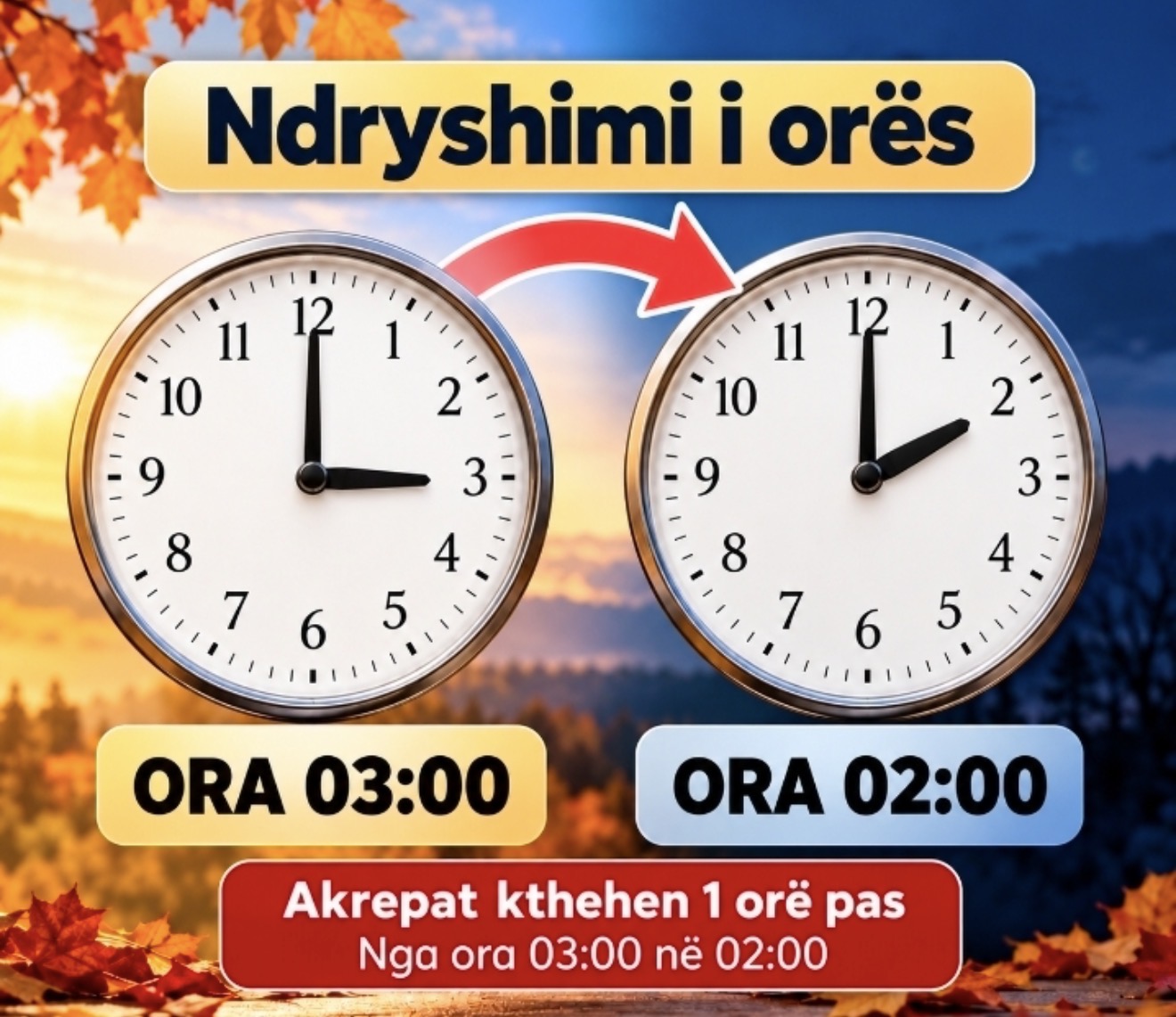
Between Saturday and Sunday, at 03:00, the clocks will go back to 02:00. But not everyone in the world continues to do this: Russia, Turkey, Iceland, China, Japan, Brazil and many other countries have abolished seasonal clock changes for years.
Between Saturday, 24 October, and Sunday, 25 October 2026, Albania will switch from daylight saving time to standard time.
At 03:00, the clocks will be turned back one hour and the time will become 02:00, theoretically giving us one extra hour of sleep. On the other hand, afternoons will get dark earlier. According to the European clock change calendar, the daylight saving period for 2026 ends on 25 October.

Standard time will remain in effect until the last Sunday of March 2027, when the countries that apply the system will set the clocks forward one hour again.
In the European Union, the current system stipulates that daylight saving time begins on the last Sunday of March and ends on the last Sunday of October. Albania, although not an EU member, follows the same calendar, as do most of Europe.
Why do clocks change?
The idea of seasonal clock changes is historically linked to making greater use of natural daylight during the months with longer days, and to reducing the use of artificial lighting.
In Europe, clock changes were used as early as World War I and were reintroduced more widely in the following decades, while the energy crisis of the 1970s gave this practice further impetus.
The European Union began harmonising the rules in 1980, while the current system is regulated by a European directive that entered into force in 2001.
Nevertheless, the usefulness of changing the clocks continues to be debated, especially because of changes in how energy is consumed and the impact that shifting the schedule may have on sleep and daily rhythms.
Recent studies show that switching from one schedule to another may temporarily change the duration and timing of sleep. A large-scale study found that turning the clocks back in autumn was associated with an average of about 10 minutes more sleep, while the scientific literature as a whole does not support the idea that every health effect of clock changes is necessarily negative.
The EU wanted to abolish clock changes, but the decision remained pending
In 2018, the European Commission proposed ending clock changes twice a year. The European Parliament subsequently adopted its position in favour of abolishing the system, with the initial aim that seasonal changes would end in 2021.
However, member states failed to reach an agreement in the Council of the EU, and as of 2026 no final decision has been taken. For this reason, the system continues to be applied.
Which European countries do not change their clocks?
Although most European countries continue to move the clocks forward in March and back in October, there are some significant exceptions.
Iceland does not change its clocks and uses GMT throughout the year. The country last used the seasonal system in 1967.
Russia abolished seasonal clock changes in 2011. It initially moved to a system with summer time all year round, but in 2014 it changed the rules again and switched to permanent standard time. The last seasonal clock change was in 2010.
Belarus stopped seasonal clock changes in 2011 and since then has kept the same time all year round. The last traditional clock change was in 2010.
Turkey abolished clock changes in 2016 and since then has used Turkey Time, UTC+3, all year round.
Meanwhile, the EU member states, as well as the United Kingdom, Norway, Switzerland and the vast majority of the Balkans, continue to change their clocks.
Most of the world does not change its clocks at all
Globally, seasonal clock changes are more the exception than the rule. In 2026, only around 70 countries use some form of daylight saving time, while dozens of others have abolished it or never used it.
Some of the best-known examples are:
China has not changed its clocks since 1991. Today it uses China Standard Time all year round.
Japan last used daylight saving time in 1951 and since then has not periodically moved its clocks.
South Korea last changed its clocks in 1988.
India last used the system in 1945 and today operates on the same time all year round.
Brazil abolished daylight saving time in 2019, after having used it in parts of the country for decades.
Argentina has not used seasonal clock changes since 2009.
Mexico abolished clock changes in most of the country in 2022. Some areas near the northern border with the United States are exceptions and continue to coordinate their time with the American side.
Paraguay is one of the most recent cases: seasonal clock changes were last used in 2024, and the country now keeps the same time all year round.
Most countries near the equator do not need seasonal clock changes, because the length of day and night varies much less over the year compared with countries in Europe and North America.
Thus, while Albania and most of Europe will set their clocks back 60 minutes again on 25 October 2026, the debate over the future of this system remains open.