







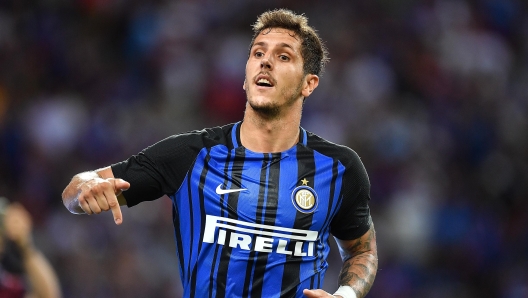
Stevan Jovetić, the Montenegrin footballer, recounts his life and career journey, starting from his childhood in Podgorica, then Titograd, during the war. He remembers how imagination was the “first assistant” of his life, playing football with goals drawn in chalk and studying Italian, as if he knew his destiny. However, life confronted him with a harsh opponent: the war. “Every time I hear the siren’s sound, a shiver runs through me. For us it was like the referee’s whistle: it meant we had to stop playing and run for shelter,” Jovetić says. This experience made him grow up quickly. Later, football took him away from there, leading him to Florence, where the dreams of a young man with “gold in his feet” were often held back by more than 45 cursed injuries during his career. After Fiorentina, he played for Manchester City, Inter and made a long tour around Europe in search of physical happiness. Today, Jovetić still plays with Omonia Nicosia in Cyprus, has found continuity and speaks without masks, sharing memories and regrets about what he could have been without the many injuries.
Jovetić stresses that he knows very well where he would have reached without all the injuries. “At City, before going onto the pitch, I was afraid of getting injured again, I thought only about that. Every pain-free sprint was a relief,” he says. Although some teammates wanted to quit after 2-3 injuries, he never considered this, being proud of himself after 45 injuries. He admits he thought about giving up, but not because of the injuries; rather after his father’s death, when he felt empty. Faith and his wife saved him, and he chose to speak with a psychologist, thus finding the strength to continue. The memories of the war are still alive: “We played in the streets with goals drawn in chalk, dreaming of Serie A. Imagine, at school I was also studying Italian… then on Sundays I sat glued to the TV watching your championship’s goals. Savićević played there, the Genius, he too from Podgorica.”
Italy became a reality for him with Florence, which he calls “a dream”. Corvino outdid the competition of many clubs, including Juventus, to which Jovetić said “no, thank you” twice. He reveals that Inter had sought him even earlier, but without success at the time. He recalls conversations with Cesare Prandelli, whom he calls “a footballing father”, and the special relationship with Siniša Mihajlović. However, there were also frictions, such as with Montella, who took away his captain’s armband because he had decided to leave. The move to Manchester City, despite winning the Premier League and League Cup, was not a happy one because of the constant fear of injuries. Then came Inter, which he describes as “a big mess”, with three presidents and five coaches in two seasons. He did well in the first year with Mancini, but in the second year he was left out of the squad without reason by Pioli and De Boer, whom he does not even consider. Spalletti asked him for patience, but Jovetić wanted to play. He admits he had quarrels with teammates: with Guarín after a match against Lazio and with Icardi during training, an incident that was “amplified” by the media.

Looking back, Jovetić has one major regret: refusing Real Madrid after his second year in Florence. He wanted to keep playing and thought he would get there later. Ten days after that decision, he tore his cruciate ligament, lost an entire season, and from there his “ordeal” began. Today, he feels happy, even better than five or six years ago. He plays in Cyprus, with Omonia Nicosia, and enjoys himself, “taking back what life took from him in the past”. In the near future, he sees himself still in football: a little more time on the pitch, then perhaps as a coach or sporting director. To keep the memories alive and to analyse his game, Jovetić keeps DVDs of all his matches, divided by season, which he reviews from time to time to understand his football and the game in general, and to tell his children how their father played.
Taken from La Gazzetta dello Sport