







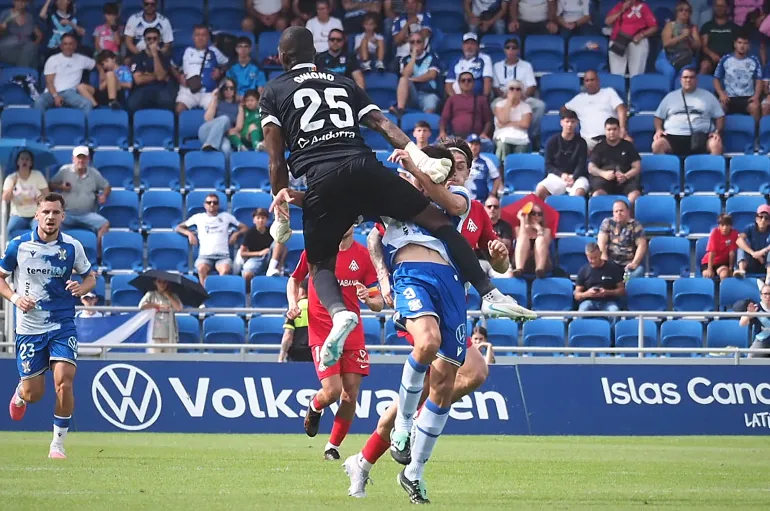
A terrifying collision in the 96th minute of the match, an extremely strong knee strike to the chest and a tragic end. Tenerife’s 30-year-old footballer, Jesus de Miguel Alameda, died after a severe collision with Andorra’s goalkeeper, Jesus Owono.
The incident occurred in midfield, during a tackle for the ball. After the violent contact, the striker immediately collapsed to the ground and lost consciousness. Medical staff intervened urgently and the footballer was taken to hospital by ambulance, but despite efforts to save him, he did not survive his injuries.
To explain what may have happened in those moments and how such a blow can have fatal consequences, Fanpage.it interviewed Professor Carlo Alessandro Russo Frattasi, an orthopaedic surgeon, sports medicine specialist at the University of Turin and forensic medicine expert.
According to the specialist, this is a trauma with extremely high energy, where the force of the impact is concentrated on a very small point of the chest. Asked how a 30-year-old footballer, healthy and under constant medical monitoring, could lose his life after a knee blow to the chest, the professor explains:
“We are talking about a trauma with extremely high energy, an event that happens very rarely. We have two footballers, each weighing 70-75 kilograms or even more, running towards each other at great speed. All the force of the collision is concentrated on a single point: the knee. So, on a very small surface.”

He then explains what happens to the body at the moment of impact.
“The chest is elastic and can be deformed by such a force. It is pushed towards the spine. In the middle is the heart, an organ roughly the size of a fist. Under these conditions, it can be completely compressed and stop functioning due to a physical mechanism, not because of a heart disease.”
According to the doctor, in cases like this everything depends on the exact place and angle of the blow.
“It is a matter of timing. A tenth of a second later, or one centimetre further away, perhaps nothing would have happened. But in this case the knee struck exactly that area, at the level of the heart.”
One of the most dramatic aspects of the event is that the footballer’s heart managed to restart after the doctors’ intervention. However, this was not enough to save him. The professor explains that during the minutes when the heart had stopped, the brain did not receive blood and the oxygen it needed.
“The heart started beating again, but during those minutes when it had stopped, the brain did not receive blood. There was no blood supply. The brain is the organ that suffers most in these cases. Just a few minutes without oxygen are enough to cause very serious and irreversible damage. Apparently, this is what happened. The heart resumed working, but the neurological condition was already compromised.”
Asked whether, at that stage, there was still hope of saving the footballer, the specialist’s answer is short and painful: “No.”
The expert says he also searched the medical literature for similar cases, but did not find a trauma with the same degree of concentration and violence. He also explains why in many collisions footballers end up being thrown several metres away, while in De Miguel’s case the situation was different.
“Let me give you a practical example. If you are stationary and someone hits you in the chest with a knee, arriving at 40 km/h, the force of the blow may throw you three metres away. In this way, part of the energy is dispersed through the movement of the body. Here that did not happen. It was a head-on collision, like two cars crashing directly into each other. The car bonnet is pressed and deformed, while the energy remains inside. That is exactly what happened.”
Another element the professor emphasises is the difference between sudden deaths in sport caused by previous cardiac problems, and what is suspected to have happened in this case.
“It is quite the opposite. This is not a cardiac death in the usual sense. It is a traumatic death, which directly causes the heart to stop. These are two different things.”
Finally, the professor was asked whether cases like this could be prevented by using special protective gear similar to that used in rugby. His answer is that such a solution would make no sense in this situation.
“No. This is a combination of circumstances that is almost unrepeatable. It was a normal game action, where two footballers went for the ball. But an extraordinary dynamic was created: a very small point of impact and two bodies moving at very high speed towards each other. Placing special protectors in football to prevent such an event would make no sense.”