







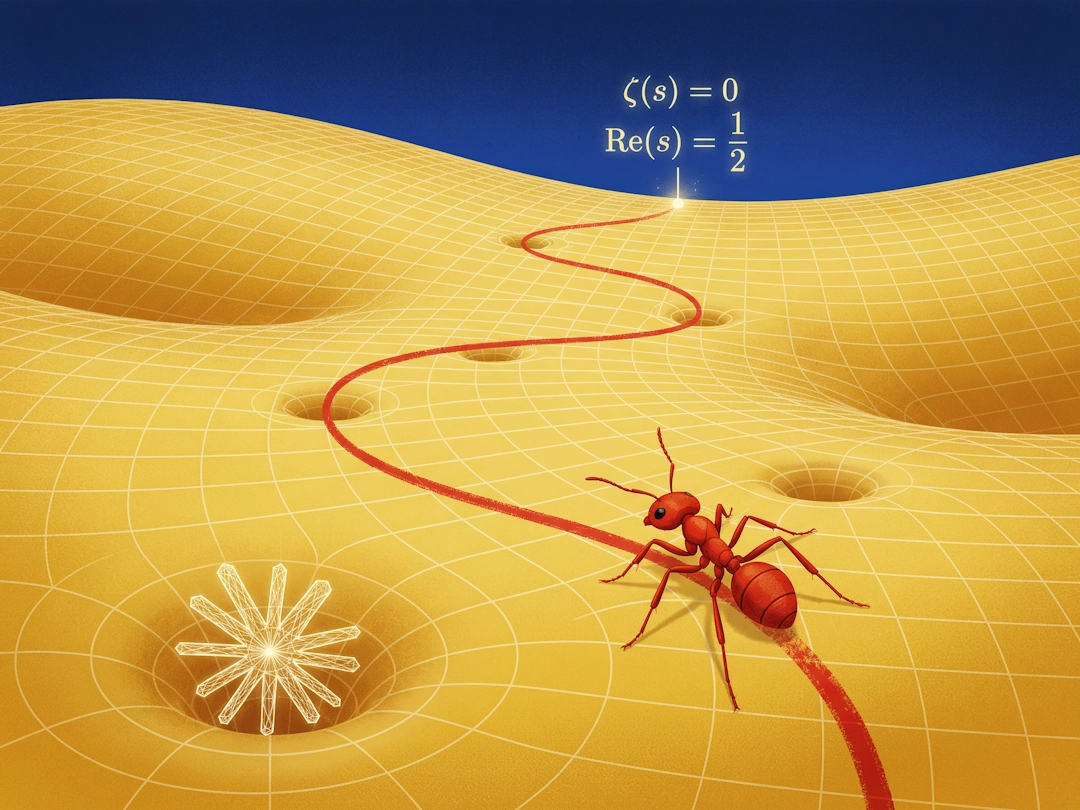
A mathematician working for the artificial intelligence company Anthropic announced that he had managed to solve the Riemann hypothesis, one of the most famous problems in mathematics, by working with the company’s Claude tool. Levent Alpoge, a member of Anthropic’s technical staff, made the announcement public on his website on Friday.
"I believe that, by working with Claude, I have discovered a proof of the Riemann hypothesis," Alpoge wrote in a note. The proof still needs to be verified and confirmed by other mathematicians. If it withstands independent scrutiny, it would be a major step both for mathematics and for the growing role of artificial intelligence in scientific research.
What is the Riemann hypothesis
The hypothesis dates back to 1859 and centers on the distribution of prime numbers, those divisible only by themselves and by the number 1. It describes a fundamental pattern in how these numbers are distributed as they become ever larger. Its confirmation is considered to have significant consequences for a wide range of further mathematical research.

The hypothesis was formulated by the German mathematician Bernhard Riemann in the 19th century. It is one of the seven major mathematical problems, known as the Millennium Prize problems, selected by the Clay Mathematics Institute, which offers 1 million dollars for the solution of each of them.
Alpoge said that the collaboration with artificial intelligence had produced more than 250,000 pages of mathematical material. He added that he had not yet mastered all the mathematical knowledge involved in this work.
"Claude and I had a great time together with such breadth in recent months, but this time Claude left me far behind at the finish line," he wrote. "No, Claude flew, jumped and shone near that finish line."
Clay Institute: announcement of historic significance
The president of the Clay Mathematics Institute, Martin Bridson, called the development an announcement of historic significance. According to him, it carries the promise of a major transformation in the perception of what is possible in the effort to expand human understanding of mathematics. But, Bridson stressed, the road from today’s announcement to a true understanding will be long and difficult.
The case comes at a time when artificial intelligence systems are making increasingly important contributions to advanced mathematical research. In September, rival company OpenAI announced that its technology had helped solve a problem related to the Navier-Stokes equations, which describe the movement of fluids such as water and air. That too is one of the seven Millennium Prize problems, but the claim that it has been solved also requires independent verification.