







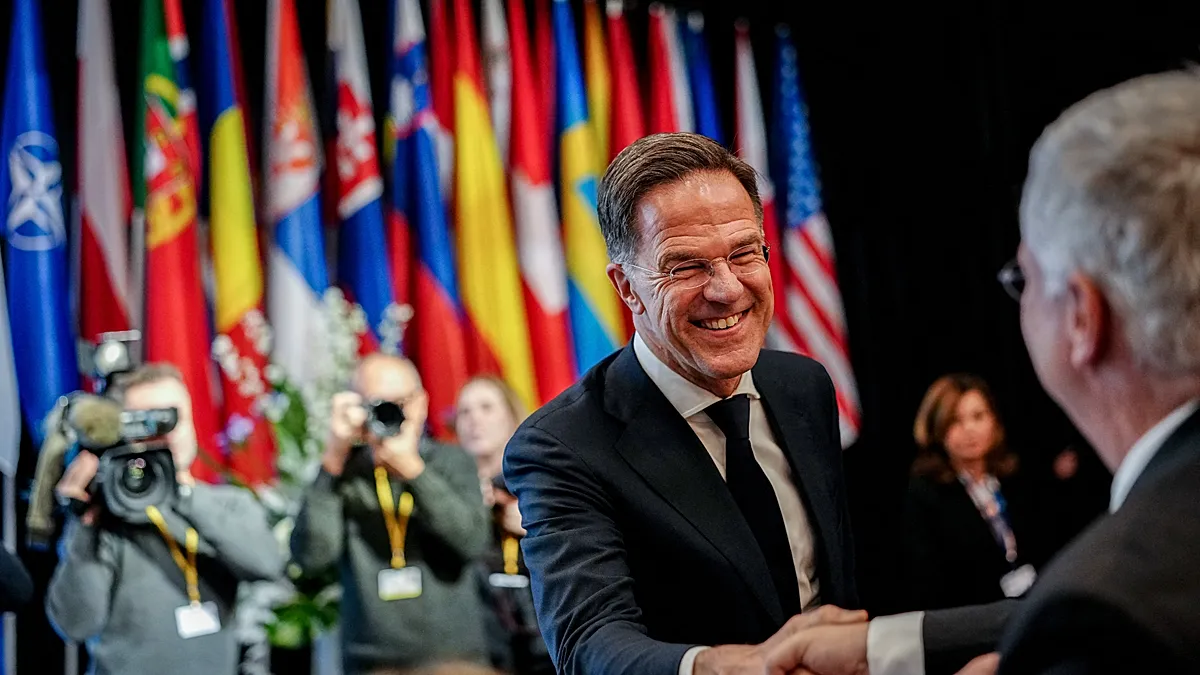
The German Chancellor Friedrich Merz called the 2008 decision not to admit Ukraine to NATO a mistake, in line with the proposal made at the time by US President George W. Bush. He spoke at a press conference in Berlin, together with NATO Secretary General Mark Rutte, Euronews reports.
According to Merz, it is now clear how wrong it was not to follow the American proposal at the NATO summit in Bucharest in 2008. He added that the full-scale invasion of Ukraine would have been prevented if the alliance had then opened the path to membership. “If Ukraine were a NATO member, this war would probably have been prevented,” Merz is quoted as saying, in comments translated from German.
The meeting took place as US-led negotiations to end the war in Ukraine continue, with Rutte visiting the German capital for the annual meeting of the NATO Parliamentary Assembly. Rutte took a cautious stance on the possibility of reopening the discussion on Ukraine’s NATO membership, stressing that successful peace negotiations must first be reached.

The comments came in response to recent statements by French President Emmanuel Macron, who called for the debate on Ukraine’s membership in the alliance to be reopened. Kyiv’s possible NATO membership has returned as part of a possible final solution to end the war.
Russian President Vladimir Putin has reportedly hinted that he would be ready to end the war in Ukraine, provided NATO agrees to return to its 1997 position. In practice, this would mean reversing the alliance’s subsequent expansion, by withdrawing membership from countries that joined after the fall of the Soviet Union.
However, Ukraine’s NATO membership remains a distant prospect, according to Rutte. He noted that, although “it is a long-standing position that Ukraine should be part of NATO,” there is no unanimity among alliance members on admitting it. Rutte also rejected the idea that the Kremlin could have a say in NATO’s current or future composition.
“What cannot happen is for us to be forced to return NATO to its 1997 borders,” he said. “Only the 32 allies decide who is in NATO and who is not in NATO.” Rutte also addressed growing tensions in Europe due to Russian hybrid attacks, including last week’s incursion into Poland, when two Russian cruise missiles and a drone landed on Polish territory, according to Polish officials.
He attributed Russia’s increased aggressiveness to growing battlefield losses, claiming that Russian forces are losing up to 50,000 soldiers every month in Ukraine. He compared this figure with Soviet losses in Afghanistan and with American casualties during the Vietnam War.
“Ukraine is pushing the front line towards Russia and striking deep” into Russian territory, Rutte told journalists. The secretary general reiterated NATO’s position that the best solution to growing hybrid attacks is to increase support for Ukraine. “Most importantly, we must continue our military support for Ukraine,” he said.
“For every incident in Europe – more support for Ukraine,” he added. Meanwhile, Ukrainian President Volodymyr Zelenskyy said that Russian President Vladimir Putin ordered the attacks after what he described as “weak meetings” with US President Donald Trump and Chinese President Xi Jinping.
“Russia is trying to compensate for its military and diplomatic impotence with precisely this kind of terror,” Zelenskyy wrote in a post on “X” last Friday. In another development, NATO ambassadors gathered on Monday in Brussels to discuss the Russian incursion into Poland.
The alliance is now considering deploying more assets in the region in response. NATO’s military chief, the Supreme Allied Commander Europe (SACEUR), is “considering the deployment of additional assets while continuing to assess our deterrence and defence posture in Poland and elsewhere,” a NATO official confirmed to Euronews.